Beast ransomware wipes backups before encryption
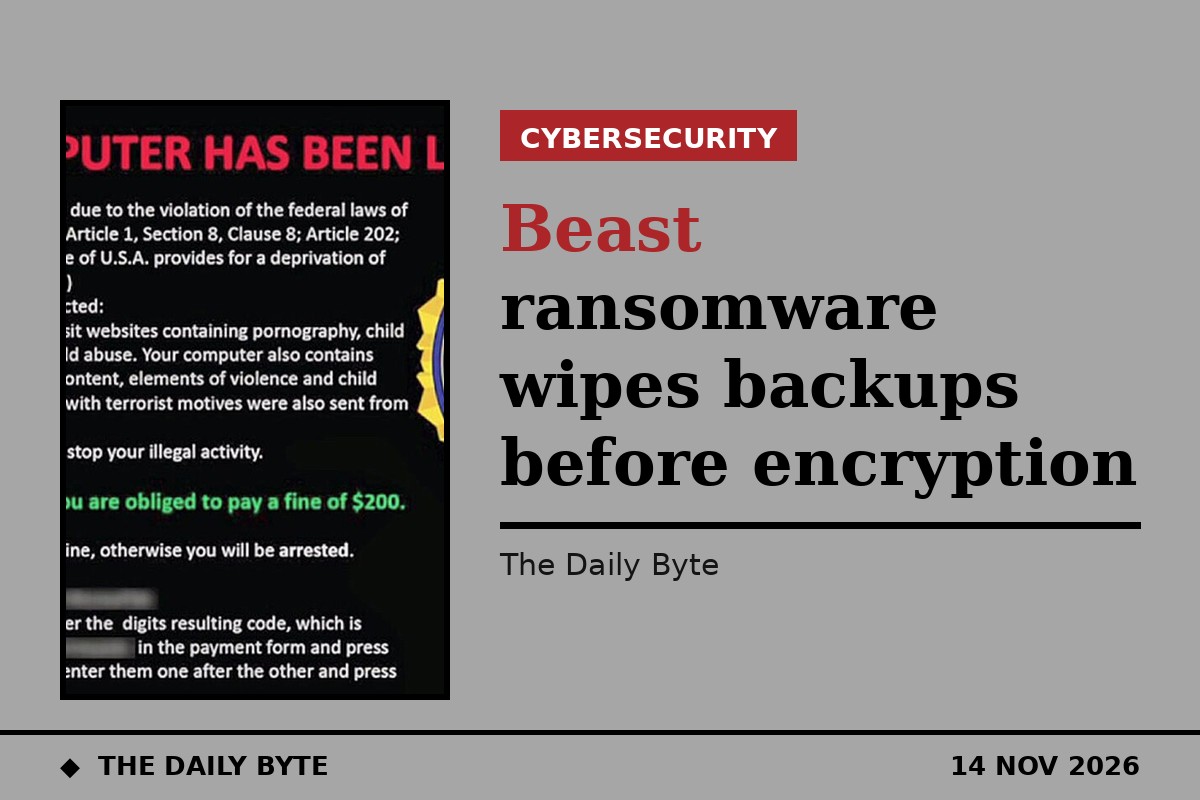
Beast ransomware is built to destroy a victim’s ability to recover before it encrypts a single file, according to new analysis from AttackIQ reported on 13 November. The ransomware-as-a-service operation gives its affiliates an interactive graphical console and the ability to override its built-in settings, and it systematically wipes recovery options first.
AttackIQ published its analysis of the sample on 23 October 2026. Beast surfaced on the RAMP underground forum in June 2024 and is reportedly the successor to Monster, an earlier ransomware operation advertised on the same forum in March 2022. Symantec and Carbon Black attribute both families to a developer they track as Hyadina, and Symantec reported in July 2026 that the operation had re-emerged under the name GodDamn, with significant code overlap. The original Beast leak site remains active, and the latest reported Beast activity dates to 30 August 2026.
A console for the attacker, chaos for the victim
The analysed sample is an 81 KB, 32-bit C/C++ executable compiled on 9 August 2024. Operators open its graphical interface by pressing ALT+CTRL and typing 666, from where they can enumerate drives, shares and subnets, choose targets, and start, pause, resume or stop encryption while watching progress. Command-line switches override the embedded defaults: -K kills processes and services, -S deletes shadow copies, -N enables network discovery, -M mounts hidden volumes and -P sets the encryption percentage.
Before encryption begins, Beast creates the mutex “BEAST HERE?” and skips systems whose locale matches CIS and several other countries. It then enables SeTakeOwnershipPrivilege, terminates 52 processes and stops 73 services covering backup, database, security and office software. When a file is still locked, it calls the Windows Restart Manager to release it. It deletes shadow copies by querying Win32_ShadowCopy through WMI and calling DeleteInstance on each result, and it empties the Recycle Bin.
Network spread and intermittent encryption
For network reach, Beast reads the ARP cache, reduces neighbouring hosts to unique /24 subnets and probes TCP/445 asynchronously. It enumerates the shares on responding hosts, excludes ADMIN$, and queues the rest as UNC paths for encryption. It also mounts volumes that have no drive letter. Encryption combines ChaCha20 with a Curve25519 key hierarchy, and encrypted files are renamed with a .{victim-id}.moon extension and a 160-byte footer ending in the marker 66 6B EA 57 1A BE 16 66, which prevents double encryption.
The analysed build encrypts 25 percent of each file’s chunks, with a minimum of three, and for files of 1 GiB or more it encrypts alternating chunks from the start, capped at 512 MiB. Intermittent encryption speeds up attacks on large shares and leaves large database and backup files only partly damaged at the front — which is why the recovery-wiping steps matter so much. Beast also contacts a public IP-logging service twice, before and after encryption, so the operator can tell when the job started and finished.
How defenders should respond
AttackIQ has released an emulation of the Beast attack chain for its Adversarial Exposure Validation platform, so teams can test whether their detection and prevention controls catch it. Defenders should alert on WMI shadow-copy deletion, mass service stops, ARP-driven SMB scanning and traffic to IP-logging domains, and watch for Run keys pointing to randomly named binaries under %ALLUSERSPROFILE%, as also reported by GBHackers. Offline backups kept disconnected from the network remain the most reliable defence against a family designed to destroy every recovery option it can reach.


