Benefits Bill 50 Times Employment Support in Cities
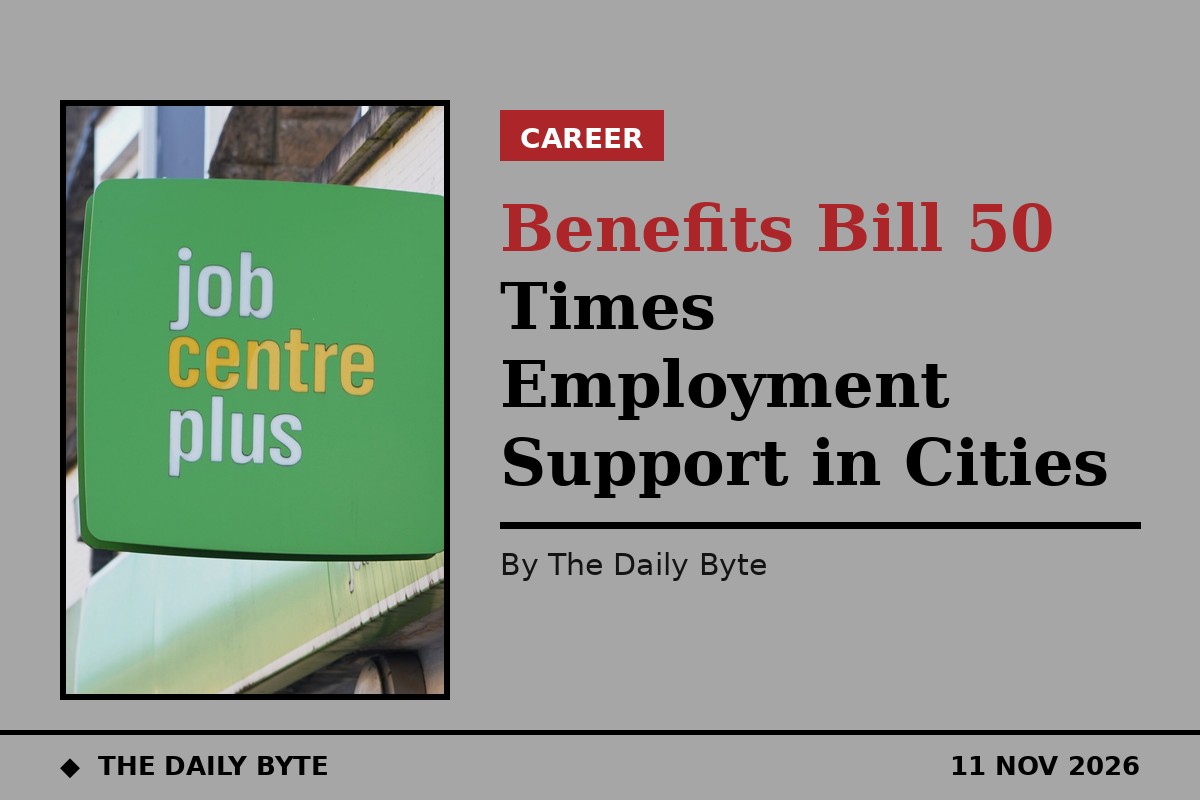
The Government spends 50 times more on working-age benefits than on helping people into employment across England's seven established mayoral areas, according to research published by Centre for Cities.
The think tank's briefing, published on 10 November, found that just £76 per working-age resident is spent on employment support in those areas, compared with £3,754 on working-age benefits. The gap is widest in Liverpool City Region, where spending on working-age benefits reaches £4,569 per resident against only £66 for employment support, a difference of almost 70 times.
Despite their growing responsibility for local economic growth, mayors currently control just 15 per cent of employment support spending in the seven areas, with the vast majority remaining under central government control. Employment rates across the mayoral city regions, which cover London, Greater Manchester, Birmingham, Liverpool, Leeds, Sheffield and Newcastle, consistently lag behind the rest of the country.
Britain spends less than most comparable countries
Centre for Cities found that Britain spends just 0.12 per cent of GDP helping people into employment, compared with an OECD average of 0.41 per cent. Of 38 OECD countries, only Costa Rica, Chile, Iceland, Mexico and the United States spend a smaller share.
Anthony Breach, the think tank's director of policy and research, said Britain was not good at employment support. He said the country spent too little helping people into work and that the unusually centralised system was a confusing mess for the jobseekers who needed it most.
He added that mayors were well placed to change that because they understood their local labour markets and already held responsibility for many of the things relevant to job seeking, from transport to skills. But he warned that devolution was not a silver bullet, pointing to evidence from Finland and Germany showing how poorly designed reforms could create perverse incentives.
What Centre for Cities wants to change
To make devolution of employment support work, the think tank recommends increasing UK spending on employment support from £3.7 billion to £4.6 billion a year, equivalent to 0.17 per cent of GDP, as a first step towards bringing Britain into line with comparable OECD countries. That would mean an additional £545 million a year for the seven established mayoral areas.
It also calls for mayors to receive a share of the financial savings and additional tax revenues generated when employment programmes successfully move people into work. Without that, Mr Breach said, local leaders would be left holding the bill for employment support while all the savings flowed to central government through lower benefit spending and higher tax receipts, giving them an incentive to keep jobseekers on benefits instead.
The briefing further recommends phasing devolution, starting with programmes that have the strongest evidence of helping people into work at reasonable cost, while building mayoral capacity to take on more complex responsibilities.
What happens next
The findings come ahead of the Milburn Review on young people and work, which is expected to recommend devolving employment support to mayors and local leaders. Alan Milburn, the former Labour health secretary leading the review, has warned that the Government spends 25 times as much on benefits for young people as it does on supporting them to find a job, and has called for a complete system reset. Nearly one million young people aged 16 to 24 are not in education, employment or training.
South Yorkshire Mayor Oliver Coppard said devolution was the best long-term way of bringing down the country's benefits bill, but called for greater investment to make the lasting impact the country needs. Greater Manchester Mayor Bev Craig said putting local leaders in the driving seat was the best way to help more people into good jobs.
A Government spokesperson said the Milburn Review would lay the foundation for sustainable reform and that its findings would not be pre-empted. The spokesperson said the Government was already devolving employment support through Trailblazers, its Connect to Work scheme and Youth Hubs delivered with local organisations, and was improving Jobcentres to create a more personalised work and skills advice service.
For jobseekers, the research highlights why support can feel fragmented: programmes are spread across different central government departments, with local leaders given little oversight. Whether the Milburn Review's recommendations change that will become clear when it is published later this month.