Bessent urges Fed to avoid half-point December hike
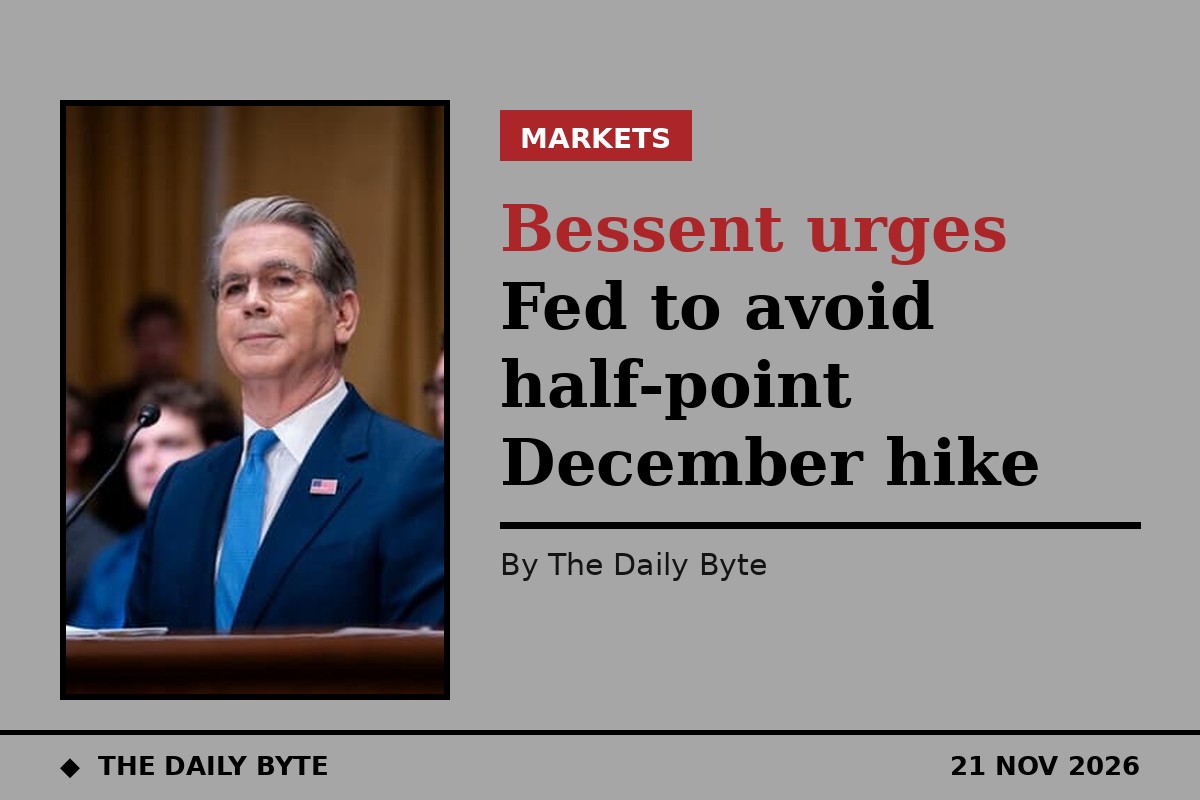
US Treasury Secretary Scott Bessent urged the Federal Reserve on Friday not to raise interest rates by half a percentage point in December, pushing back against a call from within the central bank itself for a bigger move. Bessent told CNBC he would encourage the Fed not to embrace a 50-basis-point increase at its meeting on 8 and 9 December, arguing that the case for it does not stand up.
Bessent pointed to the energy supply shock and a drop in crude delivery prices as reasons for the central bank to hold back. He also noted that one governor now backing a half-point hike had wanted a similar-sized cut within the last year. "So it seems somewhat peripatetic to now want the bigger hike just 12 months or 11 months later," he said. "So I would encourage the Fed to look forward, not backwards." He did not name the governor.
The intervention landed on a day when US stocks fell again and investors were pricing in further tightening. The Nasdaq Composite dropped more than 2% in morning trading, and the VIX volatility index topped 30, its highest level since March, as bets on more rate rises weighed on risk assets.
Waller's case for a bigger move
Bessent's comments came two days after Federal Reserve Governor Christopher Waller told CNBC that a half-point hike is probably necessary in December and that the central bank may need to "shock people". Waller said inflation is "headed in the wrong direction, and it's spreading out", and argued that more aggressive action is needed to bring it down.
Waller added that the Fed could achieve a similar effect with a quarter-point rise in December paired with a clear signal of another increase in January. But he noted that Fed Chair Kevin Warsh has resisted giving such explicit guidance about future moves, which makes a larger single step a way of sending the same message.
The minutes of the Fed's October meeting, released on 18 November, showed that nearly all officials expect a quarter-point hike in December, while two floated the idea of a larger move if inflation data worsened. At that meeting the committee voted 10 to 2 to hold the target range at 3.75% to 4.00%, with Governor Lisa Cook and Cleveland Fed President Beth Hammack dissenting in favour of a quarter-point rise there and then.
Officials split as December meeting nears
Other Fed officials have staked out different positions. Chicago Fed President Austan Goolsbee declined on Thursday to rule out a bigger move, telling reporters that inflation had run at "borderline disturbingly high" rates for several months in a row. "So everything's always on the table," he said.
New York Fed President John Williams struck a calmer note on Tuesday, saying: "I don't think the situation calls for dramatic action." St Louis Fed President Alberto Musalem has suggested as many as four hikes by the spring of 2027, underlining how far apart officials are on the path ahead.
In a speech on Friday, Governor Lisa Cook said annual inflation had been above 3% for much of 2026 and that recent price gains were broad. The Fed raised rates in September for the first time in more than three years and held them steady in October, and the December decision will be taken without the November consumer price report, which is not due until 10 December.
Markets still expect a quarter-point rise
Despite the debate over a half-point move, traders still expect the smaller step. Citi still expects a quarter-point increase in December, with its global chief economist Nathan Sheets saying on Thursday that he does not see a need for 50 basis points despite persistent inflation. In a note on Friday, the bank wrote that Fed officials would have "little appetite to hike into an equity sell-off".
The CME Group's FedWatch tool showed a more than 98% chance of a quarter-point hike, and the 10-year Treasury yield fell more than 10 basis points to 4.95% on Friday as investors bought bonds. Bessent's pushback does not settle the argument, but it makes clear that the December decision is now a live contest between those who want to move fast on inflation and those who fear moving too fast into a falling market.