Bitcoin Mining Difficulty Falls 9.13% in Biggest Cut
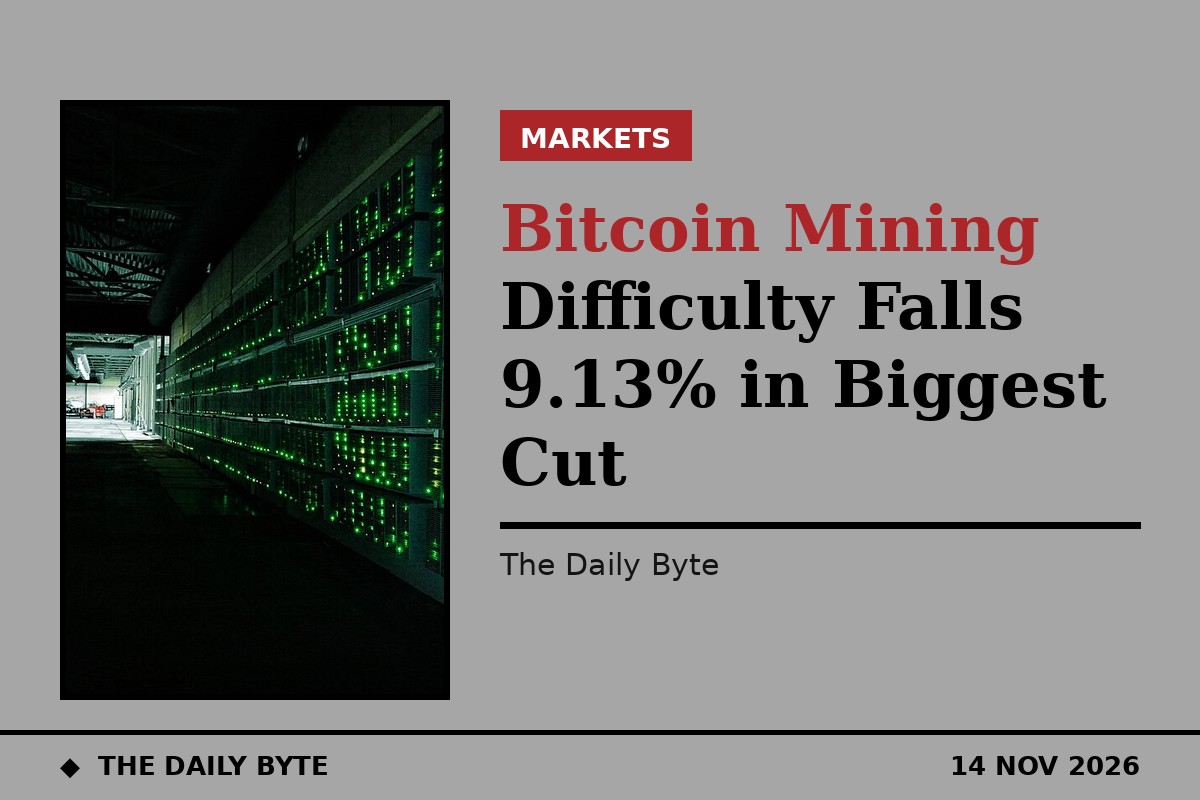
Bitcoin mining difficulty fell 9.13% to 134.82 trillion on 14 November 2026, the biggest single cut since June, after slower block production and a falling hashrate showed miners under pressure from the slide in the bitcoin price. The adjustment took effect at block height 975,744.
Difficulty is the network's way of keeping new blocks arriving roughly every ten minutes. When computing power leaves the network, blocks take longer to find, and difficulty falls to compensate. This was the twelfth downward adjustment among 23 in 2026, against eleven increases.
What changed on the network
The retarget landed at 05:02 UTC on 14 November, cutting difficulty from 148.36 trillion to 134.82 trillion. It was the largest single decline since the 10.09% cut on 14 June, and the year's third-largest cut, following an 11.16% fall on 7 February and the June reduction.
The move reversed two consecutive increases. Difficulty had risen 5.92% on 16 October and 5.54% on 29 October, when computing power on the network was still climbing. The network's hashrate stood at 906.93 exahashes per second, down from 1,001.01 exahashes per second the previous week, with a weekly average of 902.76 exahashes per second.
Hashrate measures the computing power committed to mining and provides an indication of miner participation. It can decline when miners stop operating as revenue falls or operating costs rise. Blocks had been averaging roughly eleven minutes before the adjustment, slower than the ten-minute target the network aims for.
Why difficulty fell
Bitcoin adjusts its mining difficulty every 2,016 blocks, roughly every two weeks, to keep average block production close to ten minutes as computing power changes. Higher difficulty means miners need more computing work to earn the same bitcoin reward, raising the cost of producing each block.
The trigger this time was a combination of a lower bitcoin price and miners switching machines off. A lower difficulty lifts expected revenue per unit of computing power, because each unit of hashrate earns a larger share of the fixed block reward. The block subsidy remains 3.125 bitcoin per block.
Even so, the relief is only partial. At a flat price, the 9.13% cut raises expected earnings per unit of hashrate by about 10%, but bitcoin had already fallen about 8% in the two days before the retarget, wiping out most of that gain for miners still running their machines.
The price backdrop
Bitcoin traded at about $67,600 on 14 November, down 3.7% over 24 hours, and was testing its 200-week moving average near $67,922. The price is at its lowest since August, after a week in which more than $1.2 billion of mostly long positions were liquidated across the market.
Investor demand has also cooled. United States spot bitcoin exchange-traded funds recorded a seventh straight day of net outflows on 13 November, losing $185.4 million, and the crypto fear and greed index stood at 13, classified as extreme fear. The weak backdrop helps explain why some miners have chosen to power down rather than mine at a loss.
For the wider market, the difficulty cut is a reminder that the bitcoin price and the mining business move together. When the price falls sharply, the least efficient miners are the first to switch off, and the network adjusts to reflect the computing power that remains.
What happens next
The next adjustment, at block height 977,760, is estimated to be about 14 days and 15 hours away. Difficulty is currently projected to fall by another 6.47% to 126.10 trillion, although that estimate will move as the hashrate changes over the coming fortnight.
Miners will be watching whether the hashrate stabilises at the new, lower difficulty, or keeps falling. A steady hashrate would suggest the weakest operators have already left and the remaining miners can operate profitably at current prices. A further slide would point to more machines going offline and more selling pressure from miners covering their costs.
The difficulty reset does not by itself set the bitcoin price, but it is one of the clearest on-chain signals of stress in the mining sector. After the deepest cut in five months, the network has made mining easier; whether miners return will depend on the price doing the same. TokenPost and The Defiant reported the adjustment.