Black hole jet bends towards Earth, telescope finds
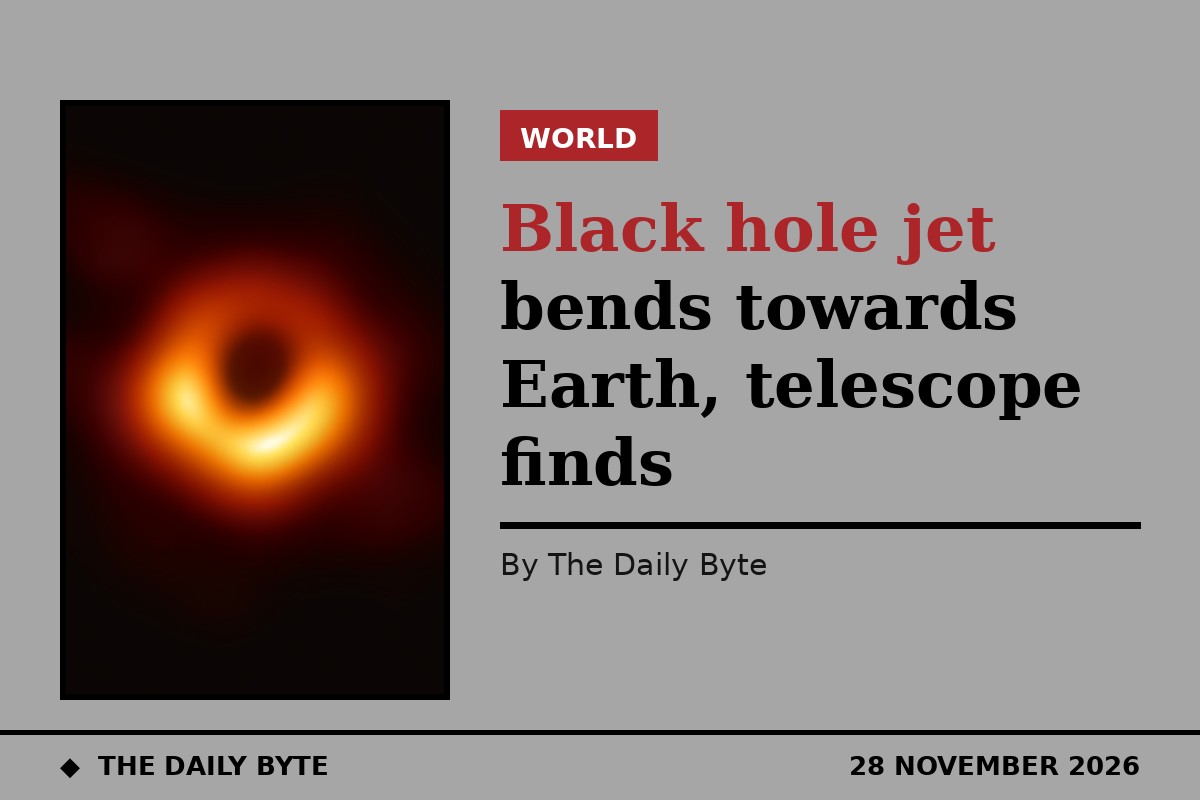
The Event Horizon Telescope has produced the sharpest view yet of a black hole jet, showing the outflow from the blazar 3C 279 bending towards Earth within a fraction of a light-year of its source. The finding, published in the journal Astronomy and Astrophysics, comes from the telescope array's 2021 observing campaign, the largest configuration it has used to date.
3C 279 is a blazar, a galaxy with a supermassive black hole at its centre whose jet of charged particles points broadly towards Earth. It sits about 538 million light-years away in the constellation Virgo, and the black hole powering it is estimated at about 800 million times the mass of the Sun. Because the jet is aimed almost at us, it is one of the brightest objects of its kind in the sky, and a standard target for calibrating radio telescopes.
The new images resolve the innermost part of the jet at scales smaller than a parsec, the unit astronomers use for interstellar distances. They show a compact structure that runs almost at right angles to the larger jet before bending back, so that one section of the outflow points more directly at Earth than the rest. The team also found that the brightest knot of emission sits downstream of the black hole, not at its base, and that the jet's direction changes over time.
That bend matters because it explains two long-standing puzzles about 3C 279. Plasma in the jet moves at close to the speed of light, so its light is concentrated in the direction of travel. When a section of the jet turns towards us, it looks brighter even though the plasma itself is no faster. At the same time, material moving almost directly towards the observer appears to crawl across the sky, which is why parts of the jet have seemed to move slowly while shining unusually brightly. Tracking individual features, the team measured apparent speeds approaching ten times the speed of light, an illusion produced by the geometry rather than faster-than-light travel.
The observations also shed light on where the jet picks up speed. Features close to the apparent base of the jet were already moving across the sky at speeds comparable to those much further downstream, suggesting the outflow gains most of its speed over a short distance near the black hole. As the fast flow narrows again it may form a shock, adding to the brightness seen near the bend.
The 2021 campaign was the largest the collaboration has run, with two new sites joining the network: the 12-metre telescope at Kitt Peak Observatory in Arizona and the Northern Extended Millimeter Array in the French Alps. Their positions filled gaps in the array, giving the team the intermediate baselines needed to probe both compact and extended structures in the jet. Observations were taken on 13, 17 and 18 April 2021 at around 230 gigahertz, and three independent imaging methods were used to check the result, producing 18 separate reconstructions.
The same programme has also produced detailed images of the jets from two other supermassive black holes, M87* and 3C 84, from observations made between 2024 and 2026. The Event Horizon Telescope gave the world its first image of a black hole, the one at the heart of the galaxy Messier 87, in 2019, and followed it with an image of Sagittarius A*, the black hole at the centre of the Milky Way, in 2022.
Hendrik Müller, a staff scientist at the National Radio Astronomy Observatory in the United States and the paper's lead author, said the work was only the start. "This paper is just the beginning. We have EHT observations from several years, as well as observations at other frequencies that we scheduled around the same time that are currently being analyzed," he said. The team expects to publish further results from the 2021 data over the next few years, and says very few quasars have been studied in this much detail, making 3C 279 one of the best opportunities astronomers have to learn how a black hole launches a jet and drives it to nearly the speed of light.


