Blinken: US Ground Invasion of Iran Would Be Disaster
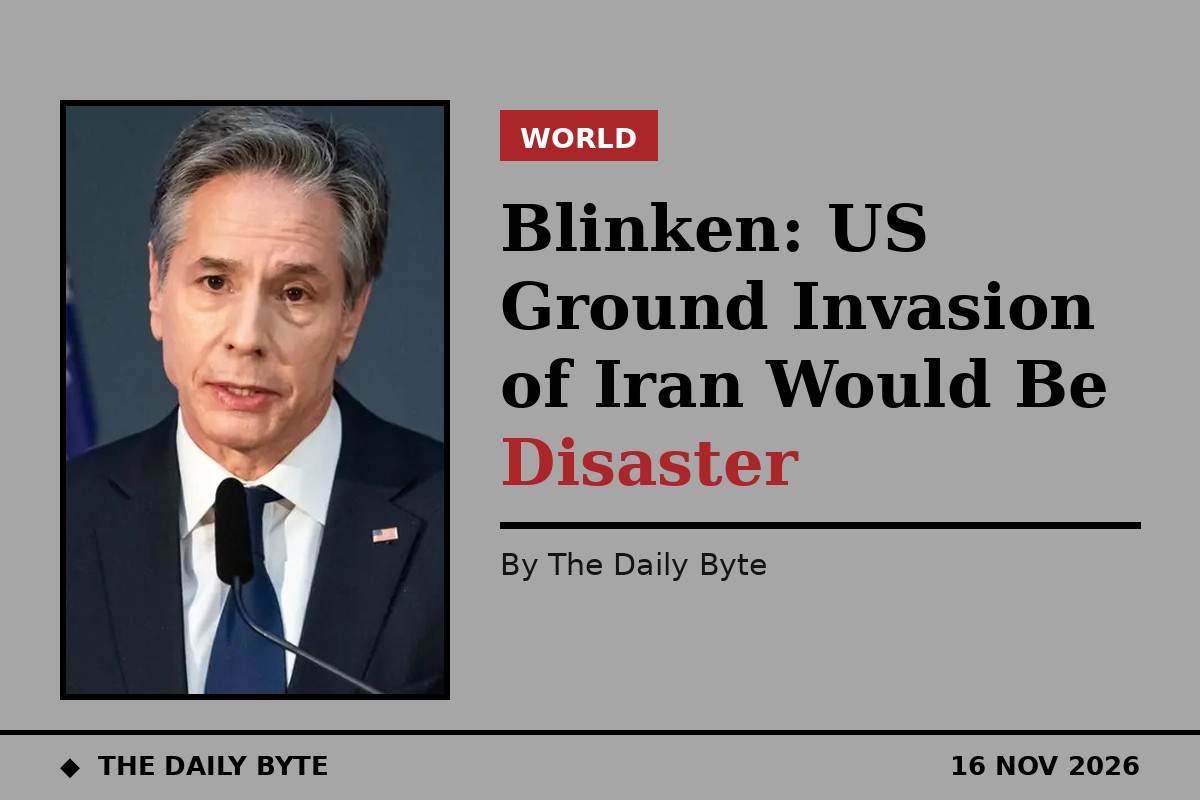
Former US Secretary of State Antony Blinken has warned that airstrikes alone cannot destroy Iran's weapons capability, and that a ground invasion of the country would be an "absolute disaster".
Mr Blinken was speaking on Saturday at the 24th Hindustan Times Leadership Summit in New Delhi, where he set out why he believes no air campaign can finish the job of dismantling Tehran's arsenal. "The weapons that it continues to produce are back far enough, the range is great enough that you can't just take everything out," he said. "You'd probably have to have a land invasion of some kind to do that, which would be an absolute disaster."
The former diplomat, who served under President Joe Biden, pointed to Iran's sheer scale as the central problem for any military campaign. The country is roughly four times the size of California, has a population of about 90 million, and manufactures weapons deep inside its own territory, far from the reach of strikes on the coast or border regions. "That coastline along the Strait of Hormuz goes on forever," Mr Blinken added.
He also warned that the two sides do not escalate in the same way, and that the imbalance favours Tehran. While Washington can "escalate vertically" by intensifying its bombing campaign, he said, Iran can "escalate horizontally" by striking American military installations, regional allies and critical infrastructure, directly or through allied armed groups. "Even though we're much more powerful, that asymmetry in their ability to escalate horizontally as opposed to vertically is not to our advantage," he said.
Mr Blinken went further in his assessment of the war itself, calling it a "foolhardy" undertaking and arguing that resolving the crisis in the Strait of Hormuz will almost certainly require concessions to Tehran. He floated the idea of "some form of toll that is not officially called a toll" as part of an eventual settlement, and put the chances of the current situation simply continuing at better than even, against a roughly one-in-four chance of a dangerous escalation.
His warning came as the nine-month-old war entered a tense new phase. Iran claimed on Sunday to have launched six drones at a US military installation in Bahrain, while a third American aircraft carrier, the USS Theodore Roosevelt, arrived in the region to join two carrier groups already there. Bahrain said its air defences intercepted the drones.
Concern about a possible ground operation has also grown in neighbouring Iraq, which shares a roughly 1,000-mile border with Iran. The Iraqi newspaper Al-Mada reported on 9 November that Iraq's prime minister had privately briefed Shiite political leaders on an alleged American military plan involving a ground offensive. Iran International reported that Tehran has become concerned Iraqi territory could be used as a staging ground for a US operation into southern Iran.
Iraqi Foreign Minister Fuad Hussein added his own warning in an interview with France 24 published on Friday, saying the region's state of "no war and no peace" could not continue indefinitely. "Either it goes towards peace or it goes towards war," he said. He also rejected a reported US demand that Baghdad close all but two of its land border crossings with Iran, calling the idea "not possible" and "a kind of sanction against the Iraqi people".
Mr Blinken speaks for neither the current US administration nor any government, and no American ground operation against Iran has been announced or confirmed. But his remarks, from a former secretary of state who has seen the intelligence, underline how limited the military options now look: airstrikes cannot finish the job, a land invasion would be a disaster, and the Strait of Hormuz — the waterway at the centre of the crisis — will almost certainly have to be settled at the negotiating table. Fox News first reported his remarks; Internewscast carried a second account of the summit speech.


