Board of Peace warns Gaza ceasefire could collapse as families face another winter in tents
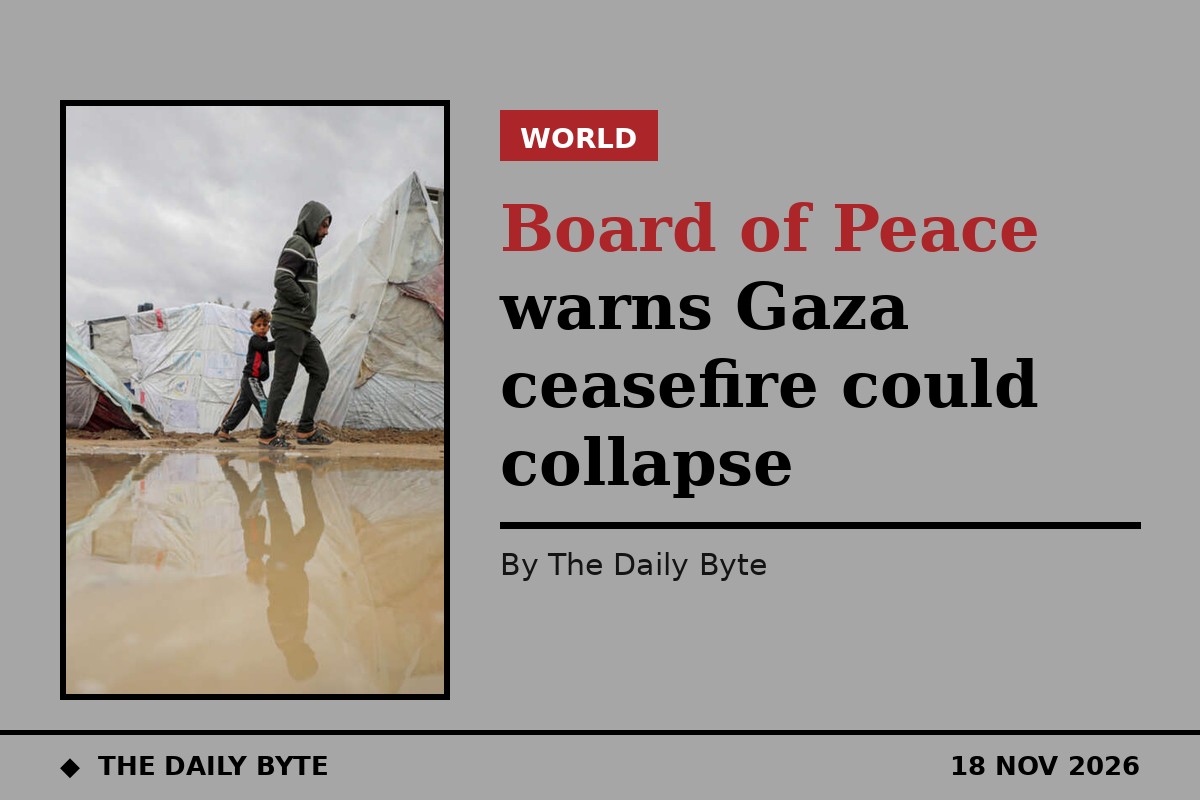
The body overseeing the US-brokered ceasefire in Gaza has delivered a bleak report to the United Nations Security Council, warning that the fragile agreement could collapse unless urgent steps are taken to implement it in full. The Board of Peace said the gap between what was agreed and what is happening on the ground is now the main risk to the process, leaving Gaza's population facing another winter in tents and rubble.
The 12-page report, seen by Reuters and submitted on Tuesday, is the board's second to the Security Council since the US-backed ceasefire came into effect 13 months ago. "The distance between what has been agreed and what is happening on the ground nonetheless remains the principal risk to the process," the report said, warning that "a ceasefire that delivers nothing visible cannot be sustained indefinitely." The board is expected to present its findings to the council in New York at the end of November.
Both sides accused of failing their commitments
The report accused both Israel and Hamas of failing to meet their commitments to end hostilities. While the ceasefire has halted major fighting, the wider plan — which calls for Hamas to disarm, Israeli troops to withdraw and reconstruction to begin — has effectively stalled since soon after it came into effect last year, Reuters reported.
Hamas agreed in July to a Board of Peace roadmap to surrender its weapons and transfer governance of Gaza to a civilian transitional authority, but Israel rejected the roadmap, saying it will not withdraw until Hamas is dismantled. "Every day that Israel continues strikes against Hamas targets, it delays putting Hamas' agreement to the roadmap to the test," the report said.
Israel has carried out near-daily strikes on Gaza, while the report said Hamas fighters have also continued attacks on Israeli troops. "Meanwhile, Hamas militant activity continues, the commitment to cease all military activities has not been met in full by the parties, and the population faces another winter in tents and rubble."
Governance, policing and aid all stalled
The report criticised Israel's government for an "absence of decisions" on arrangements to train and deploy a civilian Palestinian police force to replace Hamas as Gaza's law enforcement authority, saying this was impeding full implementation of the plan. It also pointed to Israeli delays in approving several of the bodies created to govern the Gaza Strip, arguing that the policy in Jerusalem was effectively keeping Hamas in power.
Restrictions imposed by Israel on supplies and equipment, alongside funding shortfalls, had hindered the ability of Gazans to prepare for and respond to seasonal flooding, the report said. Heavy rain inundated displacement camps last week across Gaza and more rain is expected later this month. Hamas, for its part, was collecting taxes on goods entering Gaza that were affecting the availability of basic commodities.
Senior Hamas official Basem Naim dismissed the report as "pure disinformation", accusing the Board of Peace of providing cover for Israel to evade its commitments. The office of Israeli Prime Minister Benjamin Netanyahu did not immediately respond to a request for comment.
Human cost since the ceasefire
More than 1,600 Palestinians, including many civilians, and five Israeli soldiers have been killed in Gaza since the US-mediated ceasefire was struck in October 2025, according to the reporting. Around 1,200 people were killed in Israel in the 2023 Hamas attacks, while the Israeli assault on Gaza has since killed 74,000 Palestinians.
Gaza's population of more than 2 million Palestinians lives confined to around a third of the coastal territory, mostly in makeshift tents and damaged buildings, under the control of Hamas fighters. Israel occupies two-thirds of Gaza that has been largely razed and depopulated.
The board called on the Security Council to press both sides to fulfil their agreements. "Should it collapse, there would be no road map to return to, no administration to deploy and no enabling environment to rebuild," the report warned — a warning also carried in the Associated Press account of the report. The Board of Peace was created in 2025 at US President Donald Trump's behest to oversee the ceasefire deal and reconstruction in Gaza.
Frequently asked questions
What is the Board of Peace? It is the US-backed body created in 2025 at President Donald Trump's behest to oversee the Gaza ceasefire deal and reconstruction, under a 20-point peace plan. Its first report to the Security Council was delivered in May by its director-general, Nickolay Mladenov.
When did the Gaza ceasefire begin? The ceasefire formally began on 10 October 2025, though attacks have continued since, and the wider peace plan has stalled over the deadlock on disarming Hamas.
What happens if the ceasefire collapses? The Board of Peace warned there would be no road map to return to, no administration to deploy and no enabling environment to rebuild Gaza.


