Board of Peace Warns Israel Over Gaza Plan Delay
Officials from the Board of Peace have warned Israel bluntly: it is about to miss its chance to shape Gaza's future — and if it does not act, others will decide it instead.
Board officials visited Israel last week with a short slide deck, and briefed Israeli experts and former officials this week. Their message, reported by Israeli journalist Nadav Eyal on Friday, was that the plan to rebuild and govern Gaza is stalling because Israel has not taken the steps it promised.
The final slide, "Other Alternatives for Gaza", listed what happens if Israel does not move: Gaza's future would be decided by future US administrations and Congress, by the UN Security Council — "possibly also UNRWA" — by the Palestinian Authority, or by Hamas. Its closing line read: "Israel becomes fully responsible for all humanitarian, administrative and other costs for the people of Gaza."
The three asks
Josh Gruenbaum, a senior adviser to the Board appointed by President Donald Trump, told Eyal the Board had been patient — but patience is running out. "We were very, very patient in giving Israel its space. But it's frustrating for us that now that the election is over — even though it's not over with a conclusive coalition — [Israel is] not moving forward with commitments that were already promised by Prime Minister Netanyahu to President Trump," he said.
Gruenbaum said Israel had been asked to take three decisions: sign the Status of Forces Agreement so the US-led International Stabilization Force can operate in Gaza; let Palestinian civil guards travel to Egypt for four to six weeks of training ahead of a handover to a technocratic government; and let humanitarian aid into Gaza ahead of winter.
The force, headed by a US two-star general and including troops from Morocco, Albania and Kosovo, has awaited its countersignature — "coming any day", Gruenbaum said — for months.
"Throw the keys back to the UN"
"If this political leadership [Israel's government] is now telling us that they no longer want to honor what they committed to, then just let us know now — and we're basically going to throw the keys back to the UN to oversee the mandate [for Gaza] or let the next US administration decide the future policy of Gaza," Gruenbaum said.
He said the plan was "not a smorgasbord" but a comprehensive 20-point plan that "needs to be implemented in totality", and asked whether Israel's leaders were "choosing politics over country, or country over politics?"
Another slide, "Reframing the narrative", said Hamas formally accepted the plan in July, committing to give up its weapons and transfer authority to the technocratic government (the NCAG). "Israel has declined to provide reciprocal commitments," it said, so Hamas's seriousness could not be tested.
Gruenbaum echoed the point — "We have a test here for Hamas — does Hamas really mean to demilitarise? Let's test that provision" — and said the stalling came from "political elements" in Israel's government.
A second warning from the Board
The briefing follows the Board's own 12-page report, seen by Reuters this week and due before the UN Security Council at the end of November — its second since the US-backed ceasefire took effect 13 months ago.
"The distance between what has been agreed and what is happening on the ground nonetheless remains the principal risk to the process," the report said. "A ceasefire that delivers nothing visible cannot be sustained indefinitely."
Reuters reported that Hamas agreed in July to a Board roadmap to surrender its weapons and hand governance to a civilian transitional authority, but Israel rejected it. Defence Minister Israel Katz said on Wednesday that Israel would not withdraw until Hamas is dismantled and Gaza demilitarised.
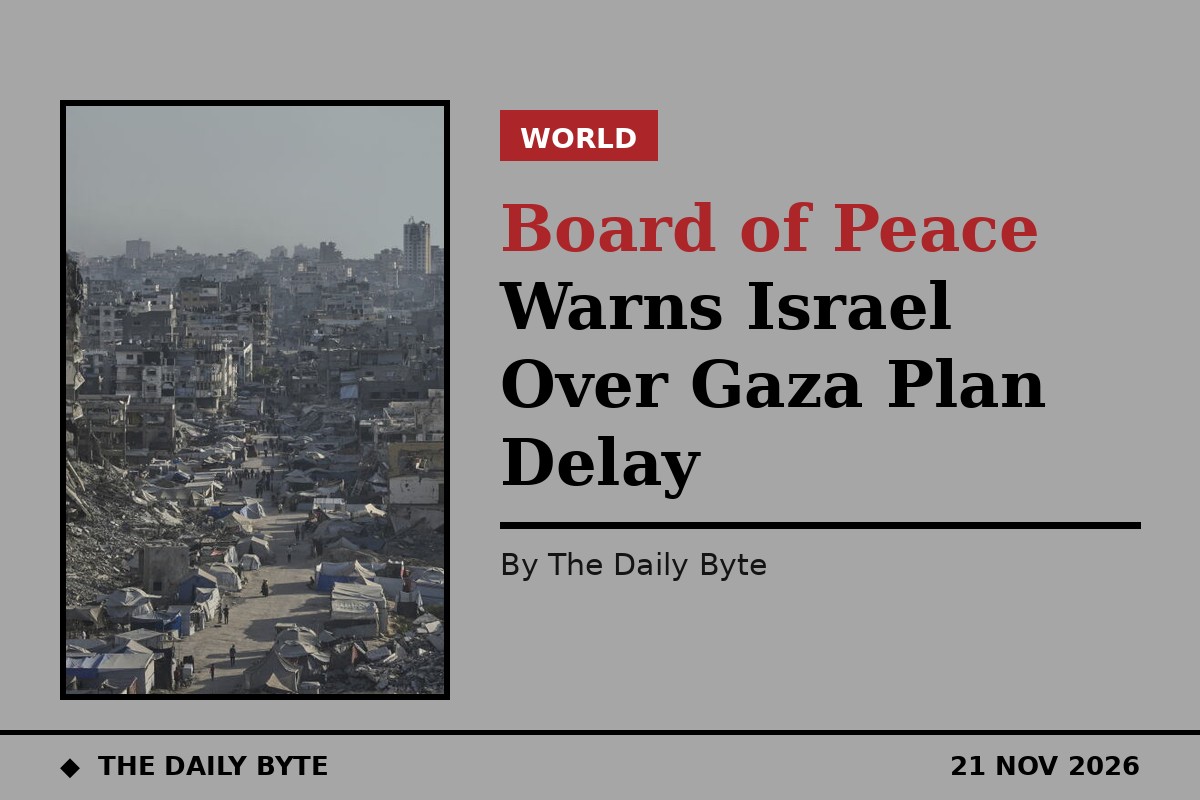
The report also criticised Israel's "absence of decisions" on training and deploying a civilian Palestinian police force, and said supply restrictions and funding shortfalls had hindered flood preparations. Heavy rain inundated displacement camps last week.
More than two million Gazans are confined to around a third of the territory, mostly in tents and damaged buildings, while Israel occupies the rest. More than 1,600 Palestinians and five Israeli soldiers have been killed since the ceasefire began in October 2025, Reuters reported; around 74,000 Palestinians have been killed since the war began, and about 1,200 people were killed in Israel in October 2023.
Senior officials in Netanyahu's government told Eyal plainly: "We don't want Gaza rebuilt. We don't want reconstruction. We don't want a withdrawal. We'll leave Hamas as it is and control half the Strip." Netanyahu's right-wing coalition remains in power as caretaker after losing its majority in an inconclusive election last month.
The Board's message is that the choice is no longer between the plan and a better plan. It is between the plan and someone else deciding Gaza's future.


