Bolivia and Chile resume talks after 16 years
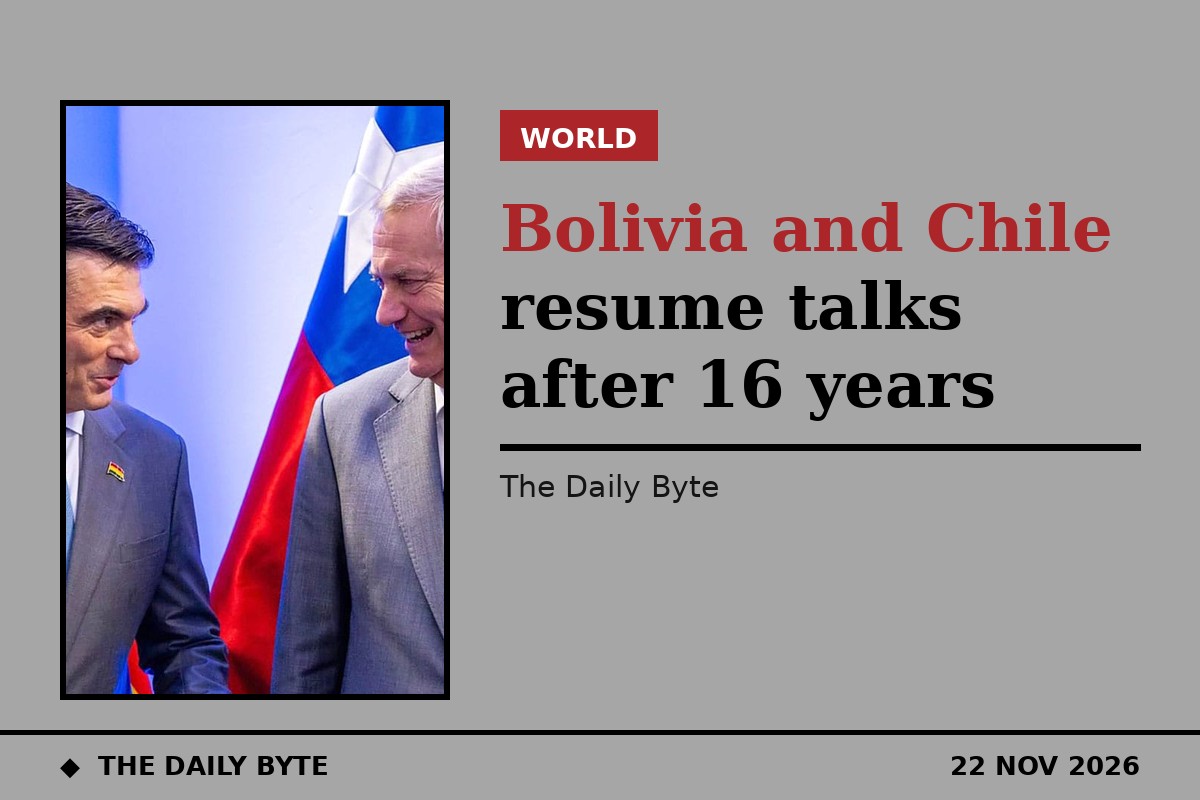
Bolivia and Chile have resumed formal political talks for the first time in 16 years, taking a further step towards normalising relations between two neighbours whose diplomats have not exchanged ambassadors since 1962.
The two governments met in Santiago on 21 November 2026 under their Political Consultation Mechanism, a channel that had not convened since 2010. Bolivia's Foreign Ministry said both delegations restated their intention to normalise diplomatic relations, while recognising that historical differences remain to be worked through with pragmatism and gradualism.
What was agreed in Santiago
The meeting was arranged by Bolivian President Rodrigo Paz and Chilean President José Antonio Kast after the two leaders met in La Paz in mid-October. Bolivia's delegation was led by Deputy Foreign Minister Carlos Paz, while Chile was represented by acting Foreign Minister Patricio Torres.
The delegations examined a practical bilateral agenda: physical integration and connectivity, free transit for Bolivian merchandise through Chilean ports, the reversal of the Sica Sica-Arica oil pipeline, Bolivia's access to fibre optics, and the modernisation of Economic Complementation Agreement No. 22, the trade pact between the two countries.
Both sides also agreed to meet again soon to discuss energy and security. A meeting of the Working Group on Free Transit is scheduled for 11 December in La Paz, according to teleSUR English, which reported the Bolivian Foreign Ministry's statement.
A relationship frozen since 1962
Bolivia and Chile have maintained interrupted diplomatic relations at ambassadorial level since 1962, apart from a brief restoration between 1975 and 1978. Since then the two countries have dealt with each other only through general consulates in La Paz and Santiago.
At the heart of the dispute is Bolivia's loss of its Pacific coastline to Chile in a 19th-century war, and its longstanding claim for sovereign access to the sea. Bolivia took the case to the International Court of Justice, which ruled in 2018 that Chile is not obliged to negotiate a sovereign outlet to the sea for Bolivia.
The thaw began with Kast's visit to La Paz on 16 October 2026, the first state visit by a Chilean president to Bolivia in 71 years. The two leaders signed five accords, including a memorandum of understanding for a Chile-Bolivia bioceanic fibre optic corridor linking the Pacific and the Atlantic, and Kast invited Paz to visit Chile in 2027.
What happens next
No date has been given for restoring ambassadorial ties, and the sea-access claim has not been settled. The official statements from both sides stress a commercial and economic cooperation agenda first, with the historical differences handled separately and gradually.
For Bolivia, a landlocked country, the practical prizes are concrete: smoother transit for its goods through Chilean ports, energy links and digital connectivity. For Chile, the talks fit a wider regional realignment in which recently elected conservative governments are rebuilding ties across South America.
Frequently asked questions
Why have Bolivia and Chile had no ambassadors since 1962? Diplomatic relations at ambassadorial level were interrupted in 1962 over Bolivia's claim for sovereign access to the Pacific, which it lost to Chile in the 19th century. They were briefly restored from 1975 to 1978 and have remained at consular level since.
What is the Political Consultation Mechanism? It is the formal channel through which the two governments discuss their bilateral agenda. It had not met since 2010 before the Santiago meeting on 21 November 2026.
Did the talks settle Bolivia's sea-access claim? No. The International Court of Justice ruled in 2018 that Chile is not obliged to negotiate sovereign sea access for Bolivia, and the current talks focus on trade, transit, energy and connectivity.
Sources: Wisevoter, reporting the Bolivian Foreign Ministry statement of 21 November 2026; teleSUR English.


