Botswana ranks last for night safety in Gallup poll
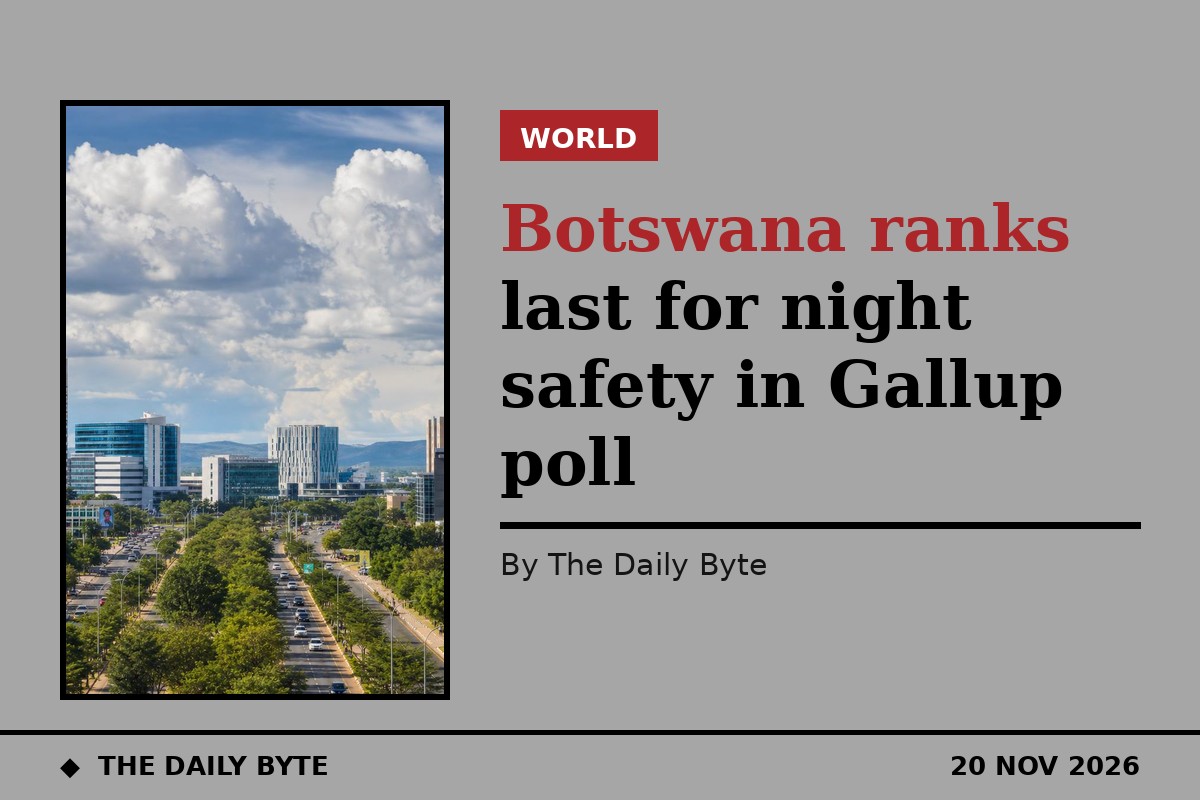
Botswana has ranked last of 140 countries for how safe people feel walking alone at night, according to Gallup's 2026 Global Safety Report, with only 28 per cent of adults saying they feel safe after dark.
The figure is down from 34 per cent in 2024, and it is the first time Botswana has sat at the bottom of the global ranking. It replaces neighbouring South Africa, which had held the lowest position for several years.
What the survey found
Worldwide, 69 per cent of adults said they felt safe walking alone at night where they live in 2025. The United Arab Emirates ranked first, with 96 per cent of adults feeling safe, up six percentage points from 2024.
At the other end of the scale, the ten countries where people felt least safe were Botswana at 28 per cent, South Africa at 35 per cent, Lesotho, Zimbabwe and Chile at 37 per cent, Ecuador at 38 per cent, the Republic of the Congo at 39 per cent, Liberia at 41 per cent, Myanmar at 42 per cent and Zambia at 43 per cent.
Four of those ten are in Southern Africa: Botswana, South Africa, Lesotho and Zimbabwe. The pattern is striking because none of them is fighting a nationwide armed conflict, yet their residents report feeling less safe than people in countries that are.
Somalia, which has endured years of armed conflict, led sub-Saharan Africa on the same measure, with 74 per cent of adults saying they felt safe walking alone at night. Mali recorded 70 per cent and Niger 68 per cent, both well ahead of Botswana, South Africa and Lesotho.
A stable democracy with a safety problem
Botswana is often described as one of Africa's most stable democracies, and the result sits uneasily with that reputation. The Africa Report pointed out that Botswana's murder rate is about a third of South Africa's, yet its people now report feeling less safe than South Africans do.
Gallup's own analysis offers a partial explanation. Its report found that perceptions of safety track prosperity and homicide rates more closely than armed conflict does, meaning that everyday crime and economic pressure shape how safe people feel more than war headlines do. The report does not attribute Botswana's fall to any single cause.
The drop itself is sharp. A fall of six percentage points in a single year took Botswana from the lower reaches of the ranking to the very bottom, and it came in a year when safety perceptions held steady or improved in five of the world's seven regions.
How the survey works
The results are based on nationally representative, probability-based samples of adults aged 15 and older in 140 countries and territories in 2025, totalling 143,620 interviews. The question asked whether people feel safe walking alone at night in the area where they live.
Gallup published the 2026 report on 18 November. For Botswana, the question now is whether the result is a one-year dip or the start of a longer slide, and whether the government responds to a finding that puts the country below every other nation surveyed, including those at war.


