Botswana pursues visa-free travel for Africans
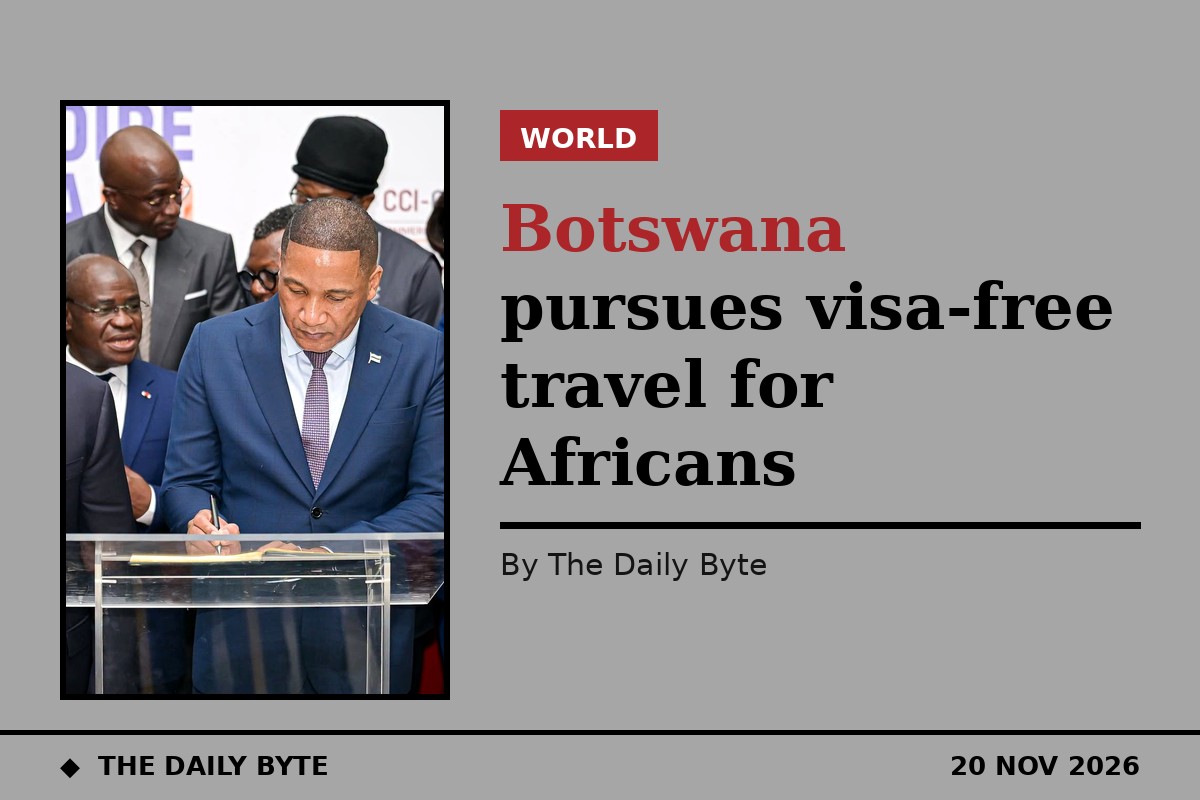
Botswana wants to scrap visa requirements for travellers from every African country, replacing them with an electronic travel authorisation issued in minutes. President Duma Boko announced the plan in Abidjan, in Côte d’Ivoire, saying Botswana would follow the route taken by Kenya, which dropped visa requirements and introduced an electronic authorisation in their place.
“We go the route of Kenya which removed all the visa requirements and introduced an Electronic Travel Authorization which you apply for in a minute or two you get it and you can visit. We want that to be the case for the rest of the continent and that’s what we’re pursuing,” Boko said, in remarks filmed by his presidential press team at a Diamond Jubilee event.
Boko said talks had already begun with Rwanda and Côte d’Ivoire. He was speaking during a state visit to Côte d’Ivoire from 15 to 18 November, Botswana’s first state visit to the West African country, at the invitation of President Alassane Ouattara.
What was actually signed
The visit produced a set of signed cooperation agreements, but the visa deal on paper is narrower than the ambition Boko described. The two governments agreed mutual visa abolition for holders of diplomatic, official, service and special passports only. Ordinary passport holders, the travellers who make up most cross-border movement, are not covered by that agreement.
The wider plan to open travel to all Africans would therefore depend on new arrangements that have not yet been agreed, and no start date has been given. The distinction matters: the signed accord is a diplomatic step, while the continent-wide electronic authorisation remains a stated goal rather than a policy in force.
The other agreements signed in Abidjan cover mineral exploration, petroleum, animal and fisheries resources, political and diplomatic cooperation, and skills development. The full texts have not been published, so the precise terms, start dates and any conditions have not been independently confirmed.
Trade worth less than $1 million
Boko used the visit to press businesses in both countries to grow a bilateral trade relationship he put at less than $1 million, a strikingly small figure for two economies of their size. Addressing a business forum in Abidjan, he told company leaders that closer African trade links were essential.
“Building interconnection networks and infrastructure to facilitate trade among African countries is no longer an option; it is a survival imperative,” he said.
He presented Botswana’s Economic Transformation Programme, which the government says has identified 186 projects worth 514 billion pula, about $37 billion, and aims to create 512,000 jobs by 2036. He invited Ivorian firms to explore partnerships in Botswana and urged companies on both sides to use the African Continental Free Trade Area to build trade.
Ouattara, for his part, said overall exchanges between the two countries fell short of the potential of their economies, and invited Botswana’s private sector to invest in Ivorian mining, petroleum and the major projects in the National Development Plan 2026–2030.
Why the visa push matters
Free movement of people is a flagship goal of the African Union’s Agenda 2063, but progress has been uneven. Kenya’s decision to replace visas with an electronic authorisation for most visitors is one of the most-cited recent examples, and Boko explicitly held it up as the model for Botswana.
Botswana has already moved in this direction in individual cases. In October, Boko announced that Botswana would remove visa requirements for citizens of Madagascar after a working visit by President Michael Randrianirina, saying easier movement could encourage commercial activity and air connectivity. No commencement date or detailed immigration conditions were given for that change either.
Botswana was also guest of honour at the second International Exhibition of Extractive Resources and Energy, SIREXE 2026, which opened in Abidjan on 18 November and runs until 22 November, with more than 30 countries taking part. At a dinner marking 60 years of leadership in the diamond sector, Boko defended natural diamonds against lab-grown stones, saying their value rested on authenticity and their bond with the communities that mine them.
Ouattara conferred on Boko the Grand Cross of the National Order of the Republic of Côte d’Ivoire at an official lunch after their talks. Whether the visa-free ambition follows the diplomatic ceremony into practice will depend on the talks Boko said had begun — and on whether the electronic authorisation system he described is built.


