Brazil Budget Watchdog: Lula Pledges Lack R$20bn Room
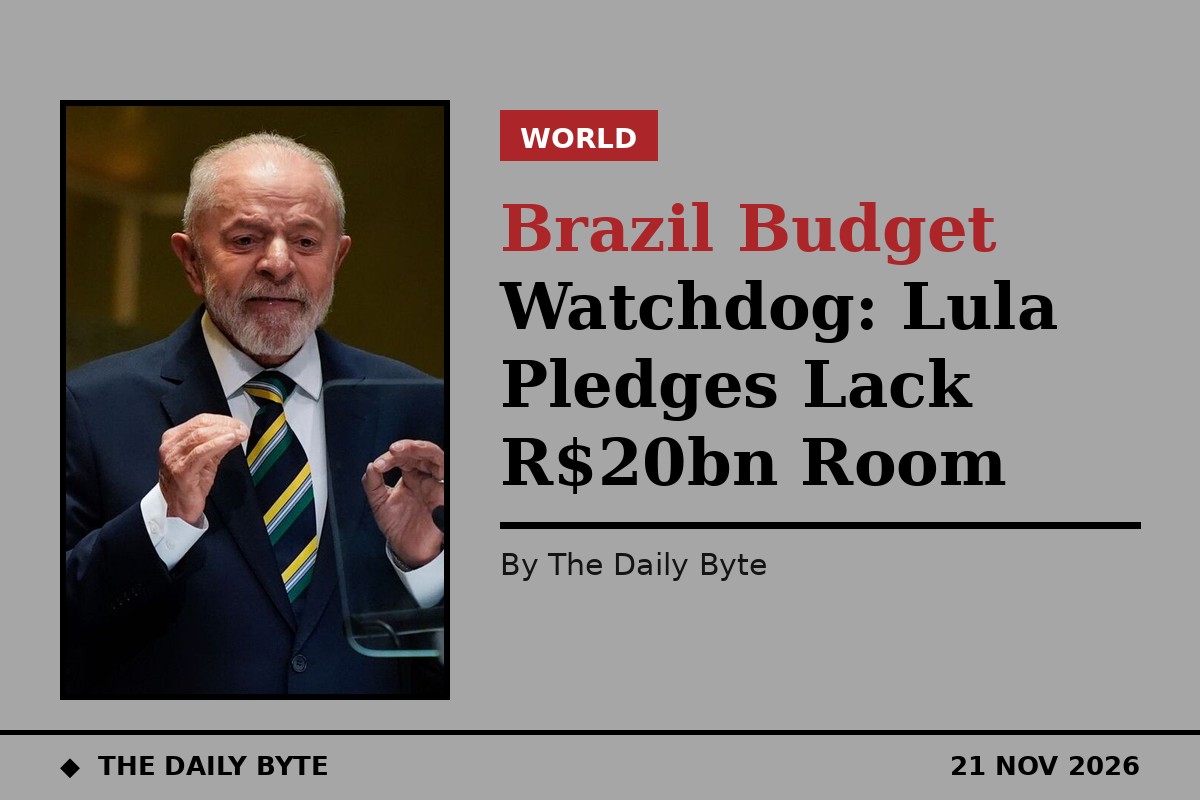
Brazil's independent budget watchdog has warned that President Luiz Inácio Lula da Silva's new spending promises still lack about R$20.1 billion (US$3.4 billion) of room in the 2027 budget, even after the government's planned reshuffle of funds. The Instituição Fiscal Independente (IFI), a fiscal monitoring unit attached to the Senate, set out the gap in its monthly fiscal report on Thursday 19 November.
The warning lands as the Chamber of Deputies prepares to take up the government's budget-repair bill, and as Lula prepares for a fourth term beginning on 5 January 2027 after winning re-election on 25 October. It asks a blunt question: can Brasília pay for a rise in Bolsa Família, the cash-transfer scheme for poor families, without breaking its own spending rule?
The ceiling is already full
Under the fiscal framework adopted in 2023, the government cannot exceed a ceiling on federal spending. The IFI says the 2027 budget bill reached Congress with that ceiling already fully used, leaving no space for the new measures announced during the election campaign.
The watchdog counts R$40.1 billion (US$6.8 billion) of new spending plus R$6.4 billion (US$1.1 billion) of lost revenue. The largest item is the Bolsa Família rise: a decree of 17 September raised payments by 15.04%, at a cost the IFI puts at R$22.7 billion (US$3.9 billion) next year. The rest includes Desenrola 3.0, a household debt-relief scheme, at R$5 billion; a wider Pé-de-Meia payment to keep teenagers in school, at R$5 billion; a university version at R$4.6 billion; weight-loss drugs in the public health system at R$1.5 billion; and Pix MEI, a scheme for micro-entrepreneurs, at R$1.3 billion. The lost revenue comes mainly from the planned end of online betting, worth R$5.3 billion, and from forgiving tax debts of individual micro-entrepreneurs, worth R$1.1 billion.
The government's answer
The Planning Ministry said in a note on 19 October that it would ask Congress to amend the budget and move about R$20 billion between items without lifting the ceiling. It did not say which items would be cut, and the IFI says that even if the move goes ahead, about R$20.1 billion still needs room.
The government's main answer is Complementary Bill 299/2026, a package of spending restraints and revenue measures that the Senate approved on 18 November, after a first vote of 45 to 31 on 12 November. The bill still needs approval from the lower house. The IFI puts its effect on the 2027 balance at between R$45.1 billion and R$56.1 billion (US$7.7 billion to US$9.5 billion), but says about 70% of that comes from revenue and only R$19.5 billion (US$3.3 billion) looks lasting. The government has put the package's value at up to R$60 billion (about US$10 billion).
Most of that money helps the budget deficit target rather than the ceiling. The parts that do open room under the ceiling — delays and caps on some mandatory payments — are worth up to R$7.8 billion by the IFI's sum, or about R$11 billion by the government's. If the remaining gap lands on discretionary spending, that pool would shrink from about R$138 billion to roughly R$118 billion — and if every new real were offset there, it would fall to about R$98 billion, below the R$103.5 billion the IFI says ministries need to keep running.
Risks ahead
The IFI also warns that much of the bill's gain is conditional: between R$25.6 billion and R$36.6 billion depends on conditions being met, against R$19.5 billion that does not. And if Congress does not convert provisional measure 1,399/2026, which creates a Selective Tax on harmful goods, into law by 31 December, the budget loses R$46.8 billion (US$7.9 billion) in 2027.
For investors, the channel runs through interest rates and the currency. The central bank's benchmark Selic rate stands at 13.75%, and the IFI notes that the bank's weekly market survey of 13 November put 2027 inflation at 5.00%, up from 4.32% four weeks earlier and above the 4.5% top of the target range. The real has weakened, with the dollar around R$5.80 and the central bank's reference rate at R$5.8889 on 19 November. The IFI expects Lula and his future finance and planning ministers to present a credible plan in December.


