Brazil Central Bank Blames Shocks for Inflation Rebound
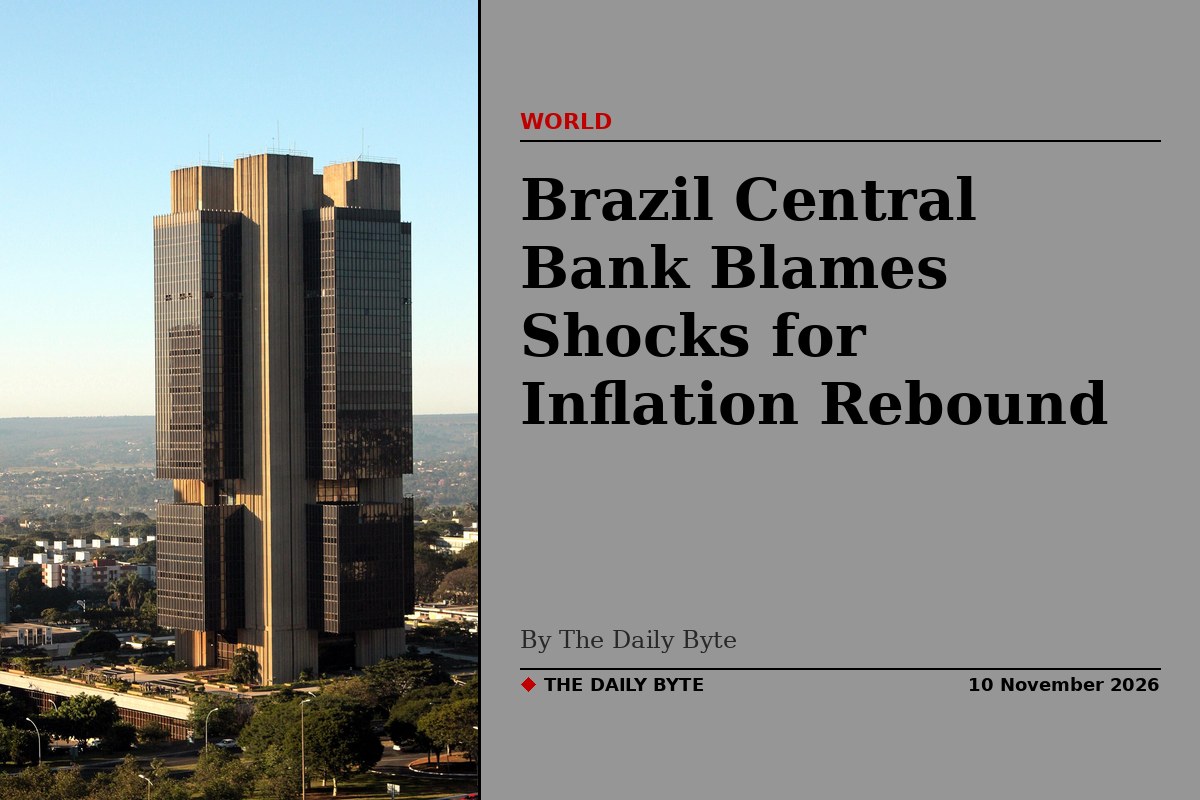
Brazil's central bank has blamed four supply shocks for a worsening inflation outlook, in minutes published on Tuesday, 10 November 2026, explaining why it halted its run of interest rate cuts last week.
The minutes of the 3-4 November meeting of the bank's monetary policy committee, Copom, said the deteriorating inflation picture, despite slowing growth, reflected higher oil prices, El Niño-related pressures, the impact of ending the 44-hour working week and a weaker currency driven by domestic policy uncertainty.
At that meeting Copom kept the benchmark Selic rate at 13.75%, ending five consecutive quarter-point cuts that had brought the rate down from 15% since March. The decision was the first since President Luiz Inácio Lula da Silva's re-election on 25 October, which triggered a broad market sell-off, a sharp fall in the real and a jump in long-term borrowing costs.
Four shocks behind the rebound
According to Reuters, the central bank said weaker domestic demand and growth projected below potential could help contain the risk of the shocks spilling over into broader and more persistent inflation. But the minutes made clear that policymakers see the balance of risks as tilted against a quick return to target.
The bank's inflation target is 3%, with a tolerance band of 1.5 percentage points either side. Inflation measured by the IPCA-15 index reached 4.62% in the 12 months through mid-October, up from 4.47% in the previous period and above the 4.5% ceiling of the tolerance band. The central bank's own survey of analysts puts inflation at 5.2% by the end of this year.
Copom raised its inflation projection for the relevant policy horizon to 3.5% for the second quarter of 2028, from 3.2% for the first quarter of that year. The projection has moved steadily away from the 3% target since the election, and the minutes offered no signal that another cut is near.
Rates on hold into next year
Economists now expect borrowing costs to stay high for far longer than markets had assumed before the election. ABC Brasil told clients it expects the Selic rate to remain at 13.75% through at least the end of 2027, while Goldman Sachs has forecast no change until at least the second quarter of 2028, Reuters reported last week.
Major banks have also cut their growth forecasts for next year sharply, with many now expecting the economy to expand only marginally amid tight financial conditions. Itaú cut its 2027 growth forecast to 0.5% from 1.2% and raised its inflation projection for the year to 6.1% from 4.6%.
The fiscal backdrop is adding to the pressure. Under Lula's current term, Brazil's gross public debt has risen by more than 10 percentage points to 82.9% of gross domestic product, and investors are questioning whether the government will deliver the fiscal adjustment needed to stabilise it. Lula has also pledged new spending measures.
What happens next
Copom's next scheduled meeting is on 8 and 9 December, its last of 2026. Fresh inflation data, fiscal announcements and exchange-rate movements will arrive before then, and the minutes suggest policymakers will need clear evidence that the supply shocks are fading before they resume cutting rates.
For Brazilian households and businesses, the message is that the era of steadily falling borrowing costs is over for now. With the Selic at 13.75% and inflation still above target, credit will stay expensive well into next year, even as the economy slows.