Brazil COP31 Fossil Fuel Roadmap: Lula Urges Faster Shift
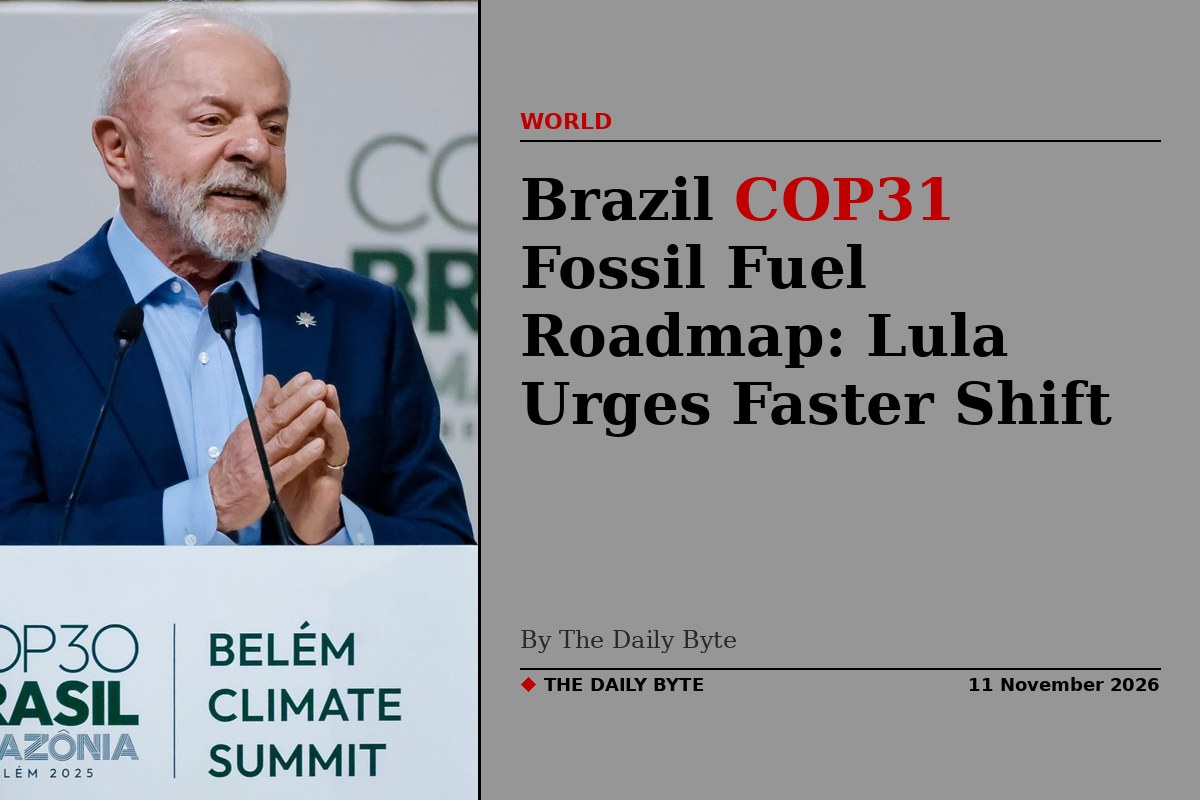
Brazil has presented a plan at the COP31 climate talks in Antalya, Turkey, to speed up the move away from oil, coal and natural gas, calling on countries to remove fossil fuel subsidies and stop building new power plants that depend on them. President Luiz Inácio Lula da Silva was due to address the conference on Wednesday, 11 November, as world leaders set out their climate priorities.
The proposal was presented by the Brazilian delegation on Tuesday, 10 November, the day after COP31 opened. It is built around the roadmap published by Brazil’s COP presidency in recent weeks, which asks countries first to plan and assess their energy systems by 2028, and then to work together to reduce fossil fuel supply from 2031. Rather than imposing a single route on every government, the plan leaves each country to expand renewable energy, including solar and wind power, in line with its own economic circumstances, resources and energy needs.
What Brazil is asking countries to do
At the heart of the proposal are two practical steps. The first is to end public support that lowers the cost of producing and consuming fossil fuels, on the grounds that such subsidies make it harder for renewable energy to compete on price. The second is to avoid approving new power plants and facilities that depend on oil, coal and natural gas, so that investment is not locked into infrastructure that could become less useful as clean energy expands.
Ana Toni, Brazil’s representative at the talks and a former executive director of COP30, told the Associated Press that the aim was to break a complex global challenge into practical solutions that could guide government decisions. She said many countries were already taking steps to expand renewable energy, and that the roadmap was intended to make that process easier and faster.
A second attempt after Belém
The plan is a second attempt at an issue on which the previous summit failed to agree. COP30, held in Belém in Brazil last year, was unable to reach consensus on a global plan to reduce dependence on fossil fuels. Brazil’s presidency has since kept the idea alive outside the formal negotiations, publishing the roadmap and bringing it to Antalya for discussion.
United Nations Secretary-General António Guterres backed the push on Tuesday, telling the conference it was “long past time to stop treating the transition away from fossil fuels as taboo or intractable” and urging countries to produce clear timelines for the change. Delegates from nearly 200 countries are meeting in Antalya as a UN report published last month found the world on course to break through the 1.5 degrees Celsius warming limit agreed under the Paris Agreement.
Electricity at the centre of the talks
The host country, Turkey, has been pressing negotiators to put a goal on electrification at the centre of a final deal, targeting a rise in electricity’s share of total global energy consumption to 35 per cent by 2035, up from a little over a fifth now. A study released on Tuesday by the International Energy Agency indicated that electricity could account for 33 per cent of global energy consumption by 2035, close to that target.
Critics of the electrification push note that the proposal does not include language requiring new power to be generated from clean energy sources, and governments have yet to clarify a broader plan for the transition away from fossil fuels. Brazil’s roadmap is not a binding agreement: it offers recommendations and a framework for action, and whether it gains support and leads to further commitments remains part of the negotiations, which run through 20 November.
Lula’s address and Brazil’s wider agenda
Lula, who was re-elected at the end of October, was scheduled to speak on Wednesday afternoon, alongside European Commission President Ursula von der Leyen, Chinese Vice President Han Zheng and Marshall Islands President Hilda Heine. He was also expected to take part in a high-level meeting on forests on the same day.
Forest protection is the other pillar of Brazil’s agenda at COP31. The delegation has presented an international roadmap to expand forest protection and seek to halt and reverse deforestation by 2030, and on 6 November the Brazilian government approved a national plan covering conservation, sustainable use and the restoration of degraded areas. Brazil is also pressing for more climate finance for developing countries, with discussions including ways to mobilise $1.3 trillion a year by 2035.
The United States has skipped the talks for a second year running, after President Donald Trump withdrew the US from climate cooperation following his return to office in 2025.


