Brazil Cuts 2027 Growth Forecast to 1.8% on High Rates
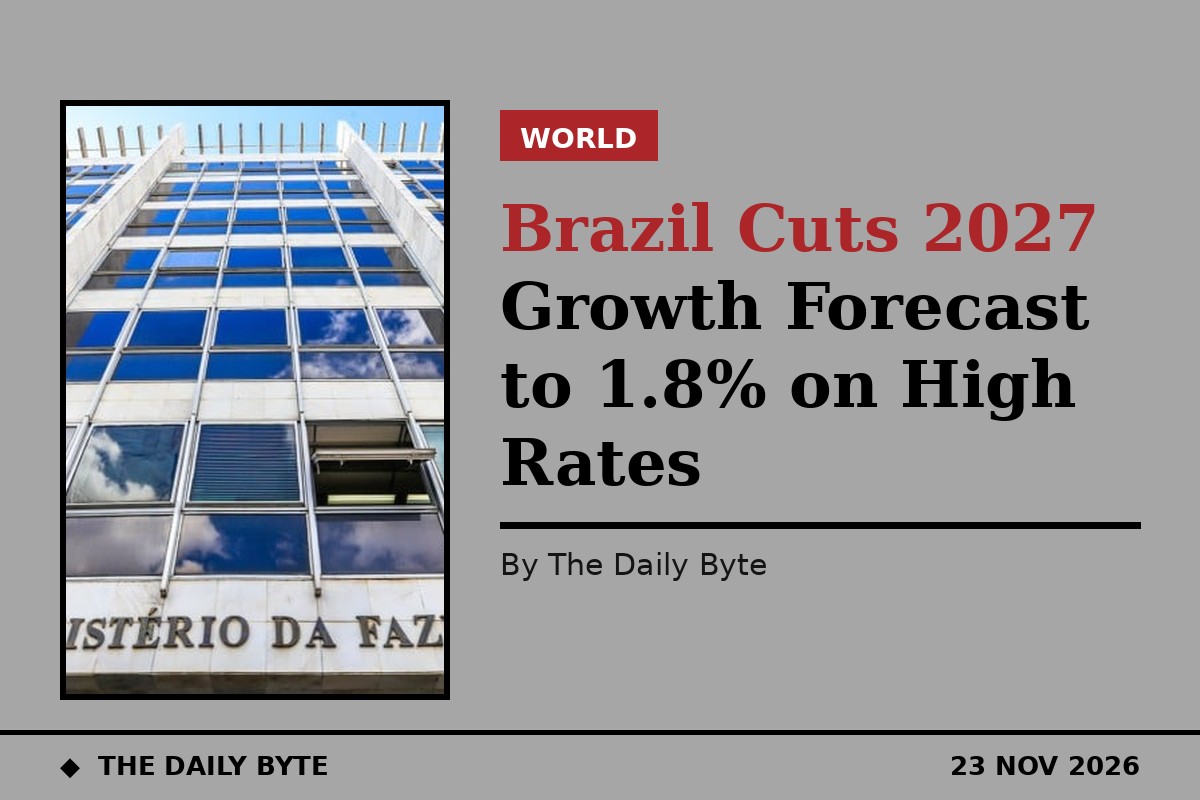
Brazil’s Finance Ministry has cut its forecast for economic growth next year to 1.8%, down from the 2.3% it projected in September, while raising its inflation estimate to 4.5%, up from 3.8% and further above the official 3.0% target. The new figures, published on Monday, 23 November 2026, underline how much tougher the outlook for Latin America’s largest economy has become.
The ministry’s economic policy secretariat also trimmed its forecast for this year, Reuters reported. Growth in 2026 is now expected at 1.9%, down from 2.0%, with inflation at 5.3%, up from 4.9% previously. The ministry blamed the weaker outlook for next year on persistently high interest rates and borrowing costs, a smaller contribution from agriculture and a weaker statistical carryover from this year.
The revised projections will underpin the government’s final revenue and expenditure report for this year, due on Tuesday, and are expected to guide updates to the 2027 budget proposal. That budget will incorporate commitments made by President Luiz Inácio Lula da Silva during his re-election campaign, including an expansion of social programmes.
Still more optimistic than the market
Even after the downgrade, the government’s projections remain considerably more optimistic than those of private economists. A weekly central bank survey showed analysts expect gross domestic product growth of just 1.0% in 2027, with inflation at 5.1%, Reuters reported last week.
Economists broadly expect the benchmark Selic rate to stay at 13.75% for longer than previously anticipated. Inflation pressures have been driven in part by the real’s sharp depreciation — it has lost nearly 20% against the US dollar since Lula’s re-election last month, as investors question the government’s ability to curb mandatory spending and stabilise public debt.
Surplus target and investment grade
On the same day, Finance Minister Dario Durigan set out the government’s longer-term fiscal ambition. Brazil will pursue a primary surplus of between 1.5% and 2% of gross domestic product by the end of Lula’s next term, Reuters reported. The primary surplus is the budget balance before interest payments, and it is the measure investors watch most closely as a guide to whether public debt is stabilising.
Speaking at an event hosted by investment bank Itaú BBA, Durigan said the country’s main goal was to regain investment-grade status from credit rating agencies, which Brazil lost more than a decade ago, while achieving robust fiscal surpluses. In its 2027 budget guidelines bill, the government had projected a primary surplus of up to 1.5% of GDP in 2030.
Durigan said the government would speed up economic measures to tackle a “challenging” 2027, but stressed that this did not imply accelerating spending. He also said he supports Brazil’s 3% inflation target and that changing the goal was not on the table. Nominations to fill vacancies on the central bank board and at regulatory agencies, including antitrust body CADE and securities regulator CVM, could be resolved within two weeks, he added.
The central bank chief weighs in
The central bank’s own chief, Gabriel Galipolo, delivered an unusually direct assessment of the fiscal picture at the same Itaú event on Monday. He said government spending growth in a fully employed economy can fuel inflation, and argued that adjustments to fiscal rules are both possible and necessary.
“If you take a close look at the numbers … it is true that expenditures growing above GDP in a full-employment economy can pressure inflation,” Galipolo said. He noted that Brazil’s minimum wage had posted significant gains in purchasing power in recent years, while acknowledging that such gains also add to inflationary pressures.
Under Lula’s current term, Brazil adopted a fiscal framework capping real spending growth at 70% of revenue gains. Galipolo’s remarks suggest the central bank sees that framework coming under strain as election-campaign spending commitments are added to the budget.
Rates, the real and the road ahead
The immediate test comes on Tuesday, when the government publishes its final revenue and expenditure report for 2026. That document will show how the new forecasts translate into the public accounts, and whether the government needs to freeze spending to meet its fiscal targets for the year.
Lula was re-elected last month for a fourth non-consecutive term, which begins on 5 January and runs through early 2031. The new forecasts are the first official economic projections of that next term, and they set a more sober tone than the campaign suggested: slower growth, higher inflation, and interest rates staying high for longer.
For households, the combination means borrowing stays expensive and prices keep rising faster than the central bank’s target. For the government, the 2027 budget will be built on numbers the market already regards as optimistic, with a fiscal adjustment — and a congressional vote on a package worth roughly 50 billion reais for 2027 — still to come.


