Brazil Life Expectancy Hits Record 76.9 Years
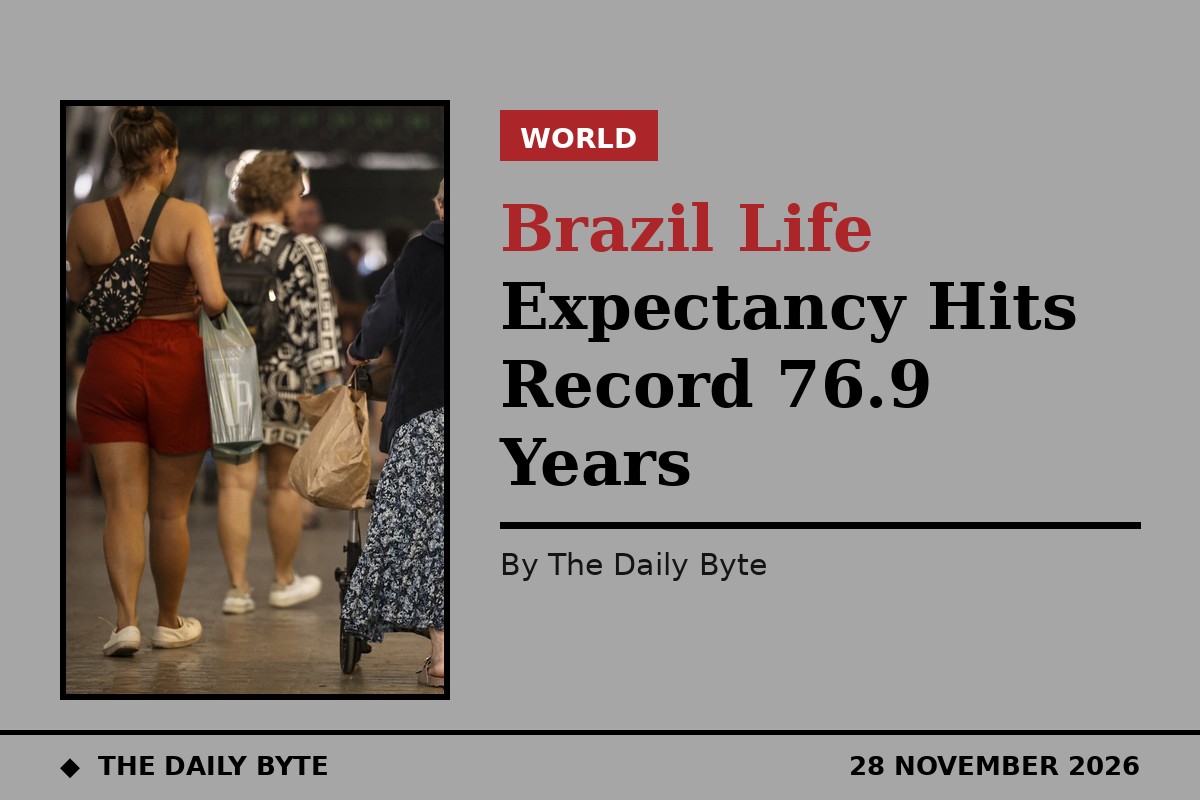
Brazilians are living longer than ever before. Life expectancy at birth reached 76.9 years in 2025, the highest figure ever recorded in the country, according to new data released by the Brazilian Institute of Geography and Statistics (IBGE) on Friday, 27 November.
The figure marks an increase of 3.1 months compared with 2024, when life expectancy stood at 76.6 years. The institute said the advance reflects the continued recovery of mortality levels after the Covid-19 pandemic and consolidates a long trajectory of gains in survival rates.
Women continue to live considerably longer than men. Female life expectancy reached 80.1 years in 2025, up from 79.9 in 2024, while male life expectancy rose from 73.3 to 73.5 years. The gap between the sexes remained at 6.6 years.
A transformation over 85 years
The scale of change since 1940 is striking. In that year, a Brazilian newborn could expect to live just 45.5 years. By 2025, that figure had risen by 31.4 years. Among men the gain was 30.6 years, and among women 31.8 years.
IBGE researcher Marcio Minamiguchi said the life tables describe the mortality pattern of the population. "They allow the analysis of different probabilities of death and the life expectancy of people of different ages," he said.
The improvement has been driven by falling mortality at every age, above all among children. Infant mortality fell to 12.0 deaths per 1,000 live births in 2025, down from 146.6 per 1,000 in 1940, a drop of 91.8 percent over 85 years. Mortality among children aged one to four fell by 97.2 percent over the same period.
Older Brazilians living longer too
Longevity gains are not confined to childhood. A Brazilian who reached the age of 50 in 2025 could expect to live a further 31.1 years on average, compared with 19.1 years in 1940. At 60, remaining life expectancy reached 22.7 years, up from 13.2 years in 1940.
Of every 1,000 Brazilians who reach 60, 629 are now expected to reach 80, nearly three times the proportion recorded in 1940, when only 213 did so.
The data also underline a persistent risk for young men. In 2025, a man aged 20 to 24 was 4.1 times more likely to die before turning 25 than a woman of the same age, a pattern the IBGE links mainly to deaths from external causes, including homicides, road accidents and suicides.
The complete life tables are also used as a parameter in calculating pension values for workers under Brazil's general social security system. The institute projects that Brazil's population will peak at 220.43 million people in 2041 before falling below 200 million by 2070.


