Brazil Inflation Eases to 4.64% in Mid-November
Brazil's mid-November inflation came in cooler than expected on Thursday 26 November 2026, giving the country's central bank some breathing room after a year in which prices have stayed above its target.
The IPCA-15 consumer price index, the early preview of Brazil's official inflation measure, rose 0.22% in the month through mid-November, statistics agency IBGE said. That was down from 0.32% a month earlier and below the 0.34% increase economists had expected in a Reuters poll.
Over the 12 months through mid-November, consumer prices rose 4.64%, up slightly from 4.62% previously but below the 4.78% forecast. The index has risen 4.38% so far this year. It is the first inflation reading since last month's election runoff, in which President Luiz Inacio Lula da Silva won re-election.
Food prices drive the monthly rise
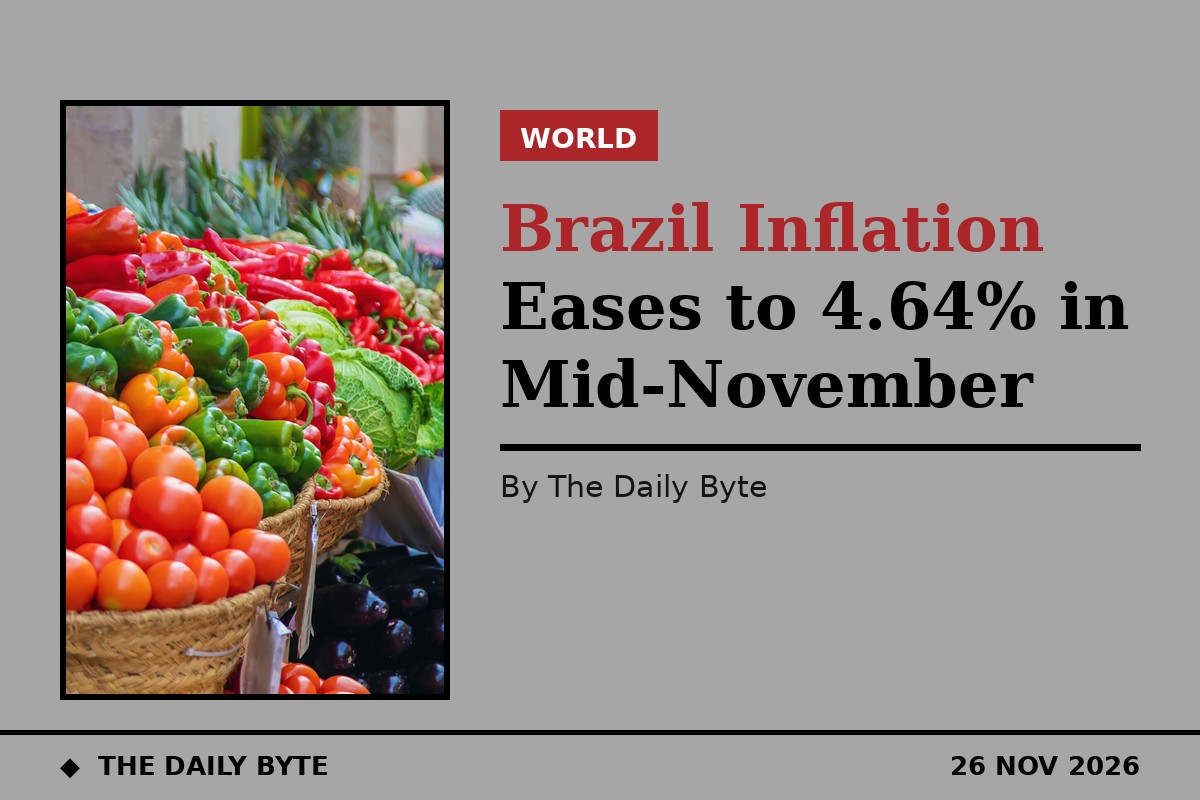
Food did most of the pushing. The food and beverages group rose 1.51% in the month, its largest contribution to the headline figure, adding 0.33 percentage points to the index. Food eaten at home accelerated to 2.02%, from 1.01% in October.
Within that, tomato prices jumped 38.92% in the month, onions rose 17.43%, meat was up 3.65% and rice rose 3.38%. Potatoes and long-life milk moved the other way, falling 2.33% and 1.84%. Eating out became cheaper in relative terms, with that part of the food group slowing to 0.28% from 0.56%.
Five of the nine groups surveyed rose in November. Communication was up 0.88%, helped by internet access and mobile phone plans, and personal expenses rose 0.49%, with package holidays and hotel stays among the risers.
Cheaper travel offsets the food bill
Transport pulled the other way, falling 0.71% and taking 0.14 percentage points off the index. Airfares dropped 9.57%, the biggest single drag on the month, and fuel prices fell 0.95%, with petrol down 1.23%. Health and personal care fell 0.28%, and housing slipped 0.14% as residential electricity prices eased 0.85% under the green tariff flag, which adds no extra charge for consumers.
Regionally, Salvador recorded the largest rise at 0.68%, driven by tomatoes and meat, while Curitiba had the smallest reading at minus 0.27%, helped by a cut in water and sewerage charges and cheaper petrol.
Still above the central bank target
The result still leaves inflation above the central bank's target. The bank aims for 3%, with a tolerance band of 1.5 percentage points either side, putting the ceiling at 4.5%. The 12-month rate of 4.64% sits just above that ceiling, even though the monthly pace has slowed.
Earlier this month the bank held its benchmark Selic rate at 13.75%, one of the highest among large emerging economies, after a cycle of rate cuts that began in March. The softer-than-expected reading may ease pressure for a quick change of course, but food prices running hot will keep policymakers cautious.
Lula pledged during his campaign to repair the public finances gradually and deliver primary surpluses, without setting out in detail how he would achieve them. He has also made several promises for more public spending, which markets will watch against the inflation picture.
What it means for households
For households, the numbers tell a mixed story. Overall price rises are slowing, and cheaper airfares and fuel helped this month, but the weekly shop is still getting more expensive, with the cost of food at home rising twice as fast as it did in October. That gap between a cooling headline rate and rising food prices is likely to shape the debate over interest rates into the central bank's next decision in December.
Prices for the November reading were collected between 15 October and 16 November, and the index covers families earning between one and 40 minimum wages across Brazil's main metropolitan areas, Brasilia and Goiania.


