Brazil storm kills five, strips roofs from 8,000 homes
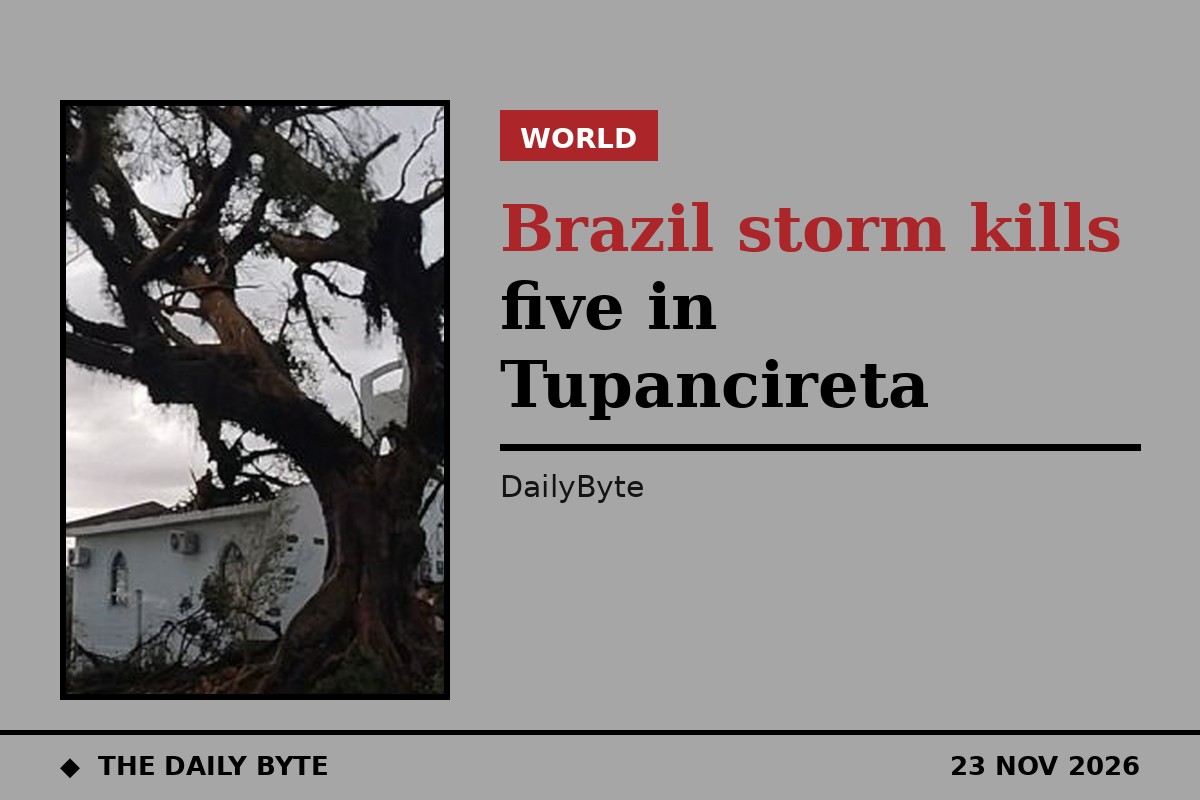
Five people were killed and 265 injured when a violent supercell storm tore through the farming town of Tupancireta in southern Brazil, stripping the roofs from nearly 8,000 homes and forcing almost 20,000 people from their houses. The storm struck before dawn on Friday, 20 November 2026, and in about half an hour left one of the worst local storm disasters Rio Grande do Sul has seen this year.
Brazil's Civil Defense said the death toll had risen to five by Sunday, with more than 250 people injured. The town of about 20,000 people was left without electricity, running water or internet, and damage was reported in 32 other municipalities across the state. The federal government recognised a state of public calamity in Tupancireta on Saturday, 21 November, a step that speeds up the release of federal money and aid.
A town hit in the middle of the night
The storm arrived at about 3 a.m. local time, when most residents were asleep. The state Civil Defense had issued a red text-message alert at 2:38 a.m., warning of storms with strong winds and hail, but the speed and force of the system left little time to prepare. Nature World News reported that winds reached 114 kilometres per hour, about 71 mph, according to the national weather institute, Inmet.
Civil Defense figures put the scale of the damage in stark terms: 7,796 homes lost their roofs, and about 8,000 of the town's roughly 8,600 homes were affected in some way. In total, 20,090 people were affected, including 19,780 displaced and 40 left homeless. Twenty schools and the local hospital were damaged, about 1,000 trees came down, and some 5,000 utility poles or sections of wire were brought down. The hospital's roof was torn away and 11 patients had to be transferred elsewhere.
Was it a tornado?
Officials have described the system as a supercell, a severe thunderstorm built around a rotating updraft that can produce large hail, destructive gusts and sometimes tornadoes. They found no evidence of a tornado in Tupancireta, but have not fully ruled one out. The leading explanation is a downburst or microburst, a sudden blast of air that crashes out of a storm and spreads across the ground in straight lines, flattening objects across a wide area.
Meteorologists quoted in Brazilian reports said only about 1 per cent of storms in Rio Grande do Sul produce tornadoes or microbursts, and the state Civil Defense monitoring centre said the extent of the damage could not be explained by a tornado alone. A detailed damage survey may still change the final classification of the windstorm. Separate tornadoes were confirmed elsewhere on the same day, with two F1 tornadoes reported in the neighbouring state of Parana.
The response and the rebuilding ahead
About 200 Army soldiers have been helping clear debris and replace roofs since Friday, and federal engineers and reconstruction specialists are assessing damage to homes, public squares, hospitals, health units and schools. QNC News reported that residents spent Saturday picking through the remains of their homes, salvaging furniture, mattresses and bicycles, while others climbed onto rooftops to make temporary repairs.
President Luiz Inacio Lula da Silva ordered medical and emergency teams to the region. At state level, Governor Eduardo Leite authorised 2 million reais in emergency aid and launched a new round of the Volta por Cima programme, which pays a one-off 2,500 reais to families in poverty or extreme poverty whose homes were damaged, with 5 million reais set aside. Mayor Gustavo Terra said the town urgently needs roof tiles, cement and labour.
No official estimate of reconstruction costs had been published by Monday, and casualty figures could still be revised as officials update their tallies. With thousands of homes open to the sky and more storms possible in Brazil's late-spring season, getting roofs back on quickly matters as much as any debate about the weather that caused the damage. Tupancireta had already declared an emergency over drought in February 2026, when more than 900 rural properties lost crops including soybeans, so the storm has hit a community that was already under strain.


