Balkan leaders back EU enlargement at Ohrid summit
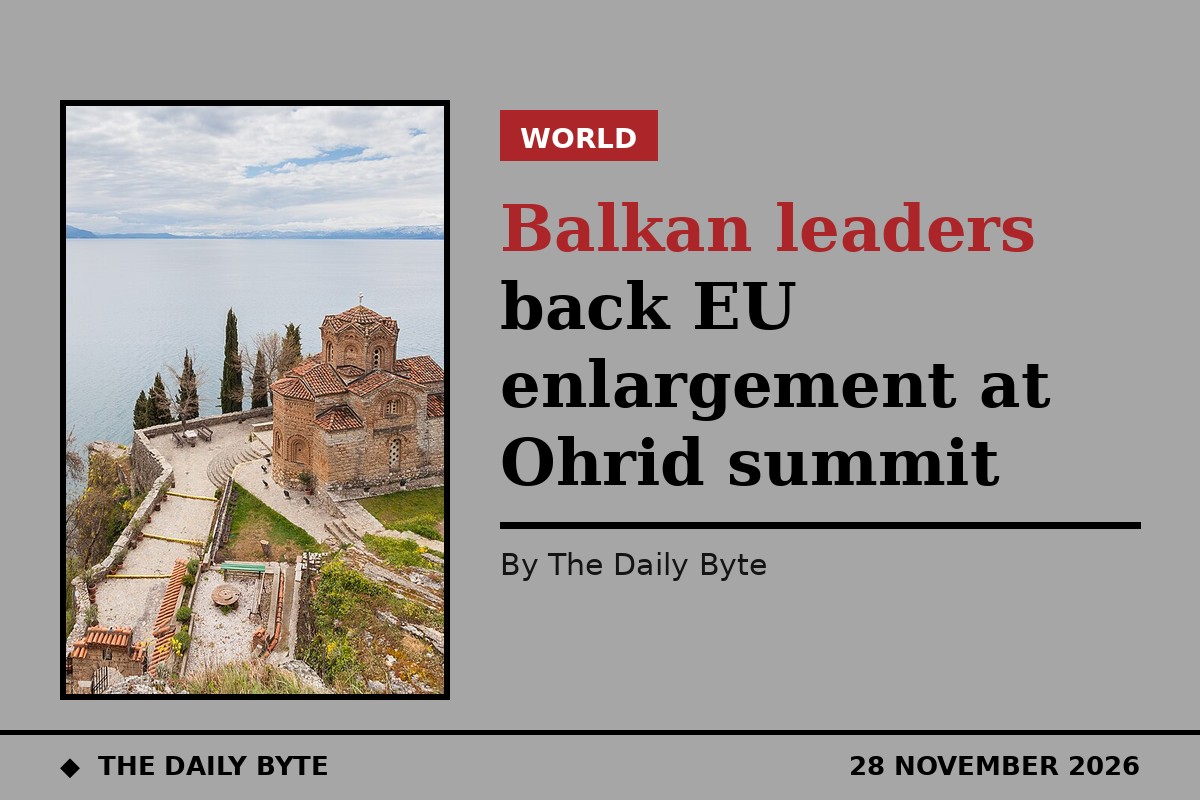
Presidents and leaders from across the Western Balkans met in Ohrid, North Macedonia, on 27 November for the annual Brdo-Brijuni summit, describing it as the most constructive gathering yet, even though no formal decision was taken. The meeting brought together the region's leaders to discuss European Union enlargement and closer regional cooperation.
The summit was hosted by North Macedonian President Gordana Siljanovska Davkova, together with Slovenian President Natasa Pirc Musar and Croatian President Zoran Milanovic. Also attending were Albanian President Bajram Begaj, Montenegrin President Jakov Milatovic, the three members of Bosnia and Herzegovina's presidency, Zeljka Cvijanovic, Denis Becirovic and Darijana Filipovic, and Serbia's new interim president, Aleksandar Cupic. Kosovo was also represented at the talks.
Enlargement at the centre
EU enlargement was at the centre of the discussions. Montenegro, which is targeting EU membership in 2028, was held up as proof that enlargement is moving forward. President Milatovic said Montenegro's progress in the final stages of its accession negotiations sent a strong message to the whole region that enlargement is alive and that full membership of the European Union is a realistic and achievable goal. Siljanovska Davkova noted that Montenegro is at the door of Brussels and that Albania is also making progress, adding: "Regional progress is of great importance not only for the region, but also for the EU."
The host president also used the meeting to press North Macedonia's own case. She said her country faces a serious problem with bilateral issues that are not linked to the Copenhagen criteria, the EU's conditions for membership, and that this is not compatible with European principles and values. No door has been open for North Macedonia since 2013, she said, and she argued that the progress made by its neighbours is also North Macedonia's progress. Slovenian President Pirc Musar said: "I believe that a strong Europe is not possible without an enlarged EU." She added that Albania will host next year's meeting, and that the goals set when the process began have not changed: all Western Balkan countries should become EU members.
A border row in the background
A long-running border dispute between Croatia and Montenegro formed part of the background to the talks. Zagreb wants an agreement with Podgorica on the land border before Montenegro completes its EU accession, leaving the maritime boundary for later. Montenegro wants both borders resolved at the same time, fearing that once the maritime issue is settled, Croatia might unilaterally impose a maritime border that could disadvantage Montenegro. Croatian Prime Minister Andrej Plenkovic has dismissed resolving the dispute through international arbitration. Milanovic said that although no decision was taken at the meeting, the main gain was the parties' efforts to understand each other and their reasonable approach to differences of opinion.
The Brdo-Brijuni Process was launched in 2013 by Slovenia and Croatia to support the EU membership processes of the Western Balkan countries. This year's meeting had originally been planned for May, but was cancelled because of disagreements between Serbia and Croatia, and the organisation of the meeting was later transferred to North Macedonia. Milanovic described the Ohrid meeting as the most constructive and positive yet. The test now is whether the goodwill in Ohrid turns into concrete progress: Montenegro's accession, Albania's advancing negotiations, and a way forward for North Macedonia, whose path has been blocked for more than a decade.


