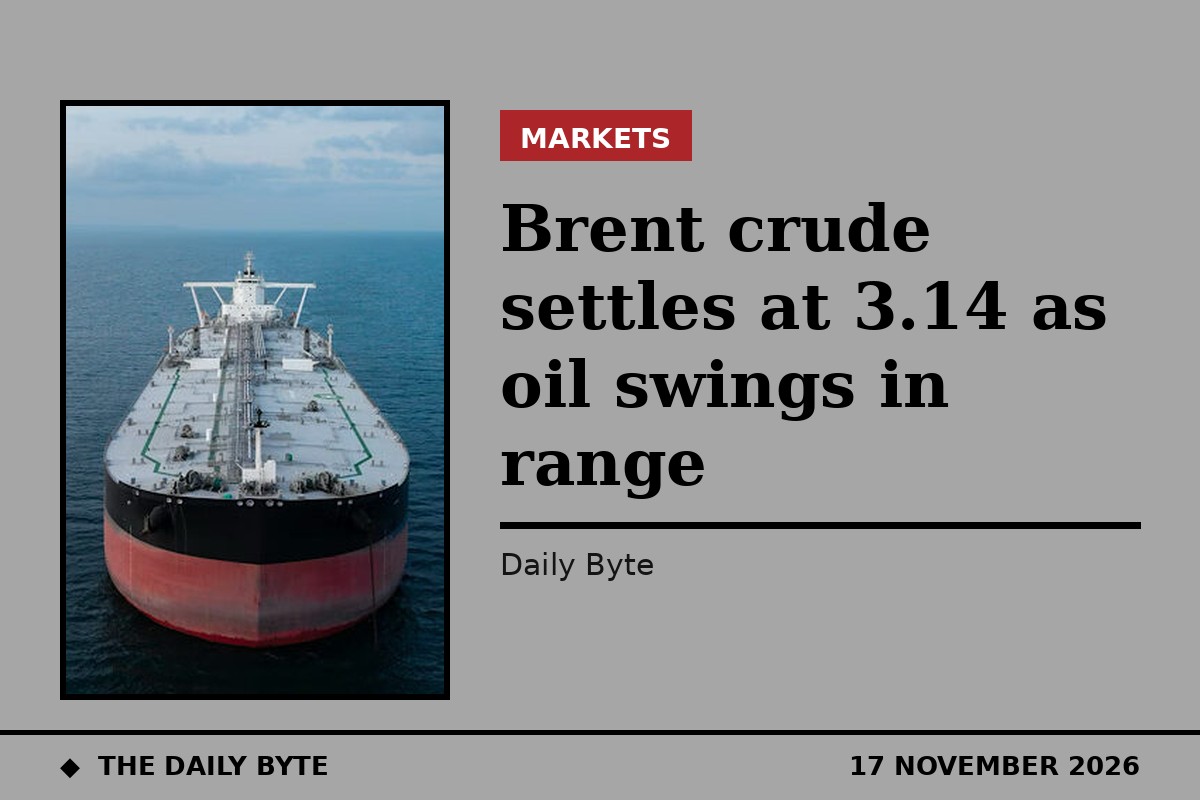
Brent crude settles at $93.14 as oil swings in $3 range on Gulf attacks and surplus fears
By aminah
·18 Nov 2026
·4 min read
Brent crude settled higher on Tuesday 17 November 2026 after a choppy session in which prices swung in a roughly $3 range, as renewed fighting in the Middle East clashed with forecasts of a growing global oil surplus. Brent for January settlement gained 0.8% to settle at $93.14 a barrel, while US West Texas Intermediate (WTI) for December delivery rose 0.3% to settle at $86.01 a barrel in New York, according to [Bloomberg via Rigzone](https://www.rigzone.com/news/wire/oil_prices_swing_as_gulf_attacks_continue-17-nov-2026-185107-article/).
The recovery came after a sharp early fall. Brent futures were down 82 cents, or 0.9%, at $91.62 a barrel by 0720 GMT, while WTI fell 83 cents, or 1%, to $84.89, according to [Reuters](https://froggyweb.com/2026/11/16/oil-slips-on-supply-surplus-outlook-despite-gulf-tensions/). Brent had reached an intraday high of $96.77 on Monday 16 November, so the early Tuesday low marked a pullback of about 5.6% from that peak.
## A surplus outlook weighs on prices
The International Energy Agency said on Friday that the world oil market will return to a surplus in the fourth quarter of this year. The agency said global crude inventories rebounded by more than 1.7 million barrels a day in October, the first increase since June, driven by strong exports from the Middle East.
The IEA has forecast a surplus of roughly 2 million barrels a day this quarter, while Goldman Sachs has flagged the risk of a glut next year. That outlook has capped prices even as regional conflict remains a live risk, and Brent's prompt spread — the difference between its two nearest contracts — has narrowed to around $2.80 a barrel in backwardation, from more than $3 a month ago, a sign that near-term supply conditions have become less tight.
Saudi Arabian output surged in October, while Saudi Arabia and the United Arab Emirates have both cut official selling prices. Oil flows through the Strait of Hormuz jumped 78% in the third quarter to 9.1 million barrels a day from the previous three months, according to the US Energy Information Administration, although they remain well below year-earlier levels.
## Gulf attacks keep a risk premium in the market
Even so, prices found support on Tuesday from fresh attacks in the Gulf. Vessel attacks were reported in and around the Strait of Hormuz, and Tehran targeted Bahrain for the third time in less than a week. Iran also threatened to retaliate against civilian infrastructure located near US or Israeli military bases if those countries target its similar sites. American warplanes, meanwhile, hit an Iranian missile launch site on Qeshm Island in the Persian Gulf, a US military official said.
"Crude oil prices should see some risk premium priced back into the market as tensions grow, while the latest flow data also points to a notable reduction in volumes in recent weeks," Ryan McKay, senior commodity strategist at TD Securities, said, as reported by Bloomberg.
The number of empty tankers sailing to collect cargoes of Middle East crude is sliding, according to Tankertrackers.com, a firm that monitors vessel movements, potentially jeopardising a recent revival in regional oil flows that has weighed on futures.
## A pattern of Friday gains and early-week falls
Brent has settled into a pattern of Friday gains on weekend fears of escalation in the US-Iran war and sharp early-week declines when those fears do not materialise, Bloomberg reported. In between, prices have whipsawed as tensions simmer.
Some traders appear to be "bottom fishing", seeing an opportunity to buy oil at a bargain after Monday's sell-off, Arne Lohmann Rasmussen, chief analyst at Global Risk Management, said. "But in general, a very nervous market."
Iran is "seriously pursuing an exit from the 'neither war nor peace' situation through dignified diplomacy", President Masoud Pezeshkian said, according to the semi-official Iranian Students' News Agency. Brent is up more than 50% this year, as on-and-off talks between the US and Iran have failed to broker a resolution to a war that sent energy prices soaring and stoked global inflation.
## Frequently asked questions
**What did Brent crude settle at on 17 November 2026?**
Brent for January settlement gained 0.8% to settle at $93.14 a barrel, while WTI for December delivery rose 0.3% to settle at $86.01 a barrel.
**Why did oil prices fall early on 17 November 2026?**
Prices fell early in the session on expectations of a supply surplus, after the International Energy Agency said the world oil market will return to a surplus in the fourth quarter and inventories rebounded in October.
**Why did oil recover later on Tuesday?**
Renewed attacks on vessels around the Strait of Hormuz, Iran targeting Bahrain, and a US strike on an Iranian missile launch site on Qeshm Island put some risk premium back into prices.
Sources: [Bloomberg via Rigzone](https://www.rigzone.com/news/wire/oil_prices_swing_as_gulf_attacks_continue-17-nov-2026-185107-article/); [Reuters](https://froggyweb.com/2026/11/16/oil-slips-on-supply-surplus-outlook-despite-gulf-tensions/).
Source
Bloomberg via Rigzone — https://www.rigzone.com/news/wire/oil_prices_swing_as_gulf_attacks_continue-17-nov-2026-185107-article/