Brent crude slips below $92 as IEA surplus outlook outweighs Gulf tanker tensions
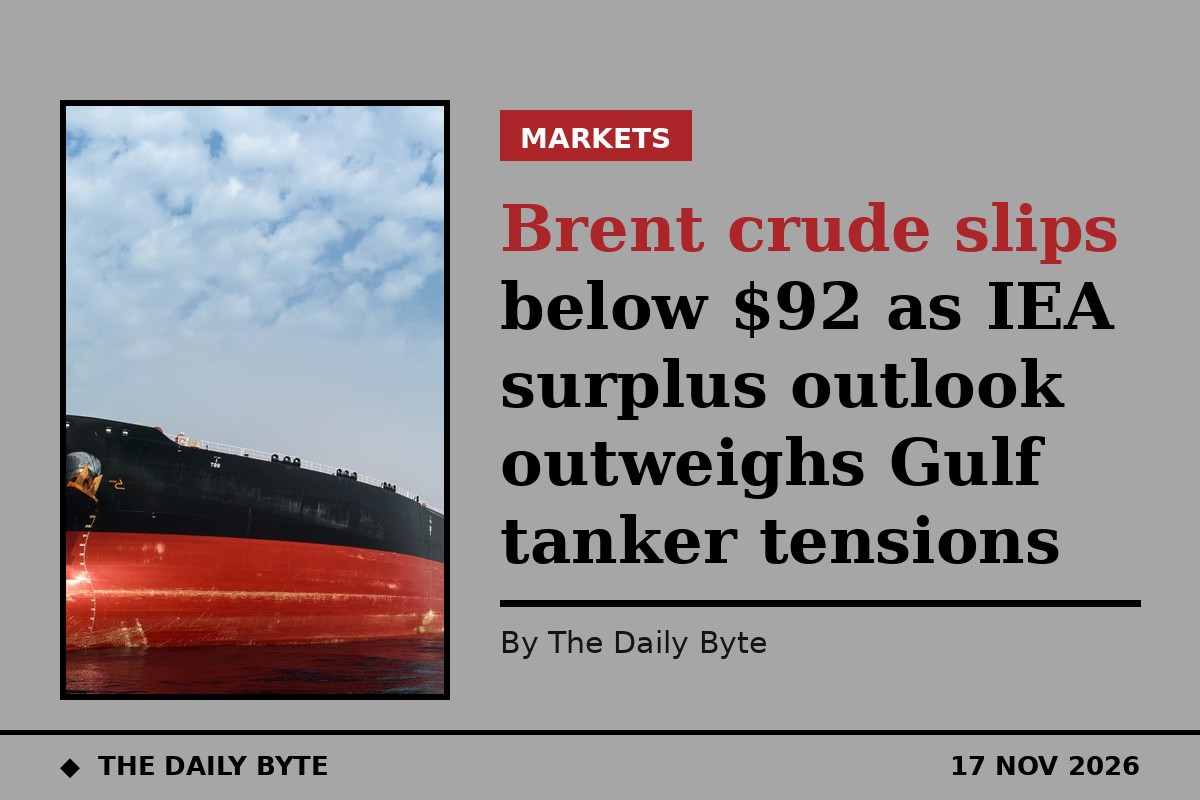
Brent crude slipped below $92 a barrel on Tuesday 17 November, as expectations of a global oil supply surplus outweighed concerns about continued attacks on tankers and energy infrastructure in the Gulf.
Brent crude futures were down 82 cents, or 0.9%, at $91.62 a barrel at 0720 GMT, Reuters reported, while US West Texas Intermediate (WTI) futures fell 83 cents, or 1%, to $84.89. A later reading put Brent at $91.71, down 72 cents, at 1404 Singapore time, according to data from OilPrice.com cited by the Dubai Standard.
IEA points to a surplus
The International Energy Agency (IEA) said on Friday that the world oil market would return to a surplus in the fourth quarter of this year, as Middle East exports recover faster than global oil demand despite attacks on shipping. That forecast has become the main driver for traders this week.
"Oil is recalibrating lower as the market increasingly accepts that supply has finally caught up with demand and may now be set to exceed it. That shift in the supply-demand balance is the main factor weighing on prices today," Tim Waterer, chief analyst at KCM Trade, told Reuters.
Brent had reached an intraday high of $96.77 on Monday, according to Investing.com data cited by Upstox, so Tuesday morning's level was about 5.6% below that peak.
Gulf risks have not gone away
The fall came despite continuing tension in the Gulf. Iranian attacks on US bases in Bahrain and disruptions to shipping in the Strait of Hormuz have continued, Reuters reported, keeping uncertainty around one of the world's most important oil-export routes.
"The geopolitical risk premium from the US-Iran conflict has not disappeared, but it is clearly taking a back seat for now," Waterer said.
Analysts at ANZ said in a note that throughput in the Strait of Hormuz was only 49% of pre-war levels, and that supply flows were vulnerable because more oil must travel by alternative routes exposed to disruption or logistical constraints.
OPEC meets to set 2027 output
OPEC held an online meeting on Monday to discuss its review of members' maximum sustainable production capacity, a key exercise that will help determine OPEC+ output quotas for 2027 and beyond. The wider OPEC+ group, which includes allies led by Russia, is due to meet on 29 November to decide output policy for 2027.
Elsewhere, stocks of crude oil in the US Strategic Petroleum Reserve fell to 276.4 million barrels last week, the lowest level since August 1982, according to data from the US Department of Energy cited by Reuters. The recent drawdowns have been part of a US agreement to release 172 million barrels from the facility.
Oil prices move throughout the day, and the figures in this report are those reported in morning trading on Tuesday. This article reports market movements; it is not investment advice.
Sources: Reuters via KRRO, Oil slips as recovering Middle East exports blunt Gulf tensions; Dubai Standard, Oil prices decline despite ongoing Gulf security concerns.
Frequently asked questions
What was the Brent crude price on 17 November 2026? Brent was down 0.9% at $91.62 a barrel at 0720 GMT on Tuesday, according to Reuters.
Why did oil prices fall? The IEA forecast a return to a global supply surplus in the fourth quarter of 2026 as Middle East exports recover faster than demand, outweighing Gulf shipping risks for now.