Brent's $20 war premium could vanish on Hormuz deal
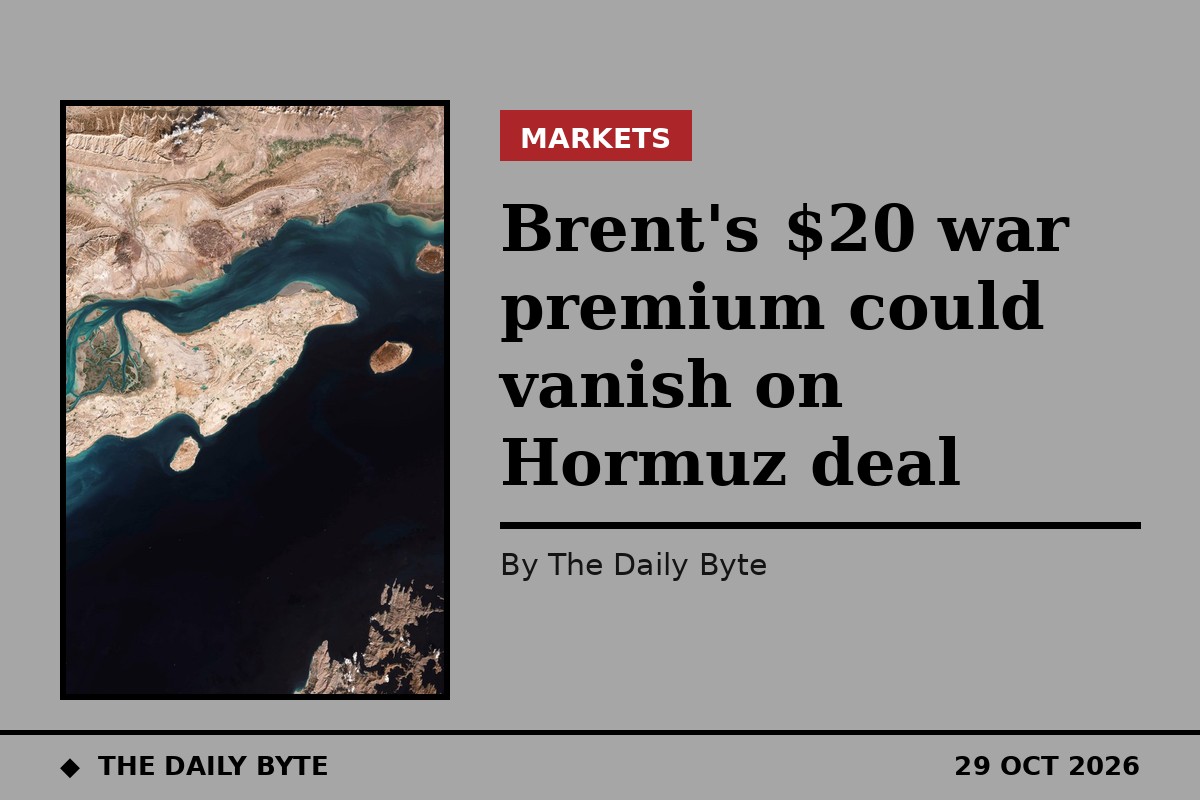
Analysts at JPMorgan have put a number on how much of today's oil price is fear, not fundamentals. Eight months into the war with Iran, their model puts Brent crude's fair value at $94 a barrel, yet Brent is trading near $114 — almost $20 above what fundamentals imply. The bank's analysts asked whether the gap is simply geopolitical risk.
Freight does not explain the gap
The bank found no evidence that higher shipping costs account for the difference. That leaves geopolitical risk around the Strait of Hormuz as the likelier explanation, though the analysts said they have never been fully comfortable with a measurable risk premium. They tested conflict indicators, risk indices and safe-haven assets; none improved the model's fit. History warns against assuming the premium lasts: deviations of more than 5% above fair value have lasted 3.8 months on average before prices converged or slipped into a discount.
BMI sees a steep sell-off after a deal
Analysts at BMI, a Fitch Solutions unit, expect a preliminary Hormuz deal to trigger a steep sell-off, with a deal likeliest in early 2027, BeInCrypto reported. BMI projects Brent averaging $107 a barrel this quarter and $112 in the first quarter of 2027, then $67 in late 2027 as rising OPEC and non-OPEC supply weighs. US Energy Secretary Chris Wright has called the spike temporary, while JPMorgan estimates crude delivered to Asia averaged $131 a barrel in October.
Neither forecast is a promise. BMI warns renewed high-intensity fighting could push prices above earlier war peaks, and JPMorgan concedes uncertainty can pull prices far from fair value. With OPEC+ producers due to meet on Sunday 1 November and United States midterm elections on 3 November, traders have two near-term dates that could shift the fear-fundamentals balance.
Sources: BeInCrypto, Rigzone.