Brent-WTI oil gap narrows as US crude draw lifts WTI
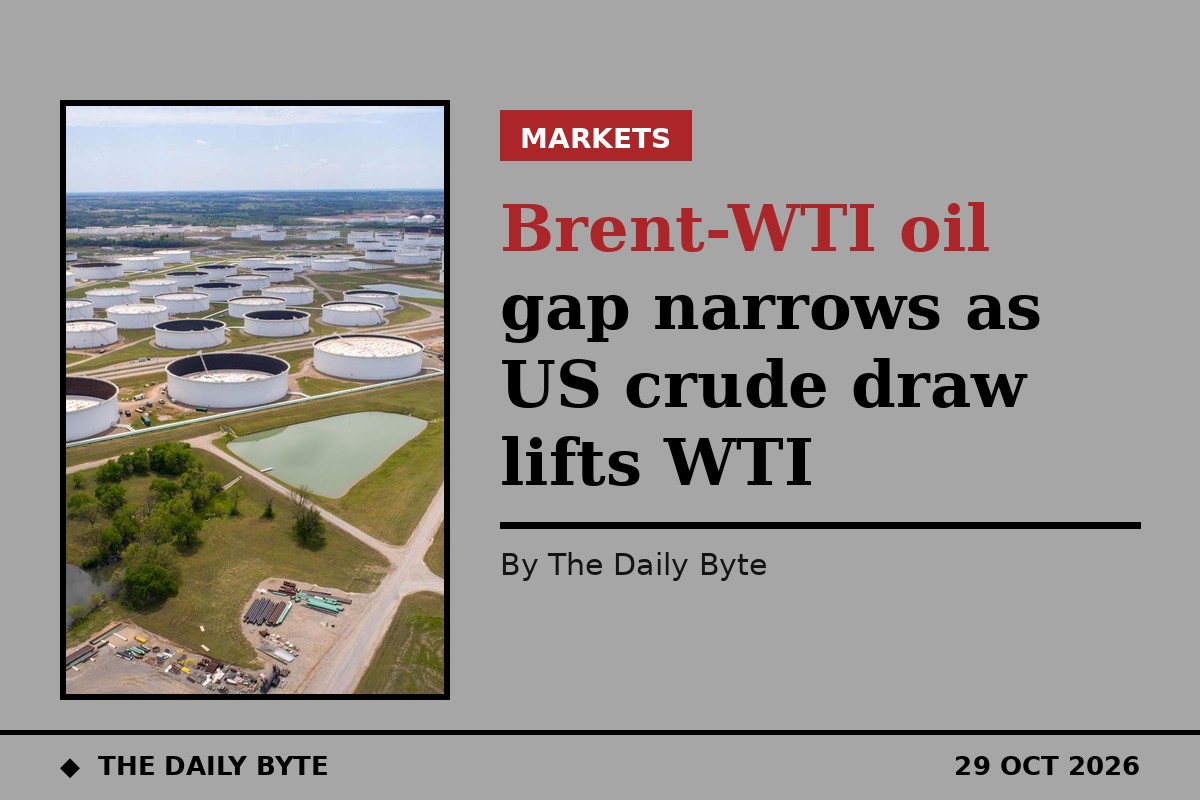
The gap between the world's two main oil benchmarks narrowed on Thursday 29 October 2026, as United States crude outperformed Brent after a larger-than-expected fall in American stockpiles. Brent, the seaborne global benchmark, eased to $115.18 in morning trading in Asia, while US West Texas Intermediate (WTI) held at $102.43, putting the spread between them at $12.76, per market data that day.
Why the gap is watched
On Wednesday 28 October, Brent rose 1.3% to settle at $115.32 a barrel, while WTI gained 3% to $102.78. The stronger WTI rise followed the US Energy Information Administration's report that commercial crude stocks fell by 1.9 million barrels in the week to 23 October, against analyst expectations of a small increase. By Thursday afternoon in London, Reuters reported Brent down 1.38% at $113.73 and WTI down 2.03% at $100.69, as hopes for revived US-Iran peace talks took some pressure off prices.
What traders watch next
Brent usually trades above WTI because it is loaded directly onto tankers for export, while WTI must travel by pipeline from Cushing, Oklahoma, to the Gulf Coast before reaching world markets. When Gulf shipping risk rises, Brent tends to carry more of the premium; when US stocks tighten, WTI catches up and the gap shrinks. Thursday's narrowing reflects easing diplomatic fears on one side and a tighter American stock position on the other.
Attention now turns to the OPEC+ meeting on Sunday 1 November, where the producer group is expected to review market conditions. No outcome has been decided in advance, and the meeting takes place against continued Houthi attacks and uncertainty over US-Iran diplomacy, so the spread — and the headline prices — remain sensitive to the next headline from the Gulf.
Sources: Reuters via Euronext, Vantage Markets.