Bright Daylight Linked to Lower Dementia Risk
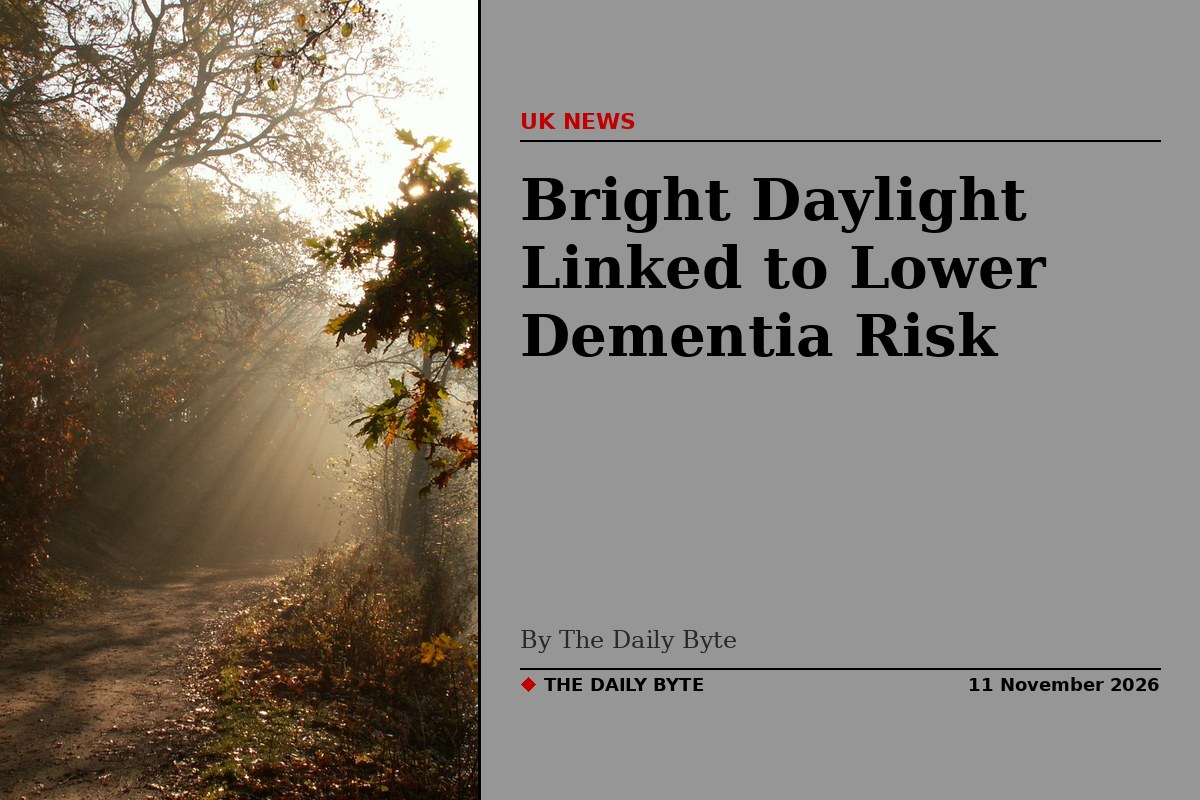
Bright daylight could be one of the simplest markers of brain health, according to a large study of more than 87,000 adults in Britain. People who spent more time in bright light during the day were less likely to develop dementia in the years that followed, with as little as 42 minutes a day linked to a lower risk.
The research, published in the journal General Psychiatry, used data from the UK Biobank. A total of 87,577 adults who did not have dementia wore wrist devices that measured light exposure for seven days. Researchers then followed them for a median of 8.1 years, during which 741 people developed dementia.
Adults whose average daytime light was above 1,000 lux, roughly the brightness of an overcast day outdoors, had a 16 percent lower risk of dementia than those who spent their days in dimmer light. Spending at least 42 minutes a day in light of 5,000 lux or more, typical of clear outdoor daylight, was linked to a 17 percent lower relative risk.
Stronger link for night owls
The link was even stronger in some groups. For people who described themselves as night owls, greater daytime light exposure was linked with up to a 41 percent lower risk of dementia. People who carry the APOE e4 gene variant, the best-known genetic risk factor for Alzheimer’s disease, saw up to a 27 percent lower risk when they had more daytime light.
When researchers ranked light exposure against established dementia predictors using a machine-learning model, getting less than about 42 minutes of bright daylight a day outperformed six of them, including obesity, alcohol intake, air pollution, hearing loss and traumatic brain injury.
“Daytime light exposure may serve as a novel indicator of dementia risk,” said Hongliang Feng, the study’s corresponding author at Guangzhou Medical University in China, which led the research.
Association, not proof
The researchers are clear about the limits of the work. This was an observational study, so it shows an association rather than proving that daylight prevents dementia. People who spend more time in bright light may also be more physically active, more socially connected or healthier to begin with, and those factors are hard to separate fully.
Light was also measured for only one week, which may not reflect a person’s habits across years or seasons, and a wrist sensor does not capture exactly how much light reaches the eyes. Night-time light exposure showed no significant link to dementia risk either way.
The authors suggest the link may run through the body’s internal clock. Bright daytime light helps keep circadian rhythms stable, and disrupted rhythms are common in people with dementia. Participants exposed to more daytime light also tended to have greater brain volume in parts of the medial temporal lobe, a region important for memory and often one of the first affected by dementia.
Why it matters as days shorten
The findings are drawing fresh attention as days shorten in the northern hemisphere. Most people now spend nearly 90 percent of the day indoors, where artificial lighting typically provides only around 300 to 500 lux, far below the 1,000 lux linked with lower risk in the study. Even a cloudy midday outdoors usually exceeds that level.
The study does not amount to a prescription, and no clinical trial has yet tested whether deliberately increasing daylight lowers dementia rates. But the authors say brighter daytime light could be a low-cost strategy worth studying further, particularly for people at higher risk. Anyone concerned about memory changes, or with a family history of dementia, should talk to a doctor rather than relying on light alone, and nobody should look directly at the sun.