Brussels Kanal Museum Opens in Former Citroën Garage
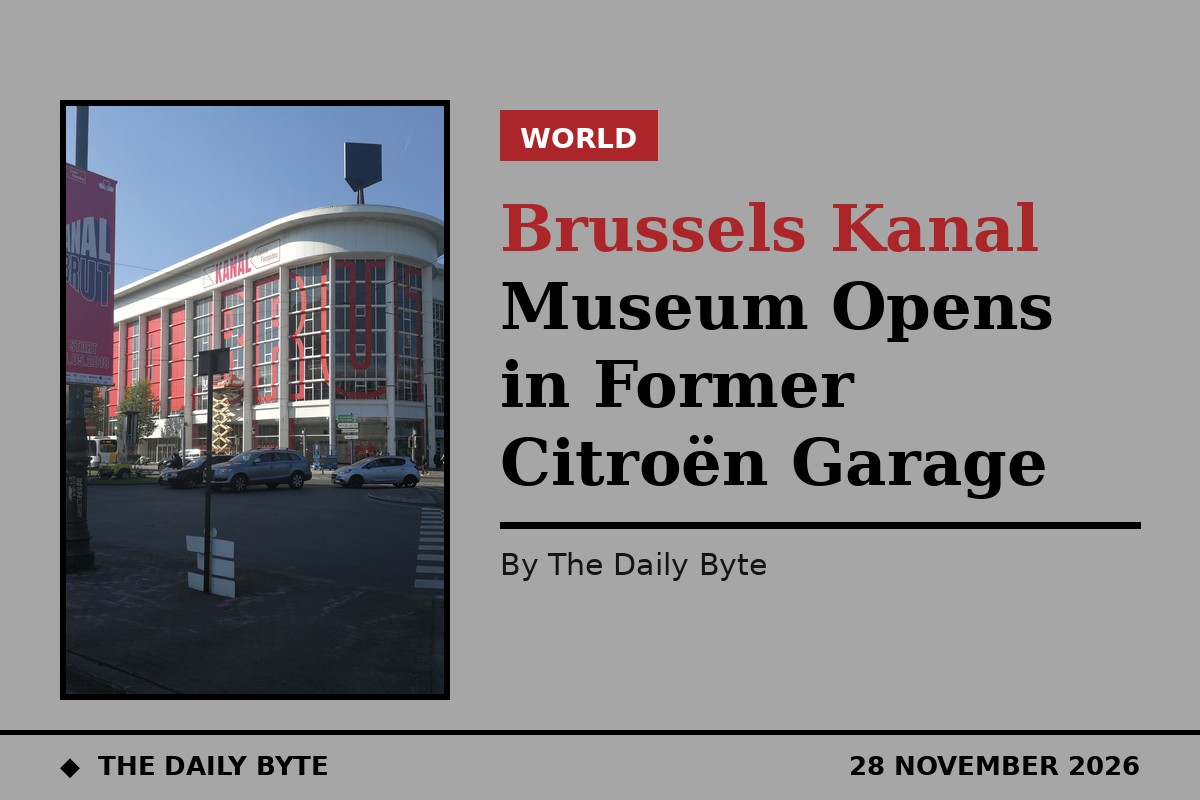
Brussels has opened Kanal, a vast new museum of modern and contemporary art, in the former Citroën garage on the city's canal, giving the Belgian capital its first dedicated museum of modern and contemporary art.
The museum opened to the public on Saturday, 28 November 2026. Spread over 40,000 square metres on the banks of the Charleroi–Brussels Canal, it is described as Europe's largest museum development, and it is larger than the original Tate Modern in London.
The building, at Square Sainctelette on Place de l'Yser, was built in 1933–34 as a garage and showroom for the car maker Citroën. After a decade-long transformation costing a reported €230 million, it now holds galleries, performance spaces, a library, a bakery, restaurants and a rooftop bar, with more than half of its floor space open to the public free of charge.
A cathedral for cars becomes a museum
The old garage was known as a cathedral for cars. Its curved glass showroom, with interiors 20 metres tall, was designed by Maurice-Jacques Ravazé with Alexis Dumont and Marcel Van Goethem, and it dominated the northern edge of the city centre for almost a century.
The conversion was designed by Atelier Kanal, a consortium of the architecture studios EM2N, noAarchitecten and Sergison Bates, which won the design competition in 2017. The architects say they took a light-touch approach, restoring most of the original building fabric and keeping its industrial character rather than rebuilding it.
"Our ambition has been to trust the building as we found it, embracing its industrial character and many layers of use," Atelier Kanal said.
Three new volumes were inserted inside the old structure. One, four storeys high with a basement level, holds the art galleries. Another houses a 378-seat auditorium and the museum's offices. The third is the new home of Kanal Architecture, formerly CIVA, the city's museum and archive of architecture. The former showroom has become a gallery topped by a publicly accessible rooftop.
A museum that is also a city
Kanal is designed to work as much as a public place as a museum. More than 20,000 square metres of the complex is permanently open to the public without a ticket, including a library holding 65,000 books, a bookshop, workshop spaces and an indoor playground designed by the Turner Prize-winning collective Assemble.
"It's a true city within a city," said Yves Goldstein, the museum's director-general. The museum's own description is that it departs from the traditional museum and instead offers a place of civic gathering, responding to the growing absence of shared public spaces in cities.
The opening programme runs to ten exhibitions involving more than 250 artists. Its centrepiece is A Truly Immense Journey, 100 Years of Masterpieces Centre Pompidou Collection, which brings together more than 350 works from the early twentieth century to the present day. Kanal Architecture opens with Right to the City – Right to the Future, an exhibition about Brussels as an incubator of architectural activism.
A partnership with Paris
The artistic programme was developed with the Centre Pompidou in Paris, which is lending works, curatorial expertise and its name under a partnership signed in 2017 that runs until 2031 and costs Kanal a reported €2 million a year. The Paris centre itself is closed for a major renovation, which makes the Brussels opening its most visible outpost for now.
The project has not been without argument in Brussels. Critics have questioned the cost — reports said the Brussels region had to provide a further loan of about €60 million in 2026 to finish the building — and some see the alliance with a French institution as a slight to the city's Dutch-speaking community.
Entry is free during the opening weekend. Afterwards, the public spaces will remain free and unticketed, while exhibition tickets will cost €24. For a city that has long been described as the de facto capital of Europe yet never had a museum of modern and contemporary art of its own, Kanal finally fills that gap.


