BSP Signals More Hikes as Philippine Inflation Hits 7.8%
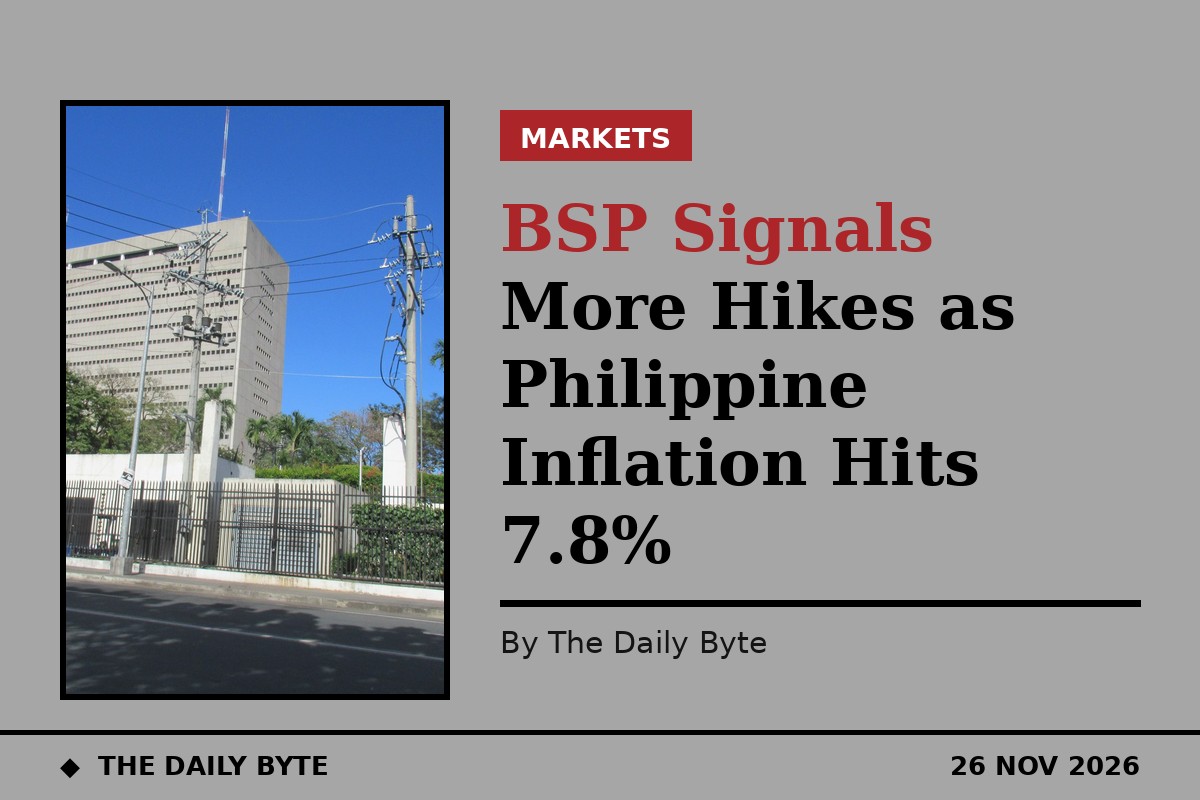
The Philippine central bank is unlikely to pause its run of interest rate rises at its final meeting of the year, Governor Eli Remolona Jr. has said, even as the economy grows at its slowest pace in years.
Remolona told reporters at a briefing on Monday that a pause at the Monetary Board's meeting on 17 December was "possible but unlikely". Inflation, he said, remains the central bank's first consideration.
"We have to rein in inflation because our target is at 3% and we're still at 7.8%," he said. "We will tighten as much as we need to."
Consumer prices rose 7.8% in the year to October, up from 7.2% in September and 1.7% a year earlier. That was the highest reading since February 2023, and inflation has now averaged 5.6% over the first ten months of the year, well above the government's 2% to 4% target range. Remolona said inflation could reach 8% in November.
The Bangko Sentral ng Pilipinas (BSP) raised its target reverse repurchase rate by 50 basis points to 5.5% in October, its fourth increase since April, taking total tightening since then to 125 basis points. Economists broadly expect another quarter-point increase in December, according to The Manila Times.
Growth is the other half of the dilemma
The case for holding rates rests on growth, which has weakened sharply. Gross domestic product grew 2.1% in the third quarter, the worst performance since the economy contracted by 3.8% in the first quarter of 2021, and the slowest outside the pandemic since 1.8% in the fourth quarter of 2009.
The nine-month average now stands at 2.5%, putting the government's full-year target of 3.5% to 4.5% further out of reach. The third-quarter reading came in weaker than the central bank had expected: growth was 2.4% in the second quarter, and officials had counted on a rebound led by faster public spending.
Remolona blamed much of the weakness on a fall in public construction. Government capital formation dropped 15% in the third quarter, after a 30% fall in the second, as a flood-control scandal delayed infrastructure work. Projects found to be substandard last year prompted corruption investigations and spending reviews, and the effort to impose discipline on that spending has slowed construction sharply.
Monetary policy alone cannot fix that, Remolona said. "We can't address the 2.1% growth with monetary policy. The effect of monetary policy has a long lag," he said. "What the economy needs now, and the government understands this, we need fiscal stimulus."
What happens next
The governor stressed that weak demand cuts both ways: it should help bring inflation down, so the central bank may not need to be as aggressive as it would otherwise be. But persistent inflation and expectations of further price rises could still force tighter policy, and decisions will rest chiefly on the inflation outlook rather than the latest monthly reading.
The BSP kept its inflation forecast for this year at 6.1%, raised its 2027 forecast to 6.0% from 5.4%, and held its 2028 projection at 3.3%. It expects inflation to stay elevated next year before easing towards the target in 2028.
There are small signs of improvement in expectations. In the central bank's survey of external forecasters, analysts on average expect inflation of 5.4% a year ahead, better than the 5.6% they expected in the previous survey. Remolona said growth may start recovering in the fourth quarter, adding that he hoped for "at least 3%".
For households and businesses, the message is that borrowing costs are unlikely to fall soon. The December decision will show whether the board follows the governor's signal with another increase, or whether the growth figures persuade it to wait.
Frequently asked questions
What is the BSP's current policy rate?
The target reverse repurchase rate is 5.5%, after a 50-basis-point rise in October 2026.
When does the BSP next decide on rates?
The Monetary Board meets on 17 December 2026, its final policy decision of the year.
How high is Philippine inflation?
Consumer prices rose 7.8% in the year to October 2026, the highest since February 2023, against the central bank's 3% target.


