Burnham: EU reset talks will go down to the wire
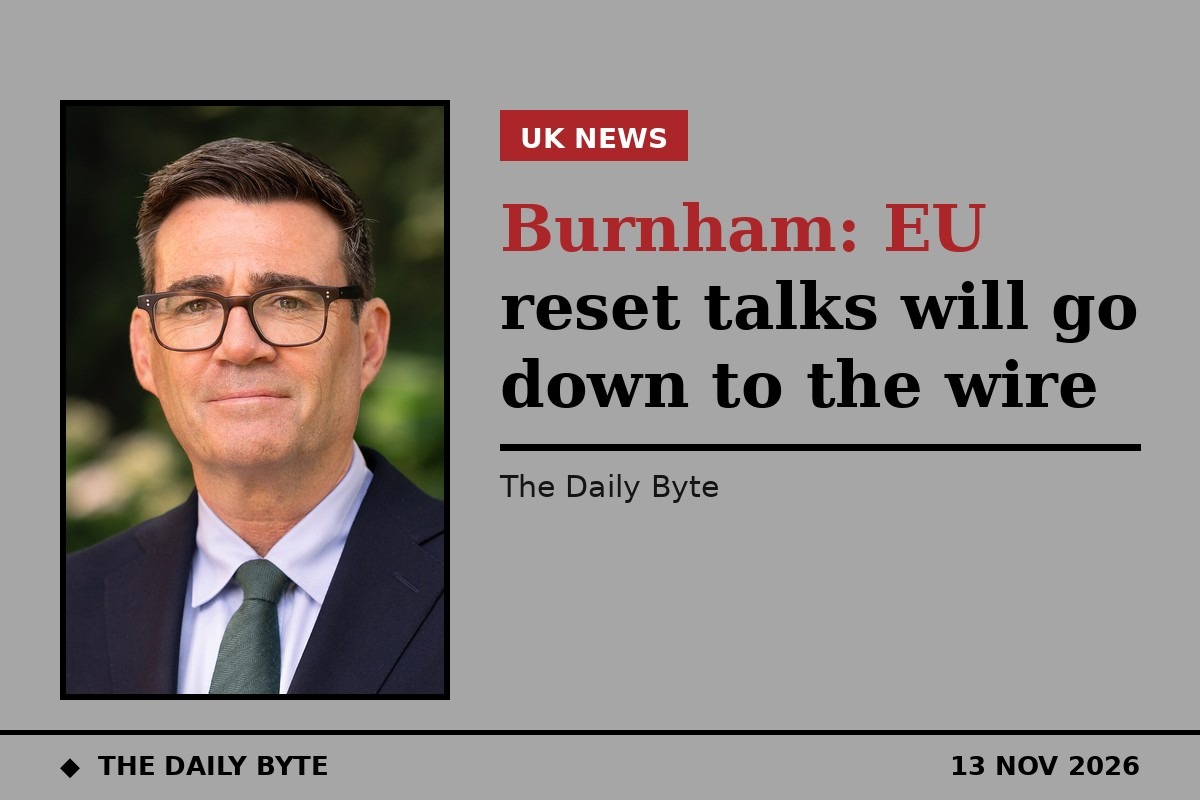
Prime Minister Andy Burnham has said negotiations over a new UK-EU reset deal will go down to the wire ahead of a summit in Brussels next week, after talks with European leaders in Dublin.
Speaking on Thursday after attending a gathering of European leaders in the Irish capital, Mr Burnham said he would keep fighting to get an agreement over the line before the summit on 20 November.
"I will fight now over the days to come to make sure we get this deal over the line," he said. "I suspect it will go down to the wire as these things probably will get hard, but we won't turn our back on these negotiations."
The Brussels meeting, where Mr Burnham will sit down with European Commission President Ursula von der Leyen and European Council President Antonio Costa, is seen as the first major test of his promise to rebuild closer ties with the EU more than a decade after Britain voted to leave.
Three deals on the table
The two sides are aiming to deliver three main agreements at the summit. The first would cut red tape for food exports by aligning sanitary and phytosanitary checks, the rules that govern trade in food, plants and animals. The second would link the UK and EU emissions-trading schemes, and the third would create a youth experience scheme.
An earlier draft of the summit text would allow young people from the UK and the EU to live in each other's territory for up to three years to work, study or travel. A text of roughly 200 pages on food checks went to EU ambassadors on 4 November, and ambassadors held a fresh round of talks on a draft summit statement on Wednesday.
The government estimates that the food agreement alone could add up to 5.1 billion pounds a year to the UK economy in the long run and lift the volume of major UK agricultural exports to the EU by 16 per cent. Mr Burnham hopes the package will help revive the economy and support his main objective of lowering living costs.
What is still unresolved
Officials on both sides warn that hurdles remain, most notably the EU's demand that European students should be able to attend British universities at reduced rates. Britain is also pressing not to be left out of the EU's Made in Europe industrial push, which would favour EU-origin content in public procurement and industrial support.
A senior EU diplomat told the AFP news agency that the three deals appeared to have largely been wrapped up, but that debate continued over the choreography of how the different agreements fit together. Diplomats in Brussels remain upbeat about the prospects for a successful summit, even as both sides continue to argue over the details.
After meeting Mr Burnham in Dublin, Ms von der Leyen wrote online: "Let's make it a summit of ambition and concrete results. More opportunities for young people. Easier agrifood trade. And a stronger cooperation on economic security."
Why the summit matters for business
For British exporters, the food agreement is the most commercially significant item. Since Brexit, checks and paperwork on animal and plant products have added cost and delay for farmers and food producers selling into the EU, and businesses on both sides have pressed for the burden to be reduced.
Linking the emissions-trading schemes would also matter for energy-intensive firms, while the youth scheme could open new routes for young Britons to live and work in Europe. Mr Burnham has said he believes a deal can be reached that works for both sides, describing it as a possible win-win and "more like the Brexit that people thought they were voting for in 2016".
The Brussels summit is the second formal UK-EU summit since Brexit and the first since the strategic partnership agreed in London on 19 May 2025. A follow-up meeting planned for July was postponed after Sir Keir Starmer resigned, and Mr Burnham, who took office that month, has also floated the possibility that Britain could one day apply to rejoin the bloc. He has pledged to set out different options for Britain's future relationship with the EU around the time of the summit.