Burnham opens 10-point Labour lead in new poll
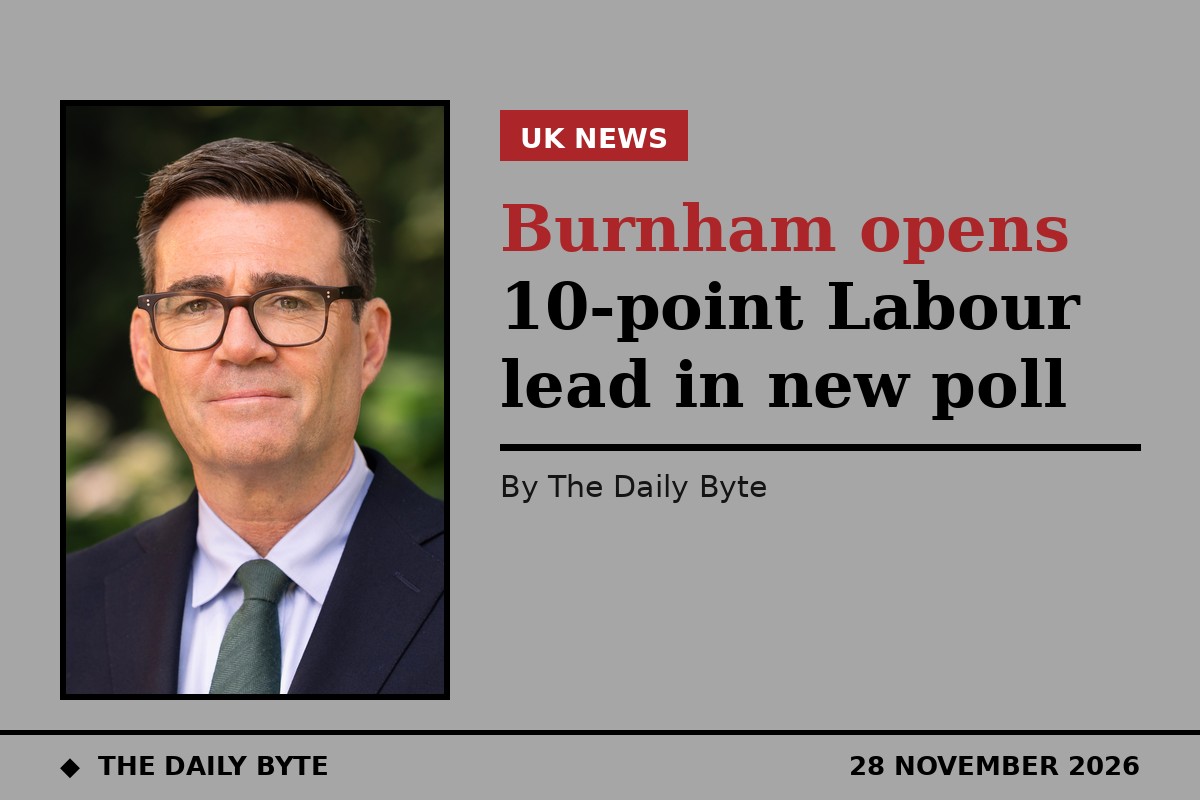
Labour has opened a 10-point lead over the Conservatives in a new opinion poll, its largest advantage since the 2024 general election, as Prime Minister Andy Burnham's push for a closer relationship with the European Union divides opinion across the country. The survey by BMG Research for The i Paper puts Labour on 32 per cent, the Conservatives on 22 per cent and Reform UK on 20 per cent. It is the first time Reform has fallen to third place since March 2025. The poll questioned 1,504 adults in Great Britain between 24 and 26 November.
The findings suggest Labour's lead has been building steadily since Mr Burnham took over as prime minister in July, following the departure of Sir Keir Starmer. At the last general election the Conservatives won 24 per cent of the vote before falling to 18 per cent in polling; they have since recovered ground, but remain 10 points behind Labour in the latest survey. Reform, which polled 35 per cent in August last year against Labour's 20 per cent, has now slipped to 20 per cent.
Rejoining the EU: voters split
The same poll asked voters about rejoining the European Union, and found support for going back into the bloc at 43 per cent, against 37 per cent who want to stay out and 20 per cent who do not know. Support for rejoining has fallen by five points since the question was last asked, while support for staying out has risen by two points. The shift follows days in which Mr Burnham raised the prospect of a second referendum on EU membership, a move his critics have attacked.
A second survey, by More in Common for The Independent, offers Mr Burnham some encouragement on the substance of his EU reset deal. It found that 52 per cent of voters think it is worth risking a fresh row over Brexit if it brings a closer relationship with the EU, against 33 per cent who think it is not worth reigniting old divisions. The poll, of 2,533 adults between 20 and 23 November, also found that 55 per cent believe the deal benefits the UK, or the UK and the EU equally, while 31 per cent think the opposite.
The deal itself brings a long-awaited youth mobility scheme and an end to food and drink checks at the border. Luke Tryl, the executive director of More in Common, said the agreement had landed well with the public. He added that while few voters want a return to the Brexit arguments of 2016 to 2019, more than half think reopening the debate is worthwhile if it brings Britain closer to Europe.
What voters think Burnham wants
The polling also reveals what voters think Mr Burnham himself wants. The largest group, 39 per cent, believe the prime minister is trying to rejoin the EU, while 34 per cent think he wants a closer relationship that stops short of membership and 13 per cent believe he wants to keep things as they are. Two-thirds of those questioned said rejoining would require a referendum, and Mr Burnham has conceded that it would be unthinkable to rejoin without another public vote.
The debate has exposed divisions inside the cabinet, with ministers split over whether to reopen the EU question at all. On the right, Conservative leader Kemi Badenoch announced on Friday that all of her party's parliamentary candidates will have to sign a new Conservative Candidate Covenant, committing them to leaving the European Convention on Human Rights, staying out of the EU and scrapping what she calls unaffordable net zero policies before they can stand at the next general election. She has accused Mr Burnham of looking backwards and said reopening the Brexit debate is the last thing the country needs.
Reform UK has also attacked the prime minister's approach. A senior Reform source told The i Paper that Mr Burnham had made a big mistake by raising the prospect of a second referendum. The party's fall to third place in the BMG poll underlines how far its fortunes have changed since last summer, when it led the field.
For Labour, the poll numbers will be read as vindication of the decision to replace Sir Keir Starmer with Mr Burnham in July. The prime minister has made the cost of living his central theme, describing it as the issue of our times, and has promised a 10-year plan for the country. Whether the polling lead holds will depend in part on whether voters believe the EU reset delivers practical benefits, and in part on whether the debate over rejoining helps or hurts a government that insists it has no fixed destination in mind for the UK-EU relationship.
Frequently asked questions
What does the latest poll show? BMG Research for The i Paper puts Labour on 32 per cent, the Conservatives on 22 per cent and Reform UK on 20 per cent, a 10-point Labour lead.
What do voters think about rejoining the EU? The BMG poll found 43 per cent support rejoining, 37 per cent want to stay out and 20 per cent do not know.
When was the poll carried out? BMG questioned 1,504 adults in Great Britain between 24 and 26 November 2026.


