Burnham rejects Welsh devolution powers bid
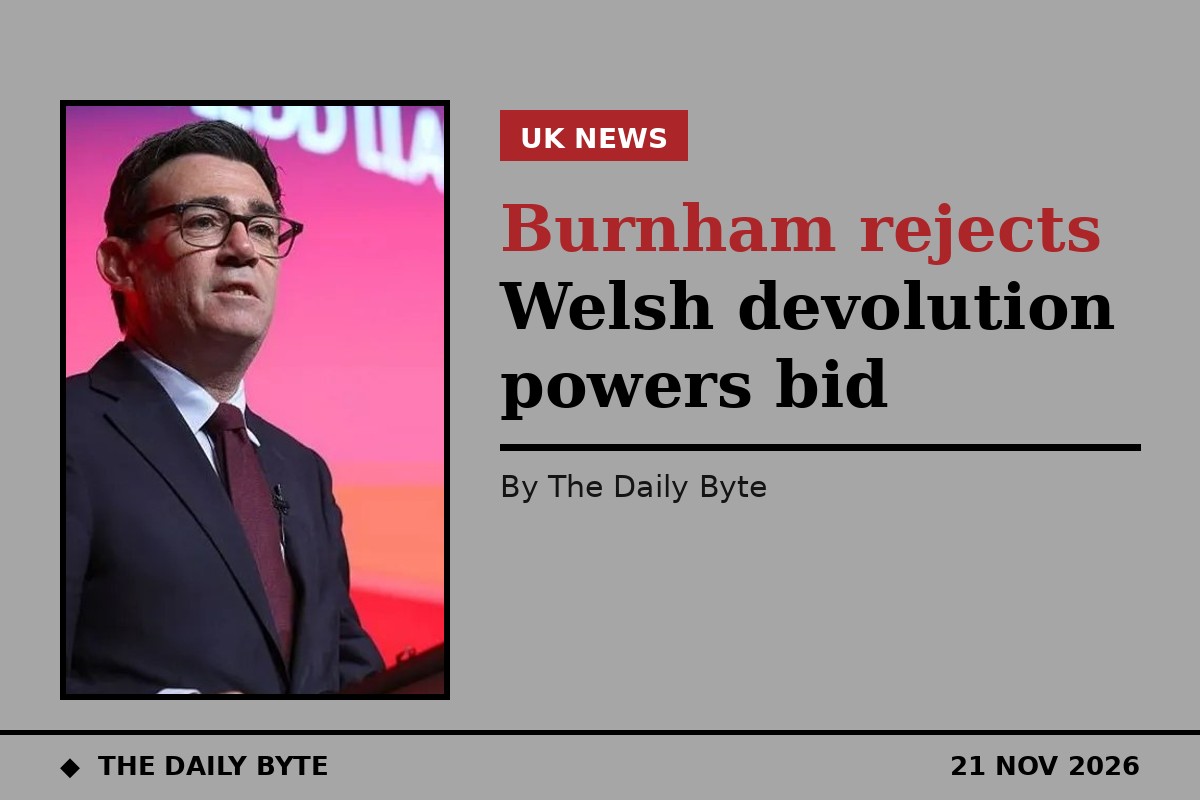
Prime Minister Andy Burnham has rejected long-standing calls from the First Minister of Wales for powers over policing, justice, the Crown Estate and rail infrastructure to be transferred from Westminster to Cardiff.
In a letter to Rhun ap Iorwerth, seen by BBC Wales, Burnham said he was "not persuaded" by the case for devolving any of the four areas. The First Minister accused the prime minister of "turning his back on devolution" and of not viewing Wales as an "equal nation".
The letter, sent on Friday, follows what had been seen as positive talks between the prime minister and the first minister in Glasgow last month. Asked about Burnham's position on devolving policing after that meeting, ap Iorwerth said: "I think instinctively the prime minister wants to go there." Burnham had also previously said he was "open" to the idea. His letter now closes that door, at least for now.
Policing and justice stay shared
On policing, Burnham argued that the integrated system shared by England and Wales must stay intact. "The integrated England and Wales policing system is essential to maintaining interoperability, enabling seamless cross-border working and ensuring forces in Wales can draw on national and specialist capabilities," he wrote. "Retaining that integrated framework helps ensure policing in Wales can respond effectively to threats and to protecting the public."
He offered the Welsh government a clear role in policing governance, but said he was not persuaded that legislative devolution was necessary. On justice, he said he "strongly believes" the current settlement lets Wales "benefit from the resources, expertise and resilience" of a shared justice system, adding: "Effective partnership working is therefore essential to improving outcomes for victims, reducing reoffending and building safer communities."
Crown Estate and rail also refused
On the Crown Estate, Burnham said its "current model provides the best means of maximising the economic and social benefits for Wales". The estate's land belongs to the reigning monarch, and the revenue from its property portfolio goes directly to the UK Treasury, with the level of profit used as a benchmark to calculate the funding given to the Royal Family. The previous Welsh Labour government, as well as the current administration in Cardiff, have long called for it to be devolved.
Burnham went further than a simple no, saying the UK government is "not persuaded by the case for devolving the management of the Crown Estate in Wales, nor to prepare for a future transfer". On rail infrastructure, he told the first minister: "I believe funding and delivery of infrastructure is best done by the new Great British Railways, in collaboration with Transport for Wales and Welsh government. I am therefore not persuaded by the case for full devolution of rail infrastructure, as it would fragment the current system and affect the service provided to the public by the highly integrated cross border network."
Cardiff calls the reply deeply disappointing
A spokesperson for the first minister called the response "deeply disappointing" and accused Burnham of turning his back on devolution. "His warm words on devolution are now ringing hollow and there is no longer any doubt that when he talks of driving power out of Whitehall, he only means to the regions of England," they said. The spokesperson added that Burnham's "refusal to even explore the devolution of the Crown Estate, justice and policing, and rail infrastructure proves that the prime minister does not view Wales as an equal nation."
Burnham's position also puts him at odds with Welsh Labour leader Ken Skates, who reiterated at a party conference last weekend that policing and the Crown Estate should be devolved. The prime minister had told members of his party last week that Welsh Labour may have lost sight of some of the principles of devolution before it was thrown out of power in a historic election defeat.
The clash leaves a visible split at the top of British politics: a prime minister who says power should flow out of Whitehall, but not, for now, across the border to Cardiff on the questions Wales has asked about for years.