Burnham defends EU deal in Commons showdown
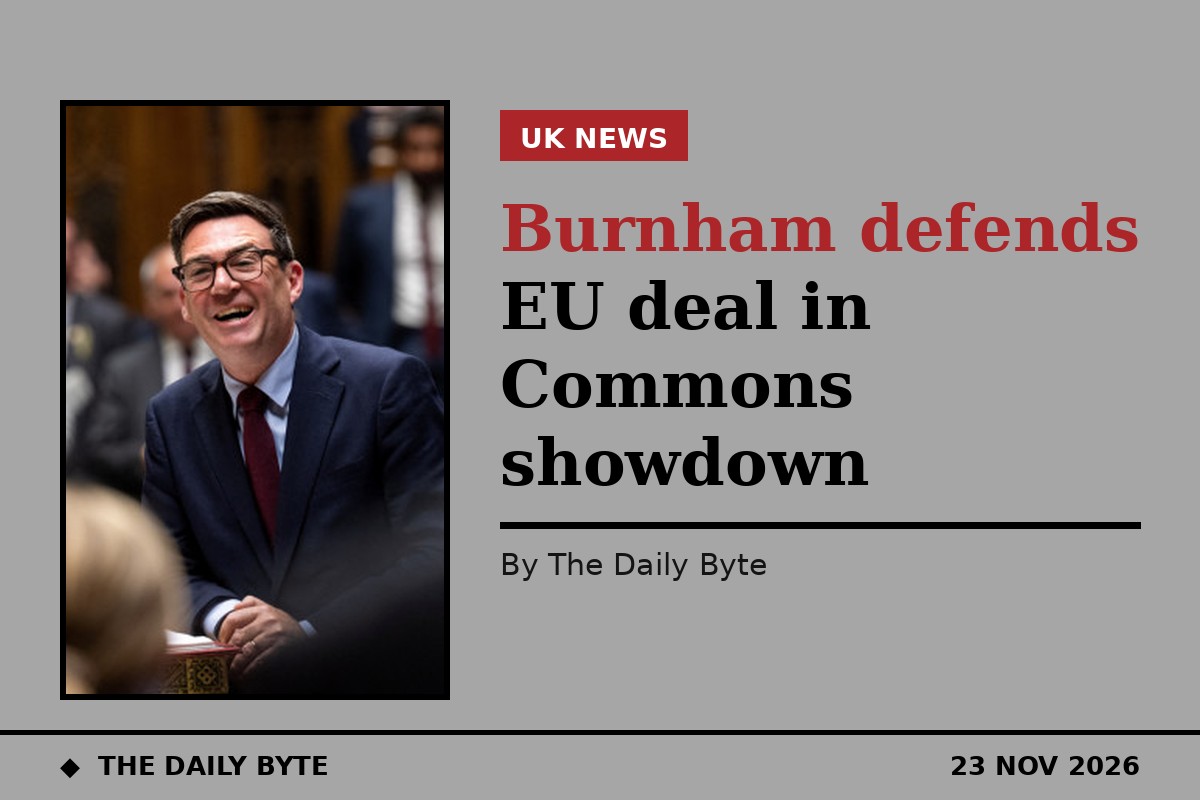
Prime Minister Andy Burnham has defended his agreement with the European Union in the House of Commons, calling it a landmark deal and the biggest growth measure of this parliament, as opposition MPs challenged his claim that it could add £17 billion to the British economy.
Mr Burnham presented the agreement, struck at a summit in Brussels on Friday 20 November, to MPs on Monday 23 November. He told the Commons there was a very real prospect that the next decade could be much better than the last, and framed the choice facing MPs as one between a broken status quo or change.
What the deal covers
The package covers food and farming exports, a link between the UK and EU emissions trading systems, and a youth experience scheme. Under the scheme, up to 100,000 young people aged 18 to 31 from each side will be able to live, work or study in the other territory for up to three years, with the scheme due to launch no later than January 2030.
The food agreement, formally known as a sanitary and phytosanitary agreement, will end most post-Brexit checks and restrictions on food and agricultural products from 1 March 2028. Mr Burnham told MPs he could guarantee that fruit growers sending apples and pears to Europe would see their produce arrive much more quickly, and said the Essex cockling industry, which struggles with paperwork delays, would benefit greatly.
The Prime Minister also visited a Morrisons regional distribution centre in Kent earlier on Monday, where he said cutting red tape would help retailers lower costs. Downing Street said the deal would lighten the load on shoppers, although it could not guarantee that prices would fall.
The £17bn claim disputed
The economic case was the sharpest point of dispute. Mr Burnham said Treasury analysis suggested the deal could add up to 0.5 per cent to UK GDP, which he put at a £17 billion boost. Conservative leader Kemi Badenoch accused him of having plucked the figure out of the air, saying the only modelling she had seen put the effect at 0.0 per cent.
The British Retail Consortium called the food agreement a big win for retailers, but said it did not expect prices on supermarket shelves to fall in response. Asked whether prices would come down, the Prime Minister's official spokesman said cutting red tape on food imports promised to ease a source of pressure on food prices.
No return without a vote
Mr Burnham rejected claims that the agreement was a prelude to another referendum on EU membership. Responding to Conservative MP Sir Edward Leigh, who warned the deal could reopen bitter divisions and even put the union at risk, he said it was not a prelude to anything, describing his approach as pragmatic.
Pressed by Sir Bernard Jenkin to say it would be unthinkable for any prime minister to take the UK back into the EU without a referendum, Mr Burnham replied: “Yes, it would be unthinkable.” He also dismissed advice from former prime ministers, including Rishi Sunak and Baroness May, who have urged him not to reignite the Brexit debate. Baroness May told the BBC on Sunday that she was aghast at talk of further negotiations.
Former chancellor Rachel Reeves and former deputy prime minister David Lammy, speaking from the back benches for the first time, congratulated Mr Burnham on the deal. MPs are expected to vote on the European Partnerships Bill, which would write the agreement into law, before Parliament rises for the Christmas recess. Mr Burnham said the deal would pave the way for further discussions on energy costs and on opportunities for touring musicians and artists.