C++26 finished again after first ballot failure
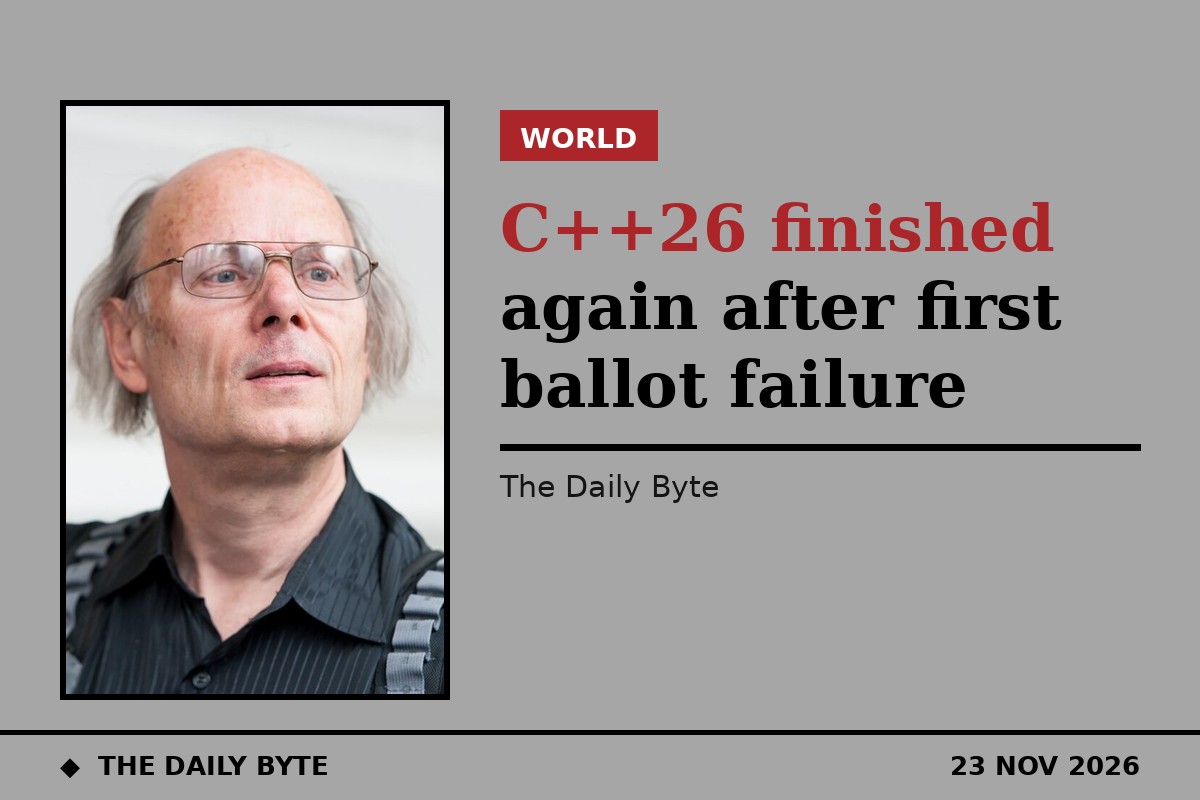
The ISO C++ committee has finished the technical work on C++26 for a second time, after the standard's first approval ballot failed — the first time a C++ draft has been turned back at that stage. The committee completed the rework at a six-day meeting in Búzios, Rio de Janeiro, Brazil, on 21 November 2026, and the updated document is now expected to go out for a second international approval ballot.
C++26 was first completed in March 2026, but its Draft International Standard (DIS) ballot did not pass unanimously. Five national bodies voted against it, and the document was sent back to the committee with further comments — most of them about contracts, the new pre, post and contract_assert feature. The committee spent most of the November meeting rehearing those comments and addressing them, rather than reopening the rest of the standard.
What changed in C++26 this time
The committee adopted an extension to contracts, paper P4451R2, which adds an always-enforced label for a contract assertion. It lets a programmer mark a specific contract so that it is always enforced, meaning execution will not continue past a violated assertion regardless of the enforcement semantics chosen for other contract assertions in the program. The extension was a direct response to requests from several national bodies during the ballot.
Three further papers were adopted for C++26, including P4466R2 on selectively transparent using-declarators and P4453R1 on memory allocation with senders and receivers, each answering a specific ballot comment. The committee rejected requests to remove contracts from C++26 altogether. When it voted to reship the standard with contracts retained, the result was 111 in favour, 9 against and 8 abstentions — 92.5% in favour, up from 90.5% at the March meeting. Support for adopting contracts in the first place, in February 2025, was 87.7%, with 100 in favour, 14 opposed and 12 abstaining.
What happens next for C++26
The committee is now producing an updated final document, which is expected to be sent out for its second DIS ballot, followed by final editorial work before ISO publishes it. The standard is therefore still not final, and the contracts semantics changed again after the first ballot failed — developers tracking C++26 adoption should check the new wording rather than relying on the March draft.
The meeting also adopted new features for the next standard, draft C++29, including labelled break and continue, std::ranges::any_view, views::slice and an 0o prefix for octal literals. Read the full trip report on Herb Sutter's blog and the summary of the Búzios meeting.
Frequently asked questions
Why did C++26 fail its first ballot? The first Draft International Standard ballot did not pass unanimously. Five national bodies voted against it, mostly over concerns about the contracts feature, and the document was returned to the committee for further work.
What are contracts in C++26? Contracts are preconditions, postconditions and assertions — written as pre, post and contract_assert — that let programmers state what a function expects and guarantees. They are the most controversial feature in C++26.
Is C++26 finished now? The technical work is complete for a second time, but the standard is not yet final. An updated document must pass a second DIS ballot and final editorial work before ISO publishes it.
Published 23 November 2026. Sources: Herb Sutter, ISO C++ committee trip report, November 2026; Lavx summary of the Búzios meeting.


