Cambodia Francophonie Summit draws 79 delegations
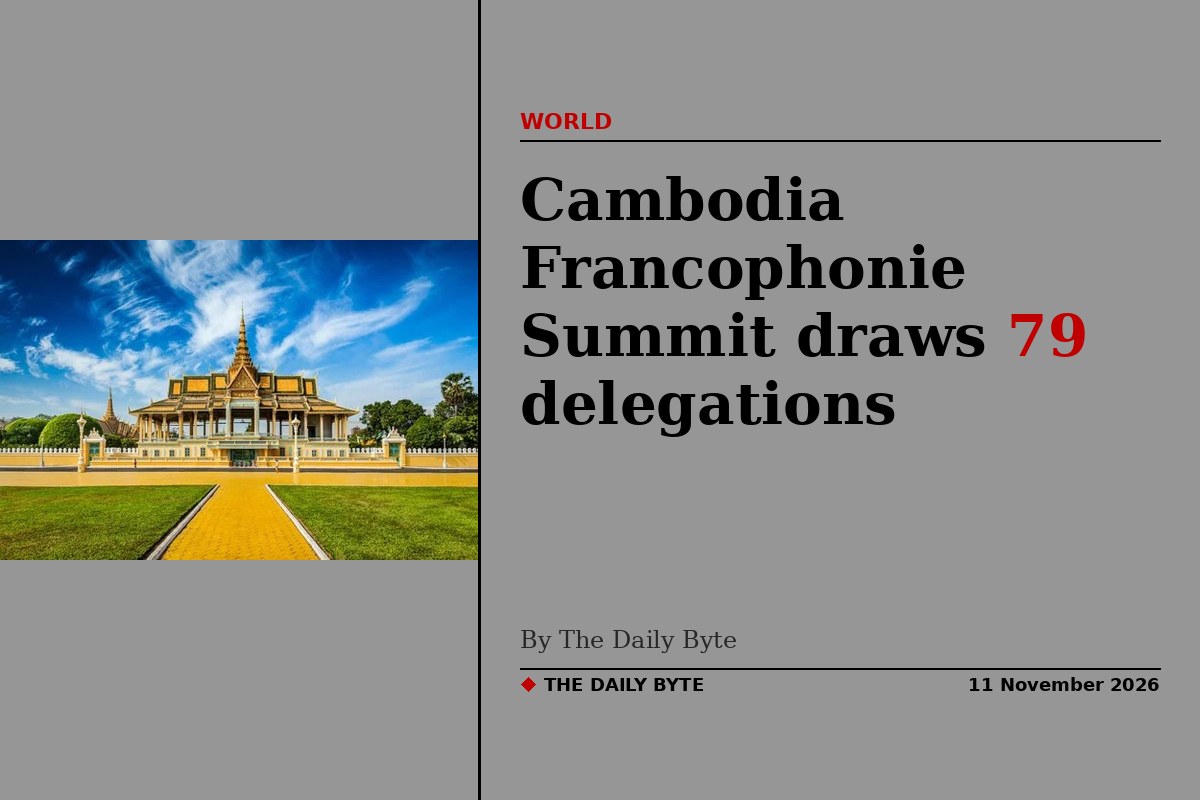
Cambodia has confirmed that 79 of the 90 expected delegations will attend the 20th Francophonie Summit in Phnom Penh on 15 and 16 November 2026, including 20 heads of state and government. The update was given by Deputy Prime Minister and Foreign Minister Prak Sokhonn on Monday, 10 November, as final preparations for the gathering entered their last phase.
The summit brings together the International Organisation of La Francophonie, known as the OIF, the community of 90 states and governments linked by the French language. Its members comprise 53 full members, five associate members and 32 observers, including countries where French is not the main language.
Alongside the 20 confirmed heads of state and government, 21 delegations will be led by deputy prime ministers, ministers or undersecretaries of state. More than 1,000 delegates are expected at the summit itself, alongside thousands more participants in business and cultural events running around it.
Large delegations and a visit from Macron
The Democratic Republic of the Congo is expected to send the largest delegation, with approximately 211 people. Vietnam is sending more than 150 delegates, while Canada is expected to send 124 representatives. The Congolese and Canadian delegations alone account for about 335 participants.
French President Emmanuel Macron is expected to attend and to make an official visit to Cambodia alongside the summit. His anticipated presence adds a bilateral diplomatic engagement to a gathering that connects governments across Africa, Asia, Europe and the Americas. King Norodom Sihamoni is scheduled to open the summit.
Phnom Penh will become only the second Asian capital to host the summit, following Hanoi in 1997. Cambodia has presented the event under the theme "Reinvest in Peace for Shared Prosperity and Sustainable Stability", a message that draws on the country's own journey from conflict towards reconstruction and on its contribution of troops to United Nations peacekeeping missions.
Three documents on peace and culture
Leaders are expected to consider three documents during the two days of meetings. The first is the Phnom Penh Declaration, intended to reaffirm the positions of the organisation and outline its future direction. The second is a resolution on crises, exiting crises and strengthening peace in the Francophone community. The third is the Phnom Penh Appeal on the protection of cultural heritage and the promotion of cultural diversity.
Prak Sokhonn described all three as expected outcomes of the summit. Their final wording, detailed commitments and arrangements for carrying them out have not yet been announced, and leaders are expected to examine and adopt them during the meeting.
The leaders' summit will be preceded by the 48th session of the Ministerial Conference of La Francophonie, where foreign ministers meet before the heads of state and government gather. On 16 November, leaders will also elect the organisation's secretary-general for 2027 to 2030 in a closed session, choosing from four candidates in the first election to apply the procedure adopted by members in 2022 in full.
Business, culture and a human rights dispute
The summit's programme extends well beyond the leaders' meetings. FrancoTech, an event focused on technology and innovation, has attracted approximately 4,600 participants, while a meeting of Francophone entrepreneurs is expected to bring together around 1,200 business representatives from 72 countries. A public Francophonie Village is planned at Wat Botum Watey Public Park, with around 90 national pavilions, cultural exhibits and food displays.
The gathering has also brought a human rights dispute into view. Tom Andrews, the United Nations special rapporteur on the situation of human rights in Cambodia, urged visiting leaders on 9 November to press for the release of detained activists, saying more than 100 people were likely imprisoned for exercising freedom of expression, assembly and association.
Pa Ponnarada, spokesperson for the Cambodian Human Rights Committee, defended the legal proceedings, saying they concerned criminal offences and rejecting the view that they restricted press freedom, freedom of speech or freedom of assembly. He cited Article 41 of Cambodia's Constitution and the country's participation in international human rights treaties.
Thailand, which joined the OIF as an observer in 2008, confirmed on 10 November that it will send observers to the summit. Its Deputy Prime Minister and Foreign Minister, Sihasak Phuangketkeow, said the gathering should focus on matters concerning the Francophone community and that the dispute between Thailand and Cambodia fell outside its scope.
More than 1,200 national and international journalists have registered to cover the summit, underlining the scale of the event Cambodia is preparing to host. With 79 delegations confirmed and registration continuing, Phnom Penh is set for one of the largest diplomatic gatherings in its modern history.


