Cambodia Protests Thai Road Works at O Smach
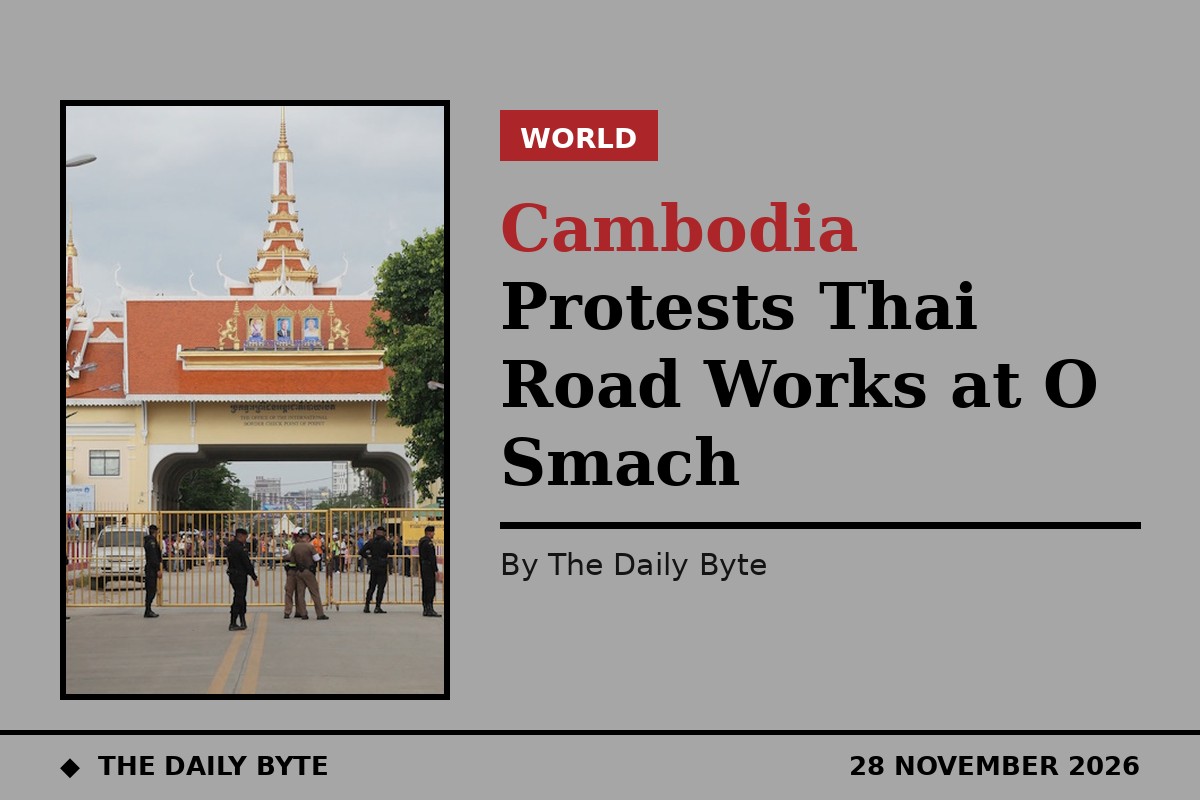
Cambodia has lodged a formal protest after Thai armed forces cleared land and widened a road at O Smach, a disputed border crossing, in the latest flare-up along the frontier.
The protest was issued on 27 November by Cambodia's Ministry of Foreign Affairs and International Cooperation as press release 174/2026. It says Thai armed forces carried out land-clearing and road-expansion work in the O'Smach area of Sangkat O'Smach, Samraong city, in Oddar Meanchey province, on 25 and 26 November. Cambodia described the works as clear violations of its sovereignty and territorial integrity, as defined by the 1:200,000-scale maps produced under the Franco-Siamese Convention of 1904 and the Treaty of 1907, and demanded that Thailand immediately halt all such activities. The protest was reported by Cambodian state media on 27 and 28 November.
Cambodia's case rests on two agreements both governments have signed. Article V of the two countries' 2000 memorandum on the land boundary bars either side's authorities from any work that changes the environment of the frontier zone; the only body allowed to do such work is the memorandum's Joint Technical Sub-Commission, for its survey. The Joint Statement of 27 December 2025, agreed by the two countries' defence ministers when the ceasefire took effect, also commits both sides to de-escalation measures and to refraining from building or enhancing military infrastructure beyond their own side. Cambodia said it did not accept any boundary line or territorial claim asserted unilaterally by Thailand, and that the works would not change its legal rights or position.
A crossing held since the December fighting
O Smach has been the border's most contested point since the fighting of December 2025. Thai troops have held parts of the town since the ceasefire, and Cambodia says the works there have stopped displaced families from returning home. In February, Cambodia's foreign ministry said Thai forces had begun a road from a container blockade at O Khla Khmum village in O Smach. On 27 August, Cambodia's defence ministry took the ASEAN Observer Team, the ASEAN monitors of the ceasefire, to the area, where the observers saw shipping containers, barbed wire, trenches being dug, and bunkers and roads being built. The Joint Boundary Commission, the body both governments agreed would survey and mark the land border, has not yet done so at O Smach.
The protest is the latest in a long series. Between 2 January and 24 October 2026, Cambodia's foreign ministry published 28 protests naming 61 Thai works at border sites, from barbed wire and roads to bunkers and demolished houses, and Thailand published eight answers. The previous protest, on 23 November, covered a Thai air chief's visit to the An Ses area and a new bunker and road works at Boeung Trakuon; Thailand answered the same day, saying An Ses lay behind the line its forces had held since the ceasefire.
No Thai answer to the O Smach protest had been found by 27 November, and no report on the works from the ASEAN Observer Team had been found by then. Thailand's standing position, stated by its foreign ministry on 13 February, is that all Thai border activities, barriers included, are fully consistent with the ceasefire statement, because both sides agreed not to act beyond their respective sides. In March, Thailand cited the same Article V against Cambodia over a market and a monument at An Ses. Cambodia's foreign ministry called on Thailand to stop the works, refrain from further unilateral action, and work to de-escalate tensions and preserve peace along the border.


