Can Heart Attack Risk Show 30 Years Early?
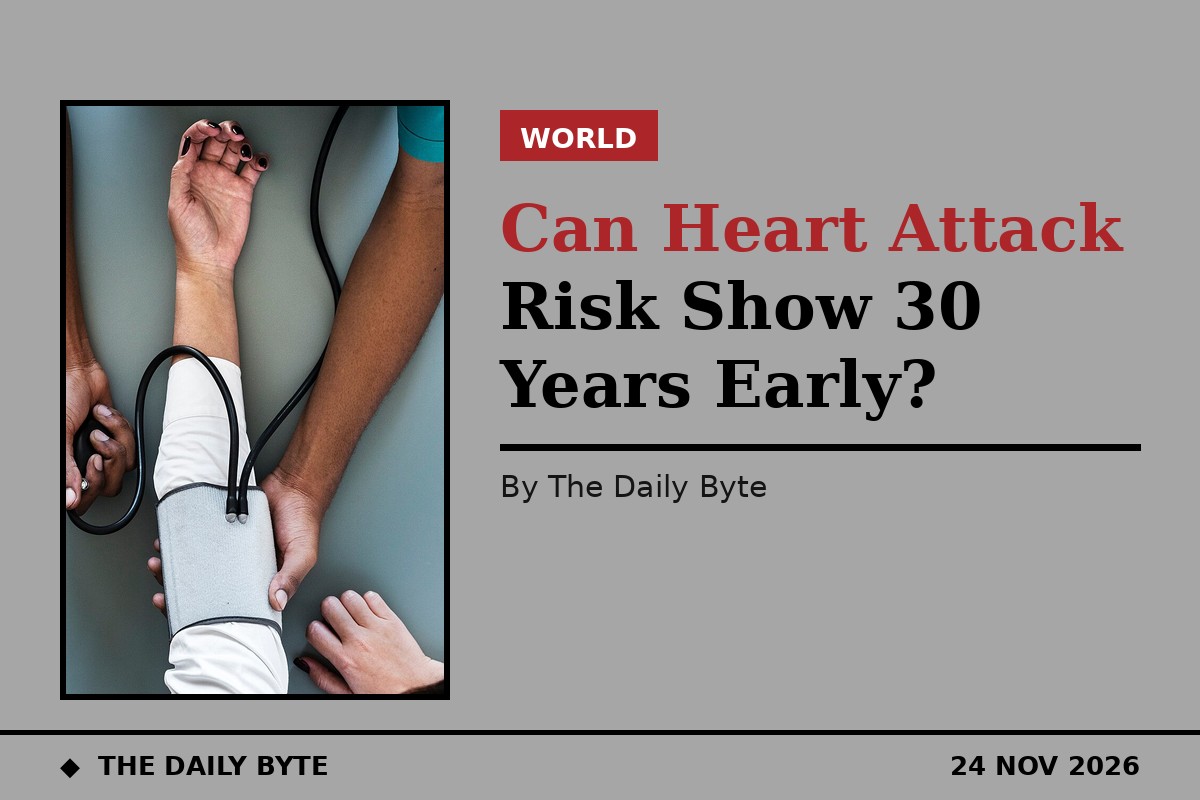
Yes, or at least the warning signs can. A study published on 23 November 2026 in JAMA Network Open found that people who later had a heart attack, a stroke or died from cardiovascular disease already had measurably different risk factors up to 30 years before the event. The clearest signal was blood pressure: systolic blood pressure was already 4 points higher three decades beforehand, and the gap widened to 7 points nearer the event. The study followed 113,612 adults across four long-running studies in the United States, Norway and the United Kingdom, and its authors say the findings point to a much longer window for prevention than doctors usually assume.
That does not mean a doctor can look at a blood pressure reading today and predict a heart attack in 2056. The differences are patterns across a very large group of people, not a test that works for any one person. This article explains what the study found, how it was done, and what it does and does not mean for you.
| Key fact | Detail |
|---|---|
| Study | Cardiovascular risk factors and biomarkers in the decades before a cardiovascular event |
| Published | 23 November 2026, JAMA Network Open |
| Led by | University of Edinburgh, funded by the British Heart Foundation |
| Participants | 113,612 adults with no prior heart attack or stroke |
| Studies pooled | Four cohorts in the US, Norway and the UK, data from 1985 to 2019 |
| Study visits | 316,719 visits; median follow-up 18.9 years |
| Events recorded | 16,917 first heart attacks, strokes or cardiovascular deaths |
| Key finding | Systolic blood pressure 4 mmHg higher 30 years before an event, 7 mmHg higher nearer the event |
| Biomarker signal | NT-proBNP levels diverged about 10 years before an event |
What did the new study find?
The researchers pooled individual data from 113,612 adults who had never had a heart attack or a stroke when they joined their studies, and tracked them for up to 34 years. During that time, 16,917 had a first cardiovascular event: a nonfatal heart attack, a nonfatal stroke, or death from cardiovascular disease. Looking backwards from each event, the people who went on to have one already looked different decades earlier, across a whole range of risk factors.
Blood pressure gave the earliest and clearest signal. Systolic blood pressure, the pressure in the arteries when the heart beats, was consistently higher in the people who later had events, starting at 4 mmHg higher three decades before and increasing to 7 mmHg closer to the event. The gap was there the whole way along: not a sudden jump in the final year, but a slow divergence that began when many of the participants were in their forties. Differences in cholesterol, diabetes, physical activity and kidney function also appeared over the same long period.
Blood tests told a similar story on a shorter timescale. Levels of a protein called NT-proBNP, which doctors use to monitor heart failure, began to differ between the two groups about 10 years before an event. Other blood markers, including C-reactive protein and cardiac troponins, were also measured. "I am excited about the findings of our study as they show that modifiable risk factors begin to diverge 30 years before a cardiovascular event occurs," said Dr Dorien Kimenai, the study's lead author and a British Heart Foundation research fellow at the University of Edinburgh's Usher Institute. The word modifiable matters: blood pressure, cholesterol, diabetes, weight and physical activity are all things that can, in principle, be changed.
How was the study done?
The study was a pooled analysis of four long-running population studies: the Cardiovascular Health Study and the Multi-Ethnic Study of Atherosclerosis in the United States, the Trondelag Health Study in Norway, and the Whitehall II study in the United Kingdom. Together they covered 316,719 study visits between 1985 and 2019, with a median follow-up of 18.9 years. The participants included 59,328 women and 54,284 men, with a median age of 46 for women and 45 for men when they joined. The analysis itself was carried out between April 2025 and September 2026.
Pooling four studies matters because no single study could answer this question on its own. By combining studies that had already done the long follow-up, the Edinburgh team could look at how risk factors changed over decades, separately for women and men and for people who had events at different ages.
The outcome the team measured was a composite: a first nonfatal heart attack, a first nonfatal stroke, or death from cardiovascular disease. That is a standard way of studying heart and circulatory disease, because all three share the same underlying problem of damaged blood vessels. Of the 113,612 participants, 8,025 women and 8,892 men had such an event during follow-up. The study was published in JAMA Network Open, and it was funded by the British Heart Foundation.
What is systolic blood pressure, and why do four points matter?
Blood pressure is measured as two numbers. Systolic pressure is the pressure in the arteries when the heart beats and pushes blood out, and diastolic pressure is the pressure when the heart rests between beats. A reading of 120 over 80, written as 120/80 mmHg, means a systolic pressure of 120 millimetres of mercury and a diastolic pressure of 80. The study's headline finding is about the first number.
Four points sounds small, and for one person on one day it is: a single reading can move by more than that depending on stress, caffeine or exercise, which is why doctors look at patterns over time. But across 113,612 people, a consistent 4-point gap present 30 years before an event and growing to 7 points as it approaches is a strong signal. The people who later had events were already, on average, running slightly higher blood pressure for decades, and that long exposure adds up.
That is the study's central idea: cardiovascular risk accumulates over a lifetime. High blood pressure damages artery walls a little at a time, year after year, and the damage compounds. A small difference maintained for 30 years can do more harm than a large difference that appears late. It is also why the researchers describe the 30-year gap as a window of opportunity: if the divergence starts that early, there is time to act on it, rather than waiting until the risk is obvious and much of the damage is done.
What is NT-proBNP?
NT-proBNP stands for N-terminal pro-B-type natriuretic peptide, a protein released by the heart when it is under strain. Doctors already use it to help diagnose and monitor heart failure, because levels rise when the heart muscle is stretched or struggling. In this study, NT-proBNP levels in the people who later had a cardiovascular event began to differ from those who stayed event-free about 10 years beforehand.
That ten-year signal is different in kind from the blood pressure signal. Blood pressure is a cause of damage as well as a warning sign: high pressure injures artery walls over decades. NT-proBNP is more like a smoke alarm: it shows that the heart is already feeling the strain, years before an event happens. The two signals together sketch a timeline. Risk factors such as blood pressure start to diverge 30 years out, and measurable strain on the heart itself shows up in the final decade.
Other markers measured included C-reactive protein, a marker of inflammation, and cardiac troponins, proteins released when heart muscle is damaged. Kidney function and physical activity were also tracked, and both differed between the groups. None of these is a standalone test for predicting a heart attack; their value is in showing how early, and how gradually, the paths of the two groups separate.
Who showed the earliest warning signs?
The patterns were not the same for everyone. People who had a cardiovascular event at a younger age were more likely to have had diabetes and a higher body mass index in the decades before the event. That finding points to a particular group who might benefit most from earlier attention: younger adults whose blood sugar and weight are already drifting in the wrong direction, even though a heart attack still feels like a distant prospect.
There were also differences between women and men. The study analysed the sexes separately, and found a reversal in blood pressure: younger women tended to have lower systolic pressure than younger men, but around the age of 65 the relationship reversed.
Age mattered too. Participants joined the studies at a median age in the mid-forties, and events happened a median of about 19 years later, so the 30-year divergence was visible in people still in middle age. As Professor Bryan Williams, chief scientific and medical officer at the British Heart Foundation, put it: "This study adds to growing evidence that red flags for cardiovascular disease appear decades before it arrives."
What does this change about prevention?
The practical message is to start earlier. The findings highlight the potential for earlier, life-course prevention: instead of treating cardiovascular risk as something to worry about in your sixties, the time to pay attention is when the risk factors first begin to diverge, decades earlier. That does not necessarily mean medication for everyone in their forties; it means knowing your numbers and acting on them while there is still time.
Professor Williams's advice is straightforward: do not wait for chest pain to start taking cardiovascular risk seriously. He recommends getting blood pressure and cholesterol checked, and discussing diabetes risk, kidney function and overall cardiovascular risk with a clinician. Those are checks that already exist, and they are the same checks that pick up the risk factors this study found diverging decades before events. The new research does not invent a new test; it gives a reason to take the existing ones seriously, sooner.
It is worth saying plainly what this article is not. It is not medical advice for any individual reader, and it does not mean that a slightly raised blood pressure reading today predicts a heart attack in 30 years. If you are worried about your own risk, the right step is to talk to a doctor or another clinician, who can look at your full picture. And if you think you or someone near you is having a heart attack now, typically chest pain or discomfort, shortness of breath, or pain spreading to the arm, neck or jaw, call emergency services immediately.
What the study cannot tell us
The study has limits, and its authors state them. It did not look at risk factor trajectories by ethnicity, and the team cautions that further research is needed to explore whether the patterns differ across ethnic groups. The four cohorts came from the United States, Norway and the United Kingdom, so the findings may not apply in the same way to populations elsewhere.
The study is also observational: it followed people over time and recorded what happened, rather than assigning anyone to a treatment. It can show that risk factors diverge decades before events, but it cannot prove that intervening at a particular age would prevent a particular event. The case for earlier prevention rests on combining this evidence with what trials of blood pressure and cholesterol treatment already show.
Finally, the findings describe groups, not individuals. A 4-point average difference in blood pressure is a population pattern, and many people with slightly higher blood pressure will never have a cardiovascular event, while some with lower blood pressure will. The study's value is in shifting the timeline: it shows that the road to a heart attack or stroke is decades long, and that the earliest signs are already visible in ordinary measurements taken in middle age. As the University of Edinburgh's announcement of the research puts it, the findings highlight a large window of opportunity to intervene, reduce cardiovascular risk and prevent serious disease.
Frequently asked questions
Can doctors predict my heart attack 30 years in advance? No. The study found population-level patterns: on average, people who later had events had higher blood pressure decades earlier. That is not a test that can predict whether any one person will have a heart attack, or when. It shows that risk builds up over decades, which is why earlier checks and prevention matter.
What is systolic blood pressure? It is the pressure in your arteries when your heart beats and pushes blood out, and it is the first number in a blood pressure reading. A reading of 120/80 mmHg means a systolic pressure of 120 and a diastolic pressure, measured when the heart rests between beats, of 80.
What is NT-proBNP? It is a protein released by the heart when it is under strain, and doctors use it to help monitor heart failure. In this study, NT-proBNP levels in people who later had a cardiovascular event began to differ from those who stayed event-free about 10 years beforehand.
What should I do about my blood pressure? Get it checked, along with your cholesterol, and discuss diabetes risk, kidney function and your overall cardiovascular risk with a clinician. That is the advice of the British Heart Foundation's Professor Bryan Williams, commenting on this study. Do not wait for symptoms such as chest pain before taking risk seriously.
Does this research apply to everyone? Not necessarily in the same way. The study did not examine risk factor trajectories by ethnicity, and its participants came from four cohorts in the United States, Norway and the United Kingdom. The authors say further research is needed on how the patterns differ across ethnic groups.


