Canada Bill C-22 Senate Hearing Puts Meta, Signal
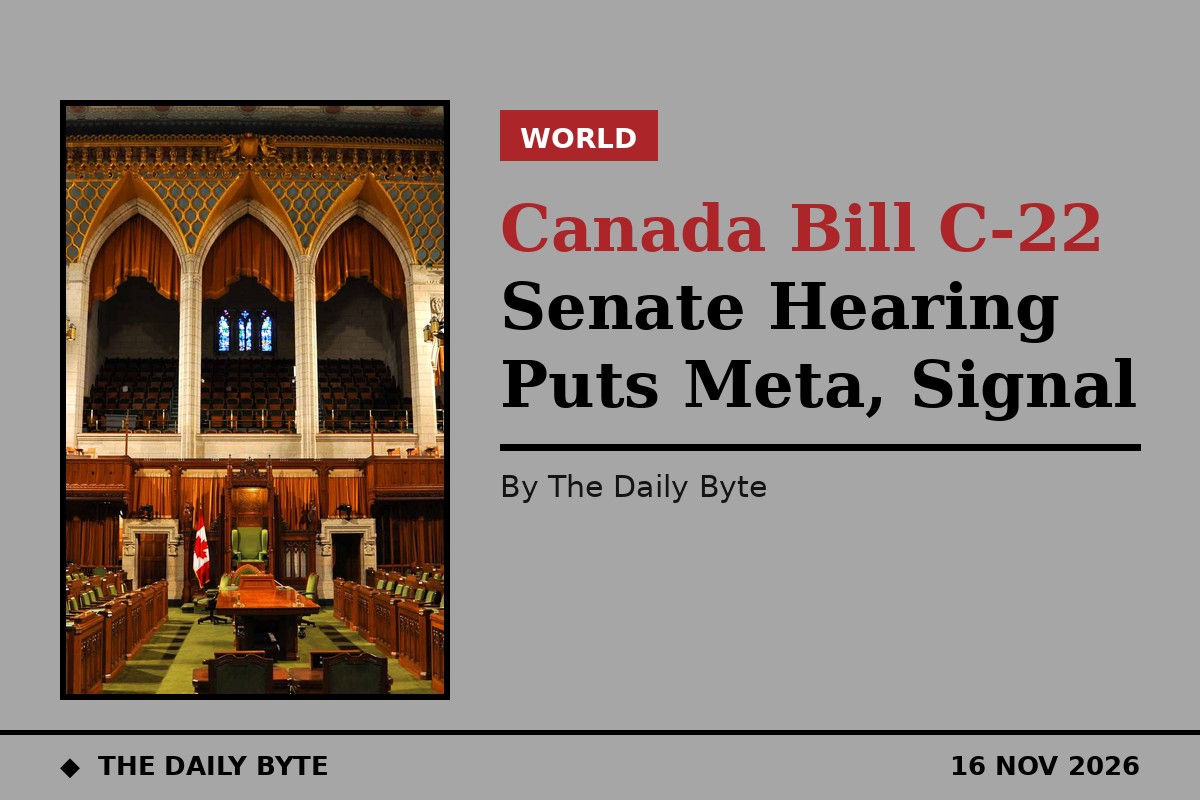
Leaders from Meta, Signal and Tailscale will appear before a Canadian Senate committee on Monday 16 November, as senators weigh Bill C-22, the Lawful Access Act, 2026, a bill that could require technology companies to build systems that let the authorities intercept communications.
The industry witnesses are scheduled to give evidence in the third panel, from 6 p.m. to 7 p.m. ET, before the Senate's national security committee. The meeting opens at 4 p.m. ET in Room W110, 1 Wellington Street. Meta will be represented by Rachel Curran and Robyn Greene, Signal by Udbhav Tiwari, and Tailscale by its chief executive, Avery Pennarun. David Shipley of Beauceron Security is also listed.
Earlier panels will hear academics and civil society groups, including Michael Geist of the University of Ottawa, Leah West of Carleton University, Tamir Israel of the Canadian Civil Liberties Association and Kate Robertson of Citizen Lab. The session is being televised live.
What Bill C-22 would require
Part 2 of the bill enacts the Supporting Authorized Access to Information Act. It would let the public safety minister issue confidential orders requiring electronic service providers to build lawful access capabilities, and would let regulations require core providers to retain user metadata for up to six months.
The bill passed the House of Commons on 18 June. The Senate gave it second reading and referred it to the national security committee on 22 October, and the committee held its first meeting on the bill, with the commissioners and the public safety minister on 2 November. Before passing the bill, the House cut the maximum metadata retention period from one year to six months, capped ministerial orders at two years, and made orders to electronic service providers subject to approval from the Intelligence Commissioner.
Signal says it would leave rather than comply
Signal has been the bluntest. Tiwari told the House public safety committee on 2 June that Part 2 conflicts with privacy rights, urged lawmakers to scrap it, and said Signal would leave a market rather than betray its users. On 5 October he named three problem areas: an order to share encryption keys, forced collection and six-month storage of more metadata, and a targeted change to how the platform works. He said complying would fundamentally break Signal.
Meta frames the problem as conscription. Curran told the Commons committee that Part 2 would allow the government to conscript private companies into service as an arm of the government's surveillance apparatus. Apple and Google have also said the bill could require capabilities that weaken encryption.
Tailscale objects to what Pennarun has called mandatory, standing surveillance readiness. He has said the company would challenge the law in court if it passes as written and would likely move if those challenges failed. About 40 per cent of Tailscale's global team is based in Canada. At least 20 technology companies and industry groups wrote to the ministers in September urging further amendments.
Government says encryption is not the target
The government says the bill was never meant to breach encryption. The House added a provision stating that the Act does not compel a provider to decrypt data unless the provider supplied the encryption and holds the key. The government's position is that Canada is the only G7 and Five Eyes country without a modern lawful access regime, and that police cannot effectively investigate online extortion, child exploitation and organised crime with older tools.
Critics point to the experience of the United States. Reports in 2024 said Salt Typhoon, a China-linked hacking group, had compromised US telecom wiretap systems, reaching call and text metadata from over a million users. Citizen Lab and the Canadian Civil Liberties Association cite that breach against Part 2 and describe the retention regime as almost certainly unconstitutional. The Canadian Bar Association says mass metadata retention would likely face a challenge under section 8 of the Charter.
Two commissioners have also asked for tighter safeguards. Intelligence Commissioner Simon Noël told the committee on 2 November that he welcomes the two-year cap and wants the minister to have to justify using a confidential order. Privacy Commissioner Philippe Dufresne asked senators the same day to narrow the definition of subscriber information.
What happens next
The committee can report the bill with or without amendments. If the Senate changes the text, the House must agree to identical wording before royal assent. If enacted, most of Part 1 would take effect 180 days after royal assent, while Part 2 would start on a date set by the Governor in Council.
Monday's hearing will show whether senators press for the changes the companies and commissioners are requesting, and whether a regime built on pre-built interception capability can be made secure, a question the Salt Typhoon breach has already put on the record.


