Canada and China Agree $400 Million Tariff Relief as Carney Meets Xi in Shenzhen
By aminah
·17 Nov 2026
·4 min read
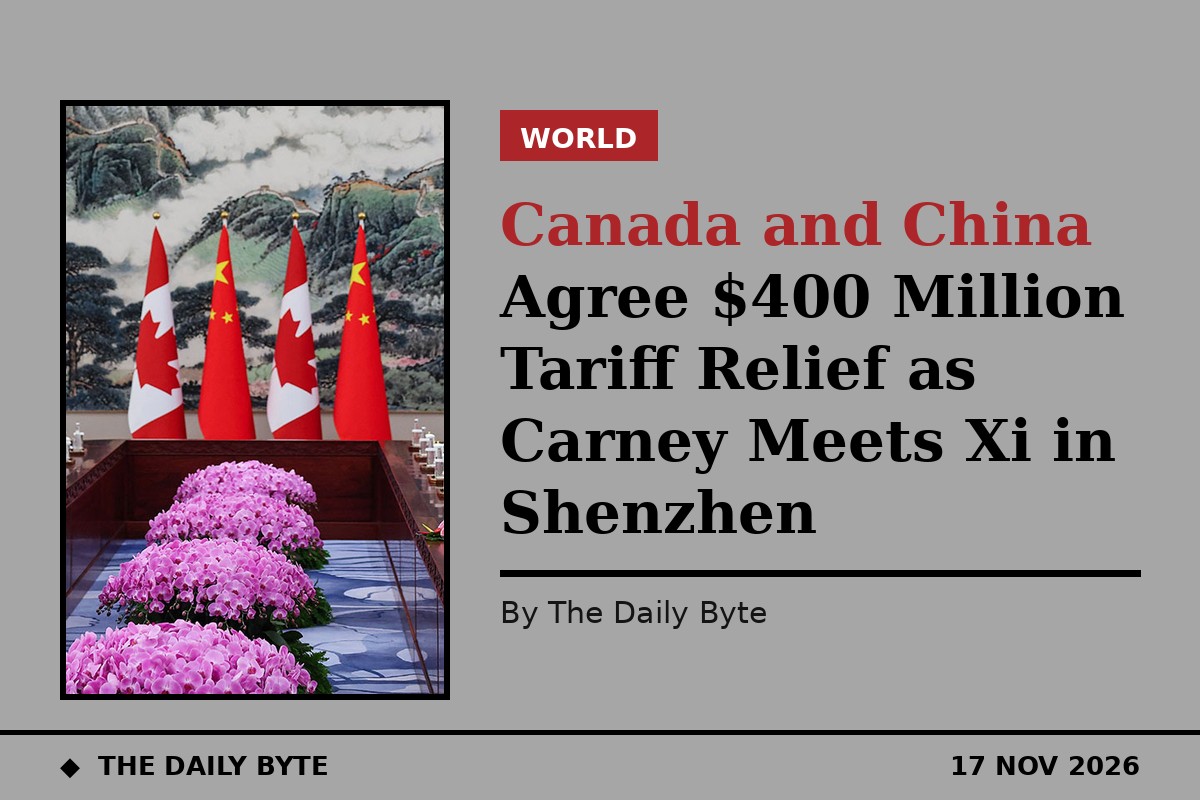
China will cut tariffs on about C$400 million of Canadian exports, including pork and seafood, after Prime Minister Mark Carney met Chinese President Xi Jinping in Shenzhen on Tuesday, 17 November 2026.
The meeting, held ahead of the Asia-Pacific Economic Cooperation (APEC) summit in the southern Chinese city, produced an extension and expansion of the preliminary trade arrangement the two countries first reached in January, when Mr Carney’s visit to Beijing launched a new Canada-China strategic partnership.
## What was agreed in Shenzhen
Canada and China agreed to extend and expand the Preliminary Joint Arrangement on Addressing Bilateral Economic and Trade Issues, improving access to the Chinese market for Canadian farmers and seafood harvesters. According to the Prime Minister’s Office, China will provide additional tariff relief for approximately $400 million in Canadian exports, including $116 million in frozen pork cuts and $285 million in fish and seafood exports, covering certain frozen cold-water shrimp and prawns, including Pacific spot prawn, certain molluscs including geoduck, sea cucumber and Greenland halibut.
The expansion builds on a two-year extension of tariff relief for Canadian exports of canola meal, peas, lobster and crab announced earlier this month. The Prime Minister’s Office said Canada has now restored market access for more than 90 percent of trade previously subject to tariff action — nearly $7.5 billion worth of Canadian exports.
Mr Carney said Canada was well ahead of schedule in its goal of boosting exports to China by 50 percent by the end of the decade, and hailed “greater predictability and stability” in the relationship.
## What Canada gives in return
In exchange, Canada has agreed to extend by two years existing remission measures for certain Chinese steel and aluminium products that are currently set to expire at the end of 2026, and to expand remission coverage to an additional 32 steel and aluminium tariff items for which Canadian supply is insufficient or unavailable. Reuters reports that the additional items cover 23 steel and nine aluminium tariff lines.
The two sides also endorsed Joint Outcomes from the second Canada-China Economic and Financial Strategic Dialogue, aimed at strengthening cooperation between financial, macroeconomic, regulatory and monetary authorities in both countries.
## The wider partnership
Mr Carney also announced a new major trade mission to China in 2027, a Canada-China Year of e-Commerce in 2027 to help small and medium-sized Canadian businesses sell through Chinese e-commerce platforms, and a Canadian contribution of $850,000 for scholarships enabling 850 Canadian students to study at Chinese universities. Canada will contribute a further $8 million to the China Council for International Cooperation on Environment and Development.
Business agreements welcomed during the visit include new air routes between the two countries, with Air Canada launching flights from Vancouver to Guangzhou in May 2027 and Chinese airlines also increasing flights. Five Canadian arts and culture companies signed commercial agreements worth more than $15 million, and a memorandum of understanding will launch a Canada-China CEO Roundtable, co-chaired by the Canada-China Business Council and the Bank of China.
The leaders also discussed cooperation against narcotics threats and collaboration on oil and gas, renewable energy and nuclear energy.
Mr Carney said: “Canada and China have recalibrated our relationship to the benefit of citizens in both countries. We have unlocked billions in new export orders for Canadian farmers, ranchers, and fish harvesters — for workers and businesses across the country. We’re making it easier to travel, study, and do business between our nations to create more opportunity and prosperity for all.”
## Why it matters
China is the world’s second-largest economy and a country of more than 1.4 billion people. In 2025, Canada’s bilateral trade in merchandise with China reached $125.6 billion, a 5.6 percent increase on 2024, and China accounted for $35.1 billion of Canada’s merchandise exports. The Prime Minister’s Office said hundreds of thousands of Canadian jobs are supported by trade with China, generating more than $30 billion in revenues and adding $6.9 billion to Canada’s GDP.
Mr Carney was joined in Shenzhen by Foreign Affairs Minister Anita Anand and Parliamentary Secretary Kody Blois. He will represent Canada at the APEC Economic Leaders’ Meeting in the city, where President Xi is also due to meet US President Donald Trump.
### Frequently asked questions
**Which Canadian exports get tariff relief?**
About C$400 million worth, including C$116 million in frozen pork cuts and C$285 million in fish and seafood, including spot prawn, geoduck, sea cucumber and Greenland halibut.
**What does Canada offer in return?**
A two-year extension of remission measures for certain Chinese steel and aluminium products, expanded to 32 additional tariff items.
**When did the Canada-China strategic partnership begin?**
It was launched in January 2026, when Mr Carney and President Xi met in Beijing.
Sources: Prime Minister of Canada (primary); Reuters via BusinessWorld.
Source
Prime Minister of Canada — https://www.pm.gc.ca/en/news/news-releases/2026/11/17/prime-minister-carney-advances-canadas-strategic-partnership-china 

