Canada concludes ASEAN free trade deal in Manila
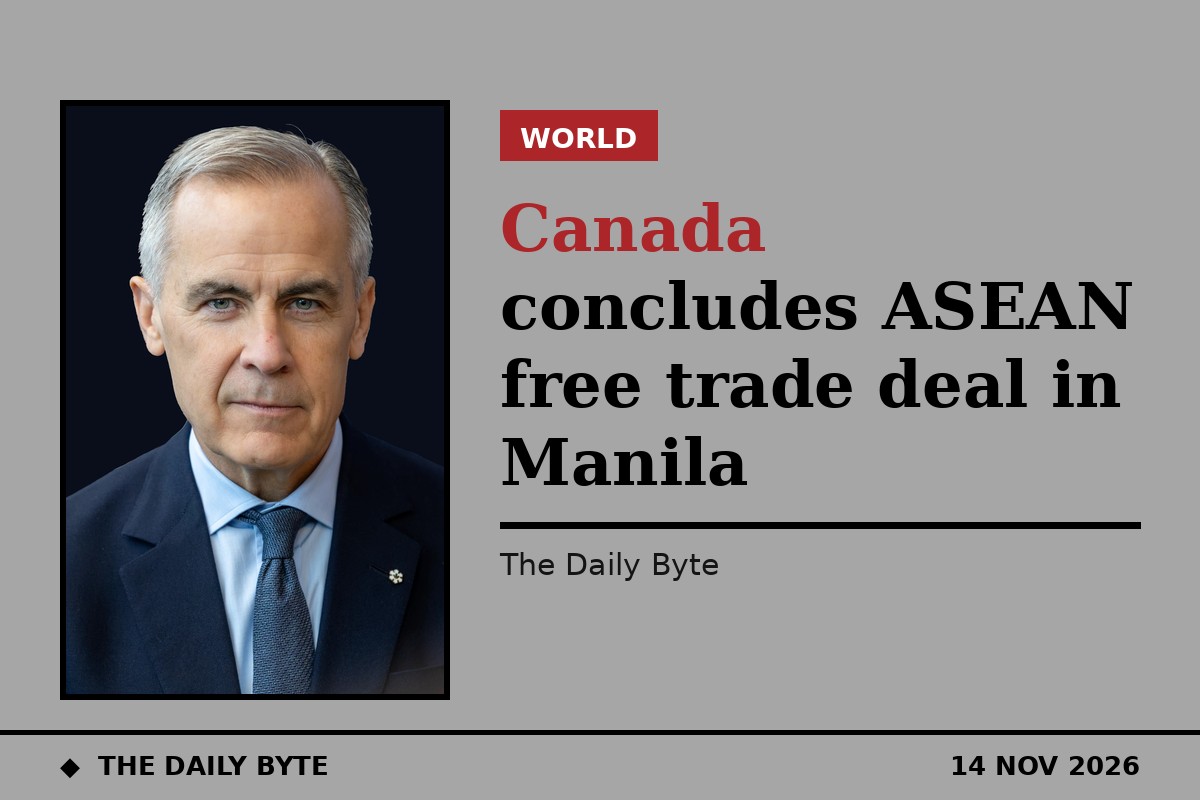
Canada has substantially concluded negotiations on a free trade agreement with the Association of Southeast Asian Nations (ASEAN), Prime Minister Mark Carney announced in Manila on Saturday, 14 November. The deal opens a market of almost 700 million people to Canadian exporters and is the centrepiece of Ottawa’s drive to reduce its reliance on a single trading partner.
Carney, who is attending the 49th ASEAN Summit as Guest of the Chair, said the ASEAN-Canada free trade agreement, known as ACAFTA, would create “more choice, more customers, and greater sovereignty for Canadians”. ASEAN has a combined economy of close to six trillion dollars, and Canada expects the agreement, once in force, to add nearly two billion dollars to its economy and create nearly 14,000 Canadian jobs, particularly in agriculture and manufacturing.
Signing targeted for 2027
Negotiations on the agreement began in 2021. The remaining steps will now be completed as quickly as possible, with the ambition of signing the agreement in 2027. Carney also announced five million dollars in assistance to help every ASEAN economy support swift ratification and benefit equally once the deal takes effect.
“With ASEAN, we are opening a market of nearly 700 million people through a landmark free trade agreement,” Carney said. “Two agreements in one year: that is the speed and ambition this moment demands. That is how we build more choice, more customers, and greater sovereignty for Canadians.”
Trade Minister Maninder Sidhu said the agreement would help reduce tariffs and other trade barriers for Canadian businesses across one of the world’s fastest-growing regions. The two sides will still need to finalise the text, sign the deal and secure ratification before it can take effect.
Canada’s fifth-largest trading partner
As a group, ASEAN was Canada’s fifth-largest merchandise trading partner in 2025, with two-way trade valued at 52.5 billion dollars, up 22.7 per cent on the previous year. The bloc’s members include Indonesia, Vietnam, Thailand, Malaysia, Singapore and the Philippines, and its economies have grown far faster than Canada’s traditional markets.
The announcement came on the same day Carney concluded a separate free trade agreement with the Philippines, the summit’s host country, after only a year of negotiations. The two deals together underline how far Canada has moved to diversify its trade since relations with the United States deteriorated over tariffs.
Carney told reporters in Manila that trade talks with Washington were making progress after collapsing in August, but that no agreement had yet been reached and Canada would not accept a deal that undermined its car industry. Against that background, the ASEAN agreement gives Canadian farmers, manufacturers and exporters a large alternative market to aim for.
Alongside the trade announcement, Carney set out more than 15.9 million dollars in investments to strengthen cooperation with ASEAN partners on public safety, ocean protection, nuclear security and clean energy. He will continue his tour in Cambodia and China, where he is due to meet President Xi Jinping at the Asia-Pacific Economic Cooperation summit.


