Canada Pays for F-35 Parts for Up to 48 Jets
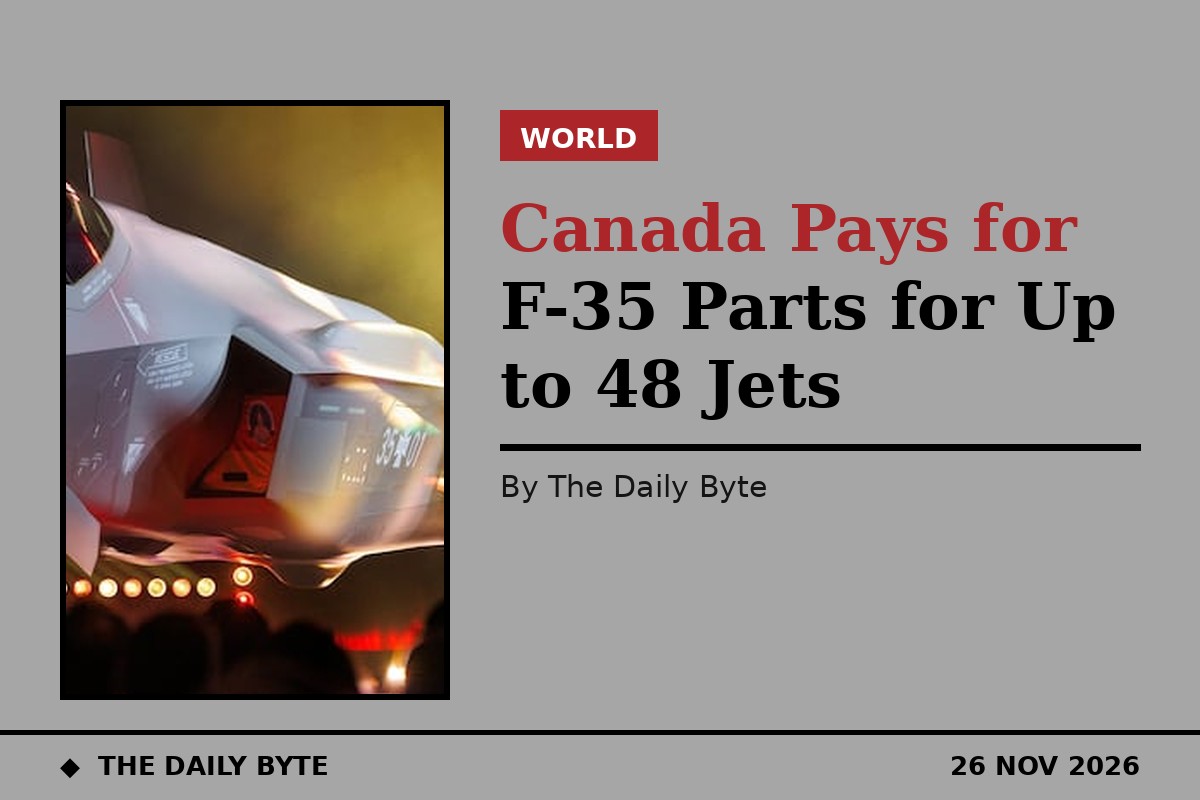
Canada has paid for parts for as many as 48 F-35 fighter jets even though it has formally committed to buying only 16, the Globe and Mail has reported, as the government's review of the full 88-aircraft order continues.
The payments cover so-called long-lead items, components that must be ordered years before a finished aircraft is assembled, and are meant to hold Canada's place in Lockheed Martin's production queue. Two government officials told the newspaper the money had been paid. The government says the payments do not amount to a decision to buy the aircraft, and that they are reversible because the parts could be sold to other F-35 buyers.
A review that will not end
Canada agreed in January 2023 to buy 88 F-35A jets to replace its ageing CF-18 Hornets, in a deal first priced at 19 billion Canadian dollars. The auditor general later put the estimated cost at 27.7 billion dollars by 2024. Prime Minister Mark Carney ordered a review of the purchase in March 2025, as trade tensions with Washington deepened, and the review has still not concluded.
The first two Canadian jets, known as CF-35As, were accepted on 22 October at Luke Air Force Base in Arizona, where Canadian personnel will train. Under the published schedule, the first aircraft is due to reach Cold Lake in Alberta in late 2028, and the CF-18 fleet is due to retire in 2032.
Defence Minister David McGuinty has repeatedly stressed that only 16 jets have been formally acquired. Mr Carney has acknowledged the long-lead payments in Parliament when pressed by Bloc Québécois leader Yves-François Blanchet, presenting them as a way of keeping Canada's options open rather than a recommitment. Sweden's Saab Gripen E remains the leading alternative if Ottawa opts for a mixed fleet, although an internal air force paper reported by CBC on 24 November centred on the F-35 and Canadian-made drones and made no mention of the Gripen.
The row with Washington
The payments come days after the Pentagon published a fact sheet criticising Canada's defence spending and its handling of the fighter review, warning that operating two types of jet could worsen personnel shortages and create uncertainty for NORAD, the joint US-Canadian air defence command. Mr McGuinty replied that Canada is a sovereign nation and does not report to the United States on defence decisions.
For now, the long-lead payments buy time. They keep Canada in the production queue for up to 48 aircraft without committing it to buy them, while the government weighs a decision that will shape its air force for decades. No date has been given for the review to conclude.


