Canada pledges $560m to protect tropical forests
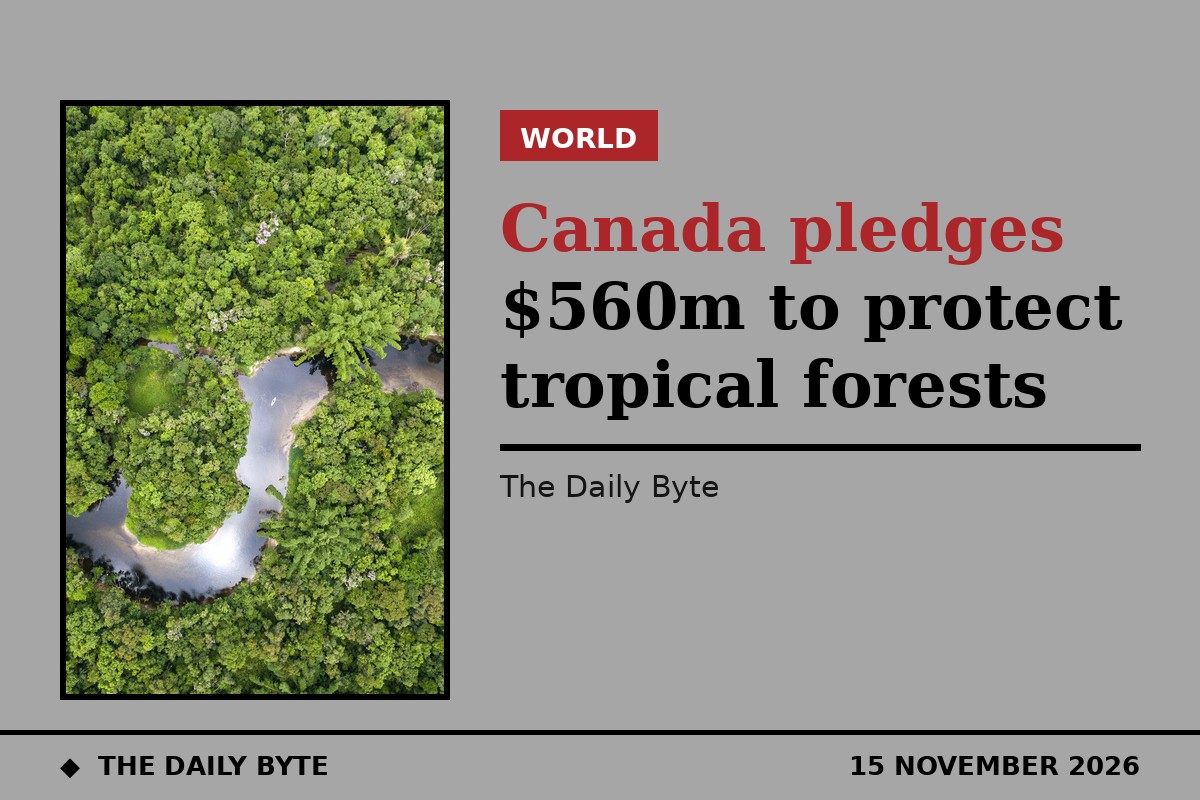
Canada will contribute up to $560 million over four years to help protect the world’s tropical forests, Prime Minister Mark Carney announced on Sunday, 15 November, during a meeting with Brazilian President Luiz Inácio Lula da Silva in Manila.
The announcement was made on the margins of the Association of Southeast Asian Nations (ASEAN) summit in the Philippines, where Carney met Lula to discuss climate action and the Tropical Forest Forever Facility (TFFF), a fund co-led by Brazil and Norway.
Carney said the contribution would help the facility meet its fundraising targets, begin operations and attract further public and private investment. The pledge is described by the Canadian government as an initial contribution, with Canada also working with partners to broaden participation in the fund.
What the Tropical Forest Forever Facility does
The TFFF is designed to mobilise public and private investment to protect tropical forests, preserve biodiversity and support the communities that depend on those forests. Once fully operational, it aims to protect more than one billion hectares of tropical forest a year across more than 70 countries, with conservation payments tied to verified results.
At least 20 per cent of those payments will go to Indigenous Peoples and local communities, recognising their role in protecting forests and biodiversity, according to the Prime Minister’s Office.
The facility was launched in November 2025 during the COP30 leaders’ summit in Belém, Brazil, under Lula’s leadership. Canada was among 66 countries that endorsed the declaration launching it. The facility aims to mobilise $35 billion in contributions from sponsoring countries and organisations, in order to attract up to $140 billion in additional private investment. Returns on that investment would then fund long-term, performance-based conservation payments to eligible tropical forest countries.
Part of a wider Canadian climate pledge
The $560 million contribution forms part of Canada’s wider goal of delivering more than $13 billion in climate finance to developing countries by 2031. In its Spring Economic Update 2026, the government committed to deliver nearly $6 billion in funding to support international climate finance.
Carney said Canadians had always understood their responsibility to protect nature, at home and around the world. “At a time when the world needs leadership, Canada is stepping up with our partners to pioneer a new approach that makes conservation economically viable and mobilises private investment at scale,” he said.
“Tropical forests are among the most vital ecosystems on Earth. Protecting them is essential to halting biodiversity loss, stabilising our climate, and safeguarding the well-being of communities everywhere.”
The announcement also builds on domestic measures announced earlier this year. In March 2026, Canada launched A Force of Nature, a $3.8 billion strategy to protect and restore habitats, support Indigenous-led conservation and help Canada protect 30 per cent of its lands and waters by 2030. In September 2026, the government announced a further $1.2 billion for ocean conservation and stewardship.
Context at the ASEAN summit
The pledge came as Carney attended the ASEAN summit in Manila, where trade has dominated much of the agenda. On the same visit, Canada announced the conclusion of free-trade negotiations with the Philippines.
The forest announcement also followed criticism from some environmental groups after Carney missed the last two United Nations climate summits, COP30 in Brazil last year and COP31 in Antalya, Turkiye, this month. The Canadian Press reported that the Manila pledge was presented as a way for Canada to show its environmental credentials while trade talks took centre stage.
Other countries and organisations that have made financial commitments to the facility include Brazil, France, Germany, Indonesia, Luxembourg, the Netherlands, Norway, Portugal and the United Kingdom, while countries including the Democratic Republic of Congo, Ghana and Peru have engaged with the fund.
Protecting tropical forests matters well beyond the countries where they grow, the Canadian government said, because their conservation helps stabilise the climate, protect ecosystems and support a resilient global economy, including in Canada, where climate change threatens communities, infrastructure and economic prosperity.
Sources: Prime Minister of Canada; The Canadian Press.


