Carney Hopes to Sign Canada-Taiwan Trade Deal Soon
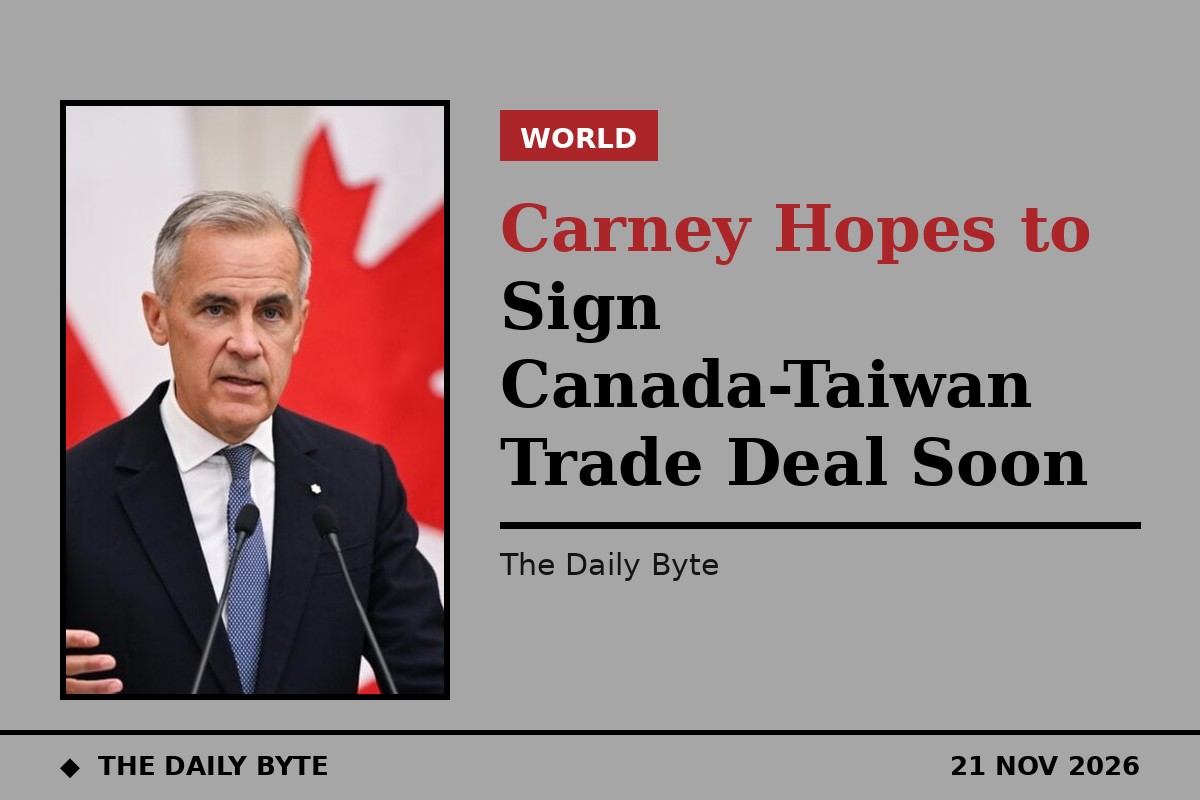
Canadian Prime Minister Mark Carney says he hopes to sign a long-delayed trade arrangement with Taiwan soon, more than a year after the deal was finalised and left unsigned. The comments came during his tour of Asia, as Ottawa works to deepen trade ties beyond the United States.
Speaking at a news conference in Shenzhen, China, on Wednesday 18 November, on the sidelines of the APEC summit, Carney said: “There’s been good progress on the economic co-operation agreement and we’re hopeful that that will be signed soon.” His office added that the government wants to wrap up the deal “in the near term”.
A deal finished in March 2025
The Canada–Taiwan Trade Cooperation Framework Arrangement was finalised in March 2025, and Ottawa consulted the provinces on it two months later, according to documents the government tabled in Parliament in September. The agreement has since been translated into French and Chinese and is “being considered for signature”, the documents say.
Taiwan’s delegation in Ottawa wrote in June that negotiations had ended more than a year earlier and that the legal review was “largely complete”. Asked in Shenzhen why the deal had sat unsigned for so long, Carney did not give a reason, saying only that he was hopeful it would be signed soon.
The House of Commons foreign affairs committee recommended last month that the government sign the agreement, noting that Taiwan is part of Canada’s Indo-Pacific strategy. The framework is not a treaty and would not need to be tabled in Parliament, but it sets out processes for more specific agreements covering green technologies, artificial intelligence and supply chains.
Politics at home
The delay has become a political issue in Ottawa. The Bloc Québécois has accused Carney of slow-walking the deal to avoid upsetting China, which claims control over the self-governing island. Carney’s office has pushed back, saying in a statement that “diligent work toward the Canada-Taiwan Trade Cooperation Framework Arrangement continues” and that, “recognizing the importance of Canada’s unofficial relations with Taiwan, we aim to bring consideration of the arrangement to a conclusion in the near term.”
Back in April, senior Canadian diplomat Weldon Epp told MPs that the government was “considering the timing and the nature of moving forward”. The agreement would be Canada’s first formal trade framework with Taiwan, a major producer of the semiconductors that power everything from phones to cars.
Part of a wider Asia push
The Taiwan deal is one piece of a much larger effort by Carney to diversify Canada’s trade away from the United States. During the same Asia trip, he concluded free-trade negotiations with the Philippines and with ASEAN, the 11-country South-East Asian bloc, with formal signings planned for 2027. He has also said a trade deal with India could come within three months.
In Shenzhen, Carney met Chinese President Xi Jinping and announced expanded tariff relief covering roughly $400 million in Canadian pork and seafood exports, in exchange for two-year tariff exemptions on some Chinese steel and aluminium. No deal was reached with the United States: Carney met President Donald Trump for under 20 minutes at APEC, and afterwards told a business summit that Canada would like a deal but “if the US doesn’t want to do the deal, we’re busy”.
For Taiwan, the signature would end a year of waiting. For Carney, it would add another agreement to a government that says it has signed more than 20 trade, investment and security deals since he took office in March 2025 — and show that Ottawa can deepen ties with Taipei even while it rebuilds its relationship with Beijing.