Caribbean Debt Tops $91.7bn Across 10 Countries
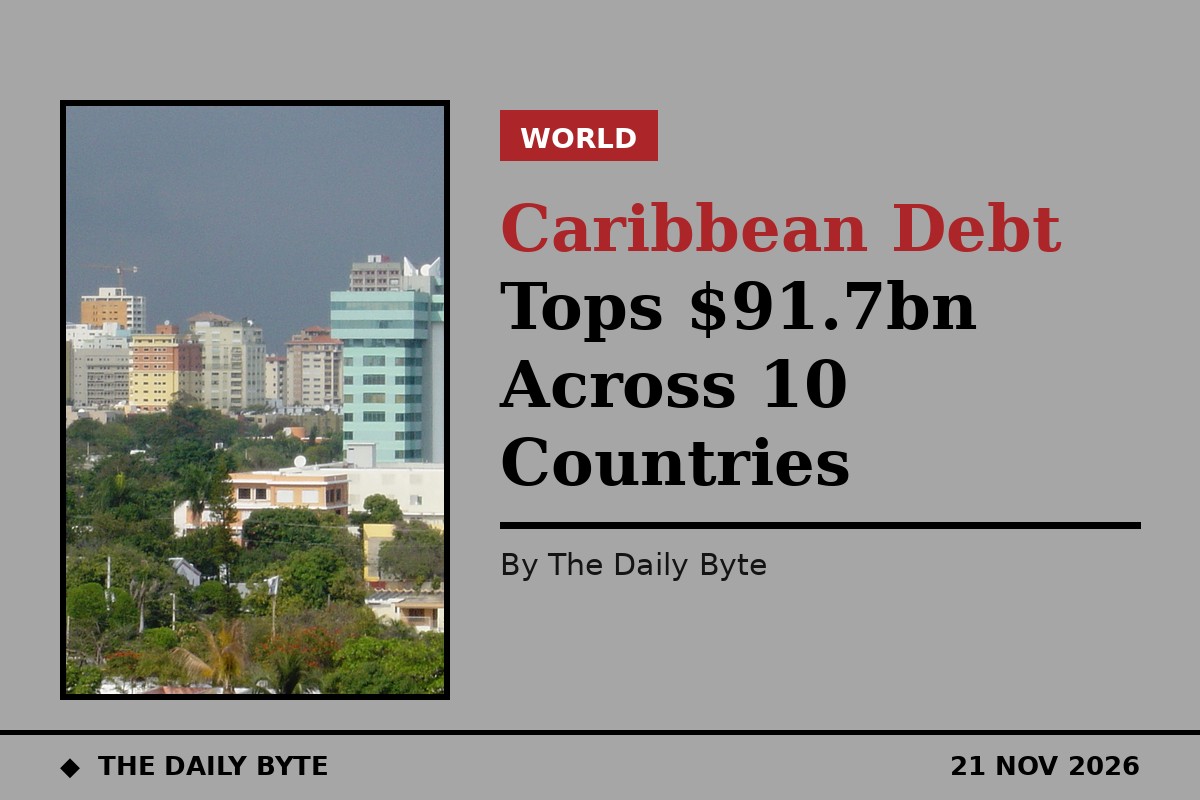
Ten Caribbean countries profiled in the World Bank's International Debt Report 2026 owed 91.7 billion US dollars in external debt at the end of 2025, according to an analysis of the report published on Friday. The Dominican Republic dominates the ranking, owing 56.3 billion dollars on its own, followed by Jamaica at 15.3 billion and Suriname at 9.6 billion.
The analysis, published by News Americas Now, stresses that the 91.7 billion dollar figure is its own calculation from the ten country profiles in the World Bank report, which was published on 5 November. The World Bank publishes no Caribbean subtotal, and the figure is not the region's total external debt: Antigua and Barbuda, the Bahamas, Barbados, St Kitts and Nevis and Trinidad and Tobago are not individually profiled, and neither is Cuba.
Ranked by total external debt stock, the ten countries are the Dominican Republic at 56.3 billion dollars, Jamaica at 15.3 billion, Suriname at 9.6 billion, Guyana at 4.3 billion, Belize at 1.6 billion, St Lucia at 1.3 billion, St Vincent and the Grenadines at 974.4 million, Grenada at 905.8 million, Haiti at 827.5 million and Dominica at 678.6 million. The Dominican Republic alone accounts for about 61 per cent of the combined total.
Size is not the same as strain
The ranking by size tells only part of the story. Jamaica ranked second by debt stock, but its debt-service-to-exports ratio reached 54 per cent, the highest of the ten countries profiled, and its debt service relative to gross national income reached 18 per cent. Its debt stock rose only 1.8 per cent in 2025, yet the burden of servicing it remained heavy.
Suriname posted the sharpest rise in the group. Its external debt increased 37.2 per cent to about 9.6 billion dollars, its external debt equalled 228 per cent of gross national income, and its debt-service-to-exports ratio stood at 44 per cent, with debt service equal to 34 per cent of gross national income. Almost half of its external debt, 4.65 billion dollars, was borrowed by private entities without a government guarantee.
Guyana provides the sharp contrast. Its external debt increased 16.3 per cent to 4.3 billion dollars, yet its debt-service-to-exports ratio was only 3 per cent, its debt service relative to gross national income was also 3 per cent, and its debt stood at 19 per cent of gross national income.
Who holds the debt
The data also show major differences in who the Caribbean owes. The Dominican Republic, Jamaica and Suriname rely heavily on private creditors such as bondholders and commercial banks. Private creditors hold about 77 per cent of the Dominican Republic's public and publicly guaranteed external debt, about 52 per cent of Jamaica's and about 42 per cent of Suriname's.
Multilateral lenders dominate in several smaller states. They hold most of the public external debt in Dominica, at 88 per cent, and in Haiti, St Vincent and the Grenadines and Guyana. The Inter-American Development Bank is the largest named multilateral creditor in the Dominican Republic, Jamaica, Guyana and Suriname, while the Caribbean Development Bank is a top creditor across the Eastern Caribbean and Belize.
China is the largest named bilateral creditor to Guyana, Suriname and Jamaica, owed 552 million, 471 million and 435 million dollars respectively, while Venezuela still appears on the balance sheets of Belize, Grenada and Haiti.
The smallest borrowers carry heavy burdens
Debt size alone can also obscure risk among the smaller economies. Dominica ranked last in the ten-country list by total external debt, at 678.6 million dollars, but that debt was equivalent to 96 per cent of its gross national income. St Vincent and the Grenadines had external debt equal to 79 per cent of gross national income, while Grenada and Jamaica were each at 68 per cent.
St Vincent and the Grenadines and Dominica both increased external debt by more than 20 per cent in 2025. Hurricane Beryl struck St Vincent in July 2024, affecting 56 per cent of the population, though the country profile does not establish whether recovery financing accounts for the increase.
Haiti was the only one of the ten whose external debt declined in 2025. Its debt fell 12.7 per cent to 827.5 million dollars, well below its 2015 level of 2.24 billion dollars, and it had no new external loan commitments in 2025. The profile does not explain the decline, and a lower debt stock should not automatically be read as a sign of economic strength.
The clearest takeaway is that headline debt numbers do not tell the full story. The Dominican Republic owes the most by far, but Jamaica and Suriname face heavier repayment pressure, Guyana's debt is rising quickly while its burden ratios stay low, and some of the smallest economies carry debt that is large relative to national income.


