Carney: Canada Could Turn to Chinese Carmakers if US Trade Talks Fail
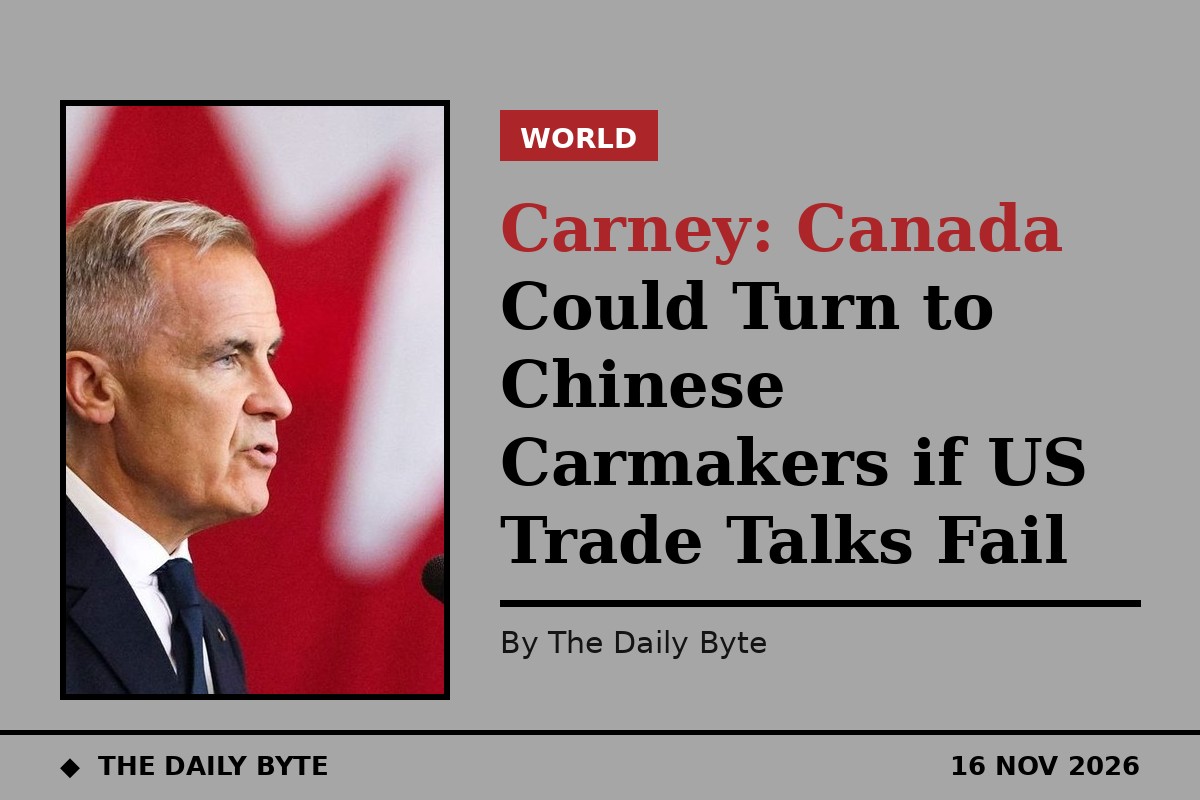
Canadian Prime Minister Mark Carney has said Canada could turn to Chinese carmakers if trade negotiations with the United States fail to preserve an integrated North American car industry.
Mr Carney made the comments to reporters in Phnom Penh, Cambodia, on Monday, ahead of a planned meeting with Chinese President Xi Jinping in Shenzhen this week, where Chinese car manufacturing is expected to be discussed.
He stressed that negotiations with Washington remained his government’s priority, and said the two sides were making progress towards a possible trade agreement, although differences remained. But he was clear that Ottawa was preparing alternatives if the talks did not deliver.
Not leverage, but action and reaction
Asked whether the prospect of Chinese investment in Canada’s car industry was intended as leverage in the negotiations with the United States, Mr Carney rejected the suggestion.
“It’s not leverage. But action, reaction,” he said, adding that Canada’s car workers had to be fully employed one way or another.
He said the outcome of the US talks could determine whether Canada pursued alternatives involving European, Chinese or Japanese carmakers instead, and argued that the North American car market had become less integrated because of US trade actions.
Any Chinese investment, he said, would have to involve substantial manufacturing in Canada, with proper labour standards and domestic supply chains that expanded over time — not simply the assembly of imported parts.
Auto industry at the centre of the dispute
The car industry sits at the heart of the trade tensions between Canada and the United States. The Detroit Three — Ford, General Motors and Stellantis — operate factories across Canada, the United States and Mexico, and US tariffs have disrupted a sector that depends heavily on cross-border production.
Mr Carney said on Saturday in Manila, in the Philippines, that any trade agreement with Washington must leave Canada with a viable car industry. He also said he had spoken at length with President Donald Trump and senior US officials, and that the two countries were making progress towards a possible deal.
The US ambassador to Canada, Pete Hoekstra, has said he is confident an agreement can be reached before the end of the year.
January deal opened the door to Chinese EVs
Mr Carney and Mr Xi reached an agreement in January under which Canada cut its 100 per cent tariff on Chinese electric vehicles to 6.1 per cent, initially allowing up to 49,000 vehicles a year, with the cap rising over time. In exchange, China lowered tariffs on Canadian farm goods, including canola.
That agreement provides the foundation for this week’s discussions in Shenzhen, where Mr Carney is due to meet Mr Xi on the sidelines of the Asia-Pacific Economic Co-operation summit.
Mr Carney is travelling to China from the Francophonie summit in Cambodia. He said Canada could do more with China in agriculture, energy and financial services, with guardrails around more sensitive sectors.
For now, Ottawa’s message to Washington is that the US talks come first — but that Canada will not wait indefinitely for a deal that leaves its car workers behind.


