Catholics fall to 55% of Latin America as evangelicals rise, Latinobarómetro finds
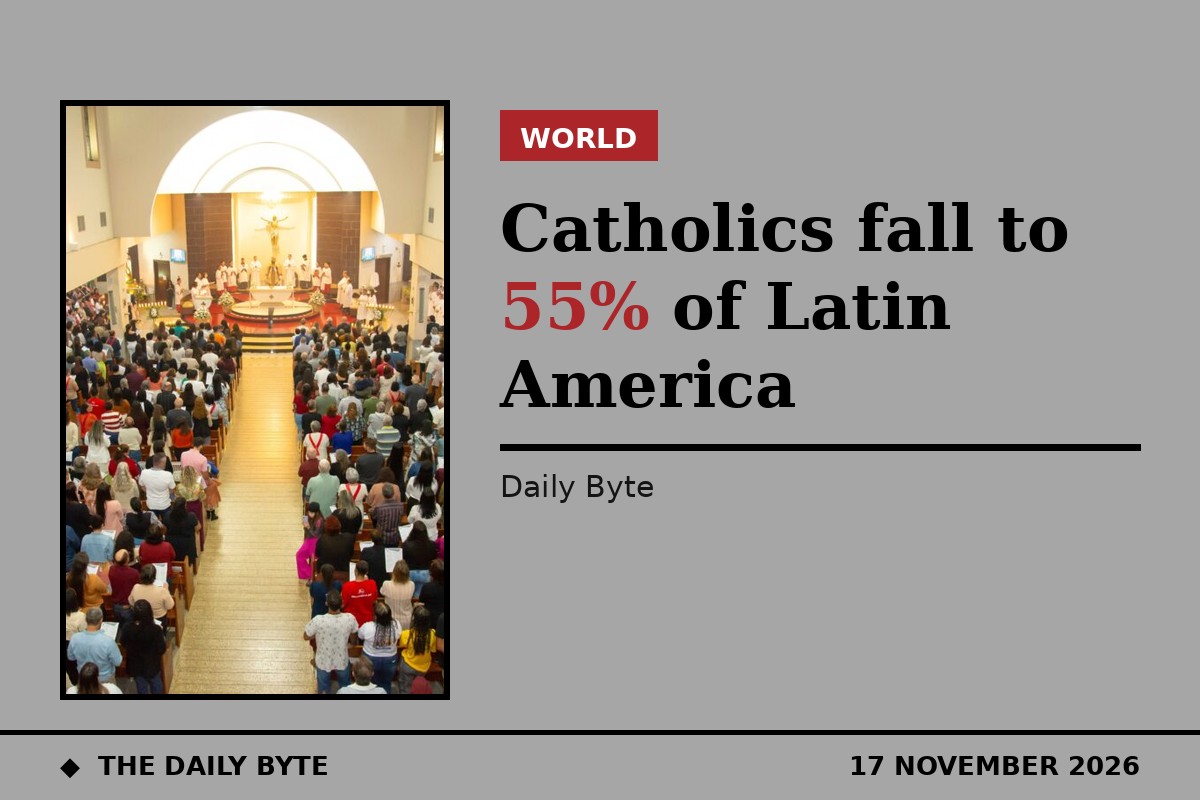
The share of Latin Americans who identify as Catholic has fallen from 80% in 1995 to 55% today, according to a new Latinobarómetro study reported on Tuesday, a 25-point decline that researchers describe as a profound transformation of the region's religious landscape over three decades.
The Chile-based research firm has asked the same questions about religious identity across Latin America for 30 years. Its latest report, La religión en América Latina 1995–2025/2026, is based on face-to-face interviews with 1,200 adults in each South American country and Mexico, and 1,000 in each Central American country, across 17 countries in 2025 and 2026. The survey carries a margin of error of plus or minus 2.8 to 3 percentage points.
Evangelicals now the largest group in three countries
Evangelical churches have been the main beneficiaries of the shift. Evangelicals made up just 6% of the Latin American population in 1995; today they account for 19%, according to an analysis of the data published by Evangelical Focus.
Evangelicals are now the largest religious group in three countries: Honduras, where 44% of people identify as evangelical against 38% Catholic; El Salvador, at 43%; and Guatemala, at 42%. They also make up a significant share of the population in Panama (34%), the Dominican Republic (31%), Brazil (26%), Costa Rica (26%) and Chile (20%).
Catholicism remains the majority faith in nine of the 17 countries surveyed. Paraguay is the most Catholic country in the region, at 82%, followed by Mexico and Ecuador, both at 69%, Peru and Bolivia at 67%, and Colombia and Venezuela at 60%. In Argentina, 55% identify as Catholic, and in Chile, Brazil, Panama and the Dominican Republic, Catholics are a plurality rather than a majority.
Panama records the sharpest fall
The decline has been uneven. Panama registered the largest drop, from 89% Catholic in 1995 to 46% today, a fall of 43 points. Mexico showed the smallest decrease, from 77% to 69%.
The religiously unaffiliated have also grown sharply. The share of people identifying as atheist or agnostic has quadrupled, from 4% in 1995 to 16% in 2026. Nearly half of Uruguay's population, 49%, now identifies as atheist or having no religion, followed by Chile at 27%, Argentina at 23% and Brazil at 21%.
Faith and trust in churches hold up
The fall in Catholic identification has not produced a matching collapse in religious practice or trust. The researchers found that the share of Latin Americans who describe themselves as "practising" or "very practising" has remained relatively stable over the past few decades, and trust in churches stood at 63% in 2025/2026, compared with 72% in 1995.
Evangelicals report higher levels of practice than Catholics: 62% of evangelicals describe themselves as "very practising" or "practising", against 48% of Catholics. The only country where Catholics reported higher practice than evangelicals was Bolivia. Overall, 63% of respondents said they had "some" or "a great deal" of confidence in the Church, with confidence highest in Honduras and Guatemala, both at 77%.
The findings were published as Pope Leo XIV returned to Rome on Tuesday after a 12-day tour of South America that took in Uruguay, Argentina and Peru. Latin America is home to 39% of the world's 1.4 billion Catholics, and the survey offers a sobering picture of the landscape facing the first American pope, who spent much of his clerical career in Peru.
Frequently asked questions
What share of Latin Americans are Catholic in 2026?
Some 55% of people across the 17 countries surveyed identify as Catholic, down from 80% in 1995, according to Latinobarómetro.
Where are evangelicals now the largest group?
In Honduras (44%), El Salvador (43%) and Guatemala (42%), evangelicals outnumber Catholics.
Which country is the most Catholic in Latin America?
Paraguay, where 82% of people identify as Catholic.
Source: Christian Post; second source: Evangelical Focus, analysing the Latinobarómetro data.


