CAR Timber Probe Links Wagner to Forest Abuses
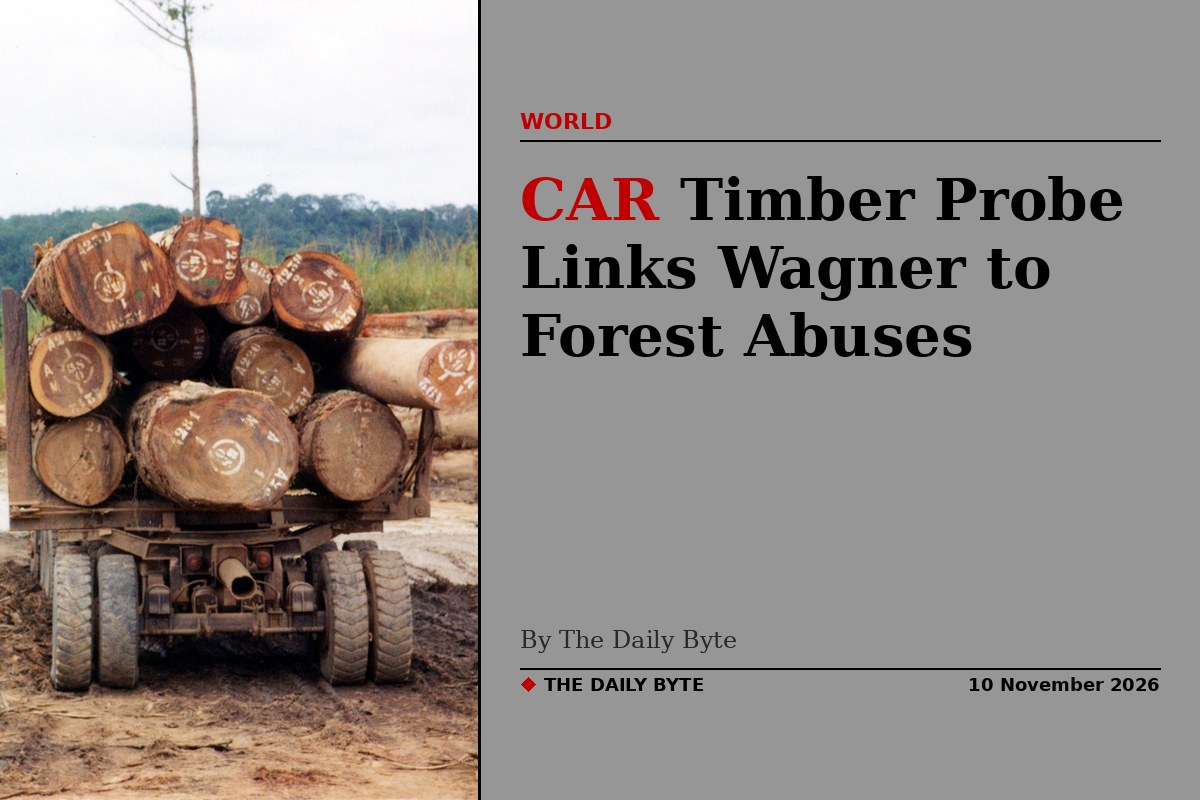
A new investigation has called for tougher international rules on timber from the Central African Republic, saying it found corruption and regulatory neglect in a sector that covers forests across two-thirds of the country.
The report, Timber for the Taking: How CAR’s Forestry Sector Has Fallen Prey to Corruption and Neglect, was published on Tuesday, 10 November, by The Sentry, a US-based investigative research group. It says nearly 40% of the country’s commercial logging area is controlled by Russia’s Wagner Group and Chinese timber firms that routinely break the country’s forestry laws and fail to deliver returns to local communities.
Six concessions investigated
The Sentry investigated six of the Central African Republic’s 14 commercial forest concessions, known as Permis d’Exploitation et d’Aménagement. Together, those six account for nearly 40% of the country’s commercial logging area.
Four of the concessions were owned by one of China’s largest timber groups active in the Congo Basin, the Vicwood Group, before ownership was quietly transferred to another Chinese company, the report says. Two other concessions are linked to the Wagner Group: one held by Bois Rouge and a second held by the Forest Consulting Company, known as FCC.
The report says Bois Rouge and FCC appear to have committed serious violations of the country’s forestry laws, including failure to pay millions in forestry taxes, misrepresentation of ownership, unlawful logging and several years of inactivity. It also says the companies failed to deliver on agreements to invest in community processing facilities, clinics and schools in exchange for logging valuable trees.
Sanctions, but concessions remain
Bois Rouge was sanctioned by the United States in 2024, after the US Treasury Department said the Wagner-affiliated timber company had sought monetary gain from illicit natural resource extraction. Britain also imposed sanctions on the company later that year. Despite those sanctions, the report says, the Central African Republic authorities have not revoked the company’s concessions.
The Sentry is urging the European Union to move the Central African Republic from “low risk” to “standard risk” under the EU Deforestation Regulation. The EU currently considers the country low risk. The group also recommended that the EU, Britain and the United States investigate and sanction entities associated with Wagner, which has been active in the Central African Republic since 2018.
Neither the Central African Republic government nor Bois Rouge responded to requests for comment, according to the reporting of the investigation. The allegations in the report have not been tested in court.
Why the classification matters
A change in the EU’s risk rating would mean tougher checks on timber entering the EU from the Central African Republic, with importers required to show that the wood was produced legally and did not contribute to deforestation. For a country whose forests form part of the Congo Basin, one of the world’s most important tropical forest regions, the rules governing its timber trade carry consequences well beyond its borders.
The report argues that the forestry sector has fallen into the same pattern seen in the country’s security and mining sectors: politically connected foreign companies acquire valuable public assets while legal safeguards go unenforced, and local communities see little of the benefit.


