Central banks buy 321 tonnes of gold as price falls
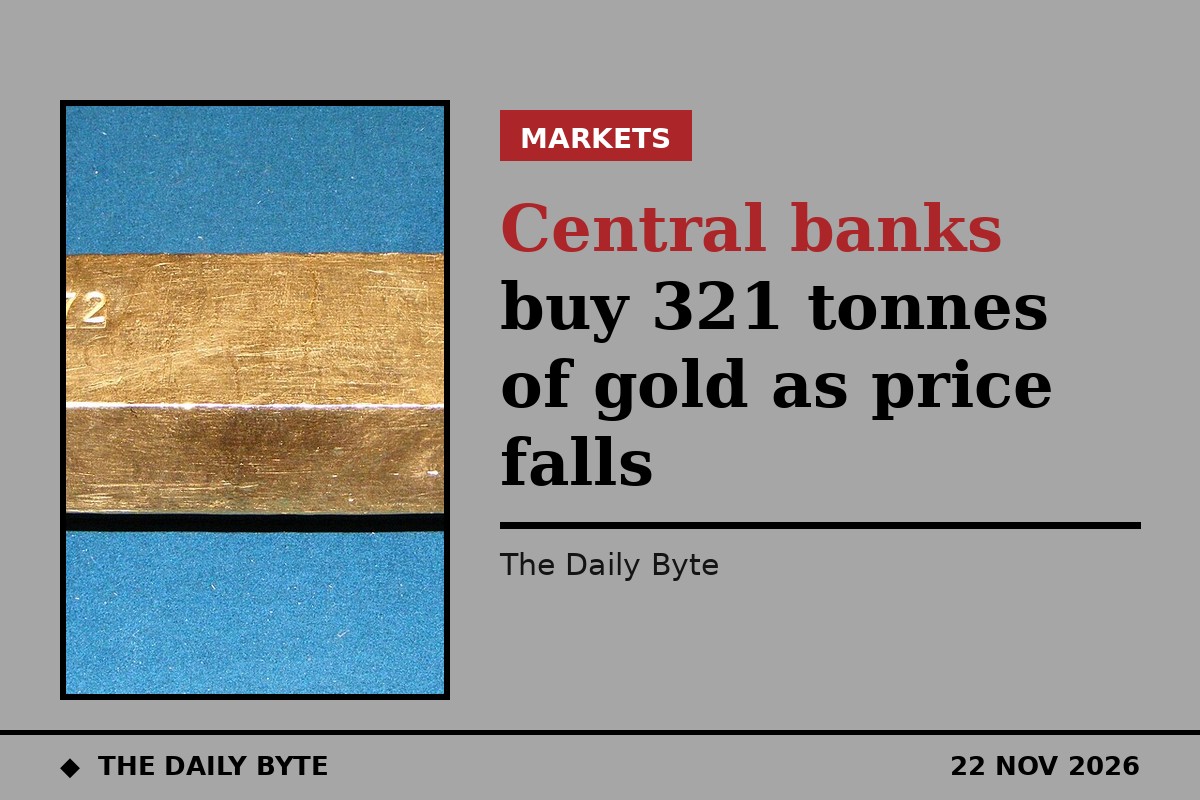
Central banks bought gold at the fastest pace in a generation this year even as the price fell sharply. Official sector buyers added a net 321 tonnes of gold in the third quarter of 2026, up 42% on the same period last year, according to the World Gold Council, taking total purchases in the first nine months of the year to 675 tonnes.
The buying came while the gold price slid to near $3,700 an ounce, its lowest level since September 2025, and roughly 30% below its January peak. The contrast between falling prices and rising official demand is the defining feature of the gold market in 2026.
China and Poland lead the buying
China and Poland were the biggest buyers, the World Gold Council's data shows, as reported by MoneyMagpie. Central banks buy gold in tonnes and hold it for generations, to diversify currency holdings, hedge currency-denominated debt and reduce reliance on the US dollar as the settlement currency. They do not buy or sell on the basis of the dollar price.
That is why the price fall has not slowed them. Retail investors and speculators trade gold on the basis of interest rates and the dollar, while central banks treat it as a long-term reserve asset. The World Gold Council has warned, however, that central-bank buying does not create a firm floor under the price.
Why the gold price has fallen
Gold pays no interest, so it suffers when interest rates and bond yields rise. US inflation for October came in hotter than expected, and Federal Reserve Governor Christopher Waller said he backs a rate rise in December, and might even consider a larger one. By the end of that week, markets saw a December rise as close to certain, Gold.co.uk reported.
The minutes of the Federal Reserve's October meeting, published on Wednesday evening, read like a warning: nearly all policymakers expected to raise rates in December, two floated the idea of a larger rise, and most worried that inflation could stay high for some time. Gold fell more than 3% in a single session. US government bond yields climbed towards 5%, and the dollar rose to its strongest level in around 19 months. A strong dollar makes gold more expensive for buyers paying in pounds, euros or rupees, which tends to cool demand.
Silver has fallen further
Silver has had a worse month than gold. It dropped 5% on Wednesday alone, falling below $45 an ounce, and has lost around twice as much as gold so far this month. Jewellery demand fell 17% and bar and coin demand fell 19%, according to the World Gold Council's third-quarter report, as high prices put buyers off.
Goldman Sachs cut its end-2026 gold target from $4,650 to $4,150 on 5 November, according to Reuters, and most major banks now expect gold to finish 2026 somewhere between about $4,000 and $4,600, before recovering in 2027.
Frequently asked questions
How much gold did central banks buy? A net 321 tonnes in the third quarter of 2026, up 42% on a year earlier, and 675 tonnes in the first nine months of the year, according to the World Gold Council.
What is the gold price now? Gold was trading near $3,700 an ounce in the week of 16 November 2026, its lowest since September 2025 and roughly 30% below its January peak.
Why are central banks buying while the price falls? They buy gold as a long-term reserve asset to diversify currency holdings and reduce reliance on the US dollar, rather than trading on short-term price moves.
Sources: MoneyMagpie and Gold.co.uk, both reporting World Gold Council data.