ChatGPT Retires Advanced and Standard Voice on 11 December
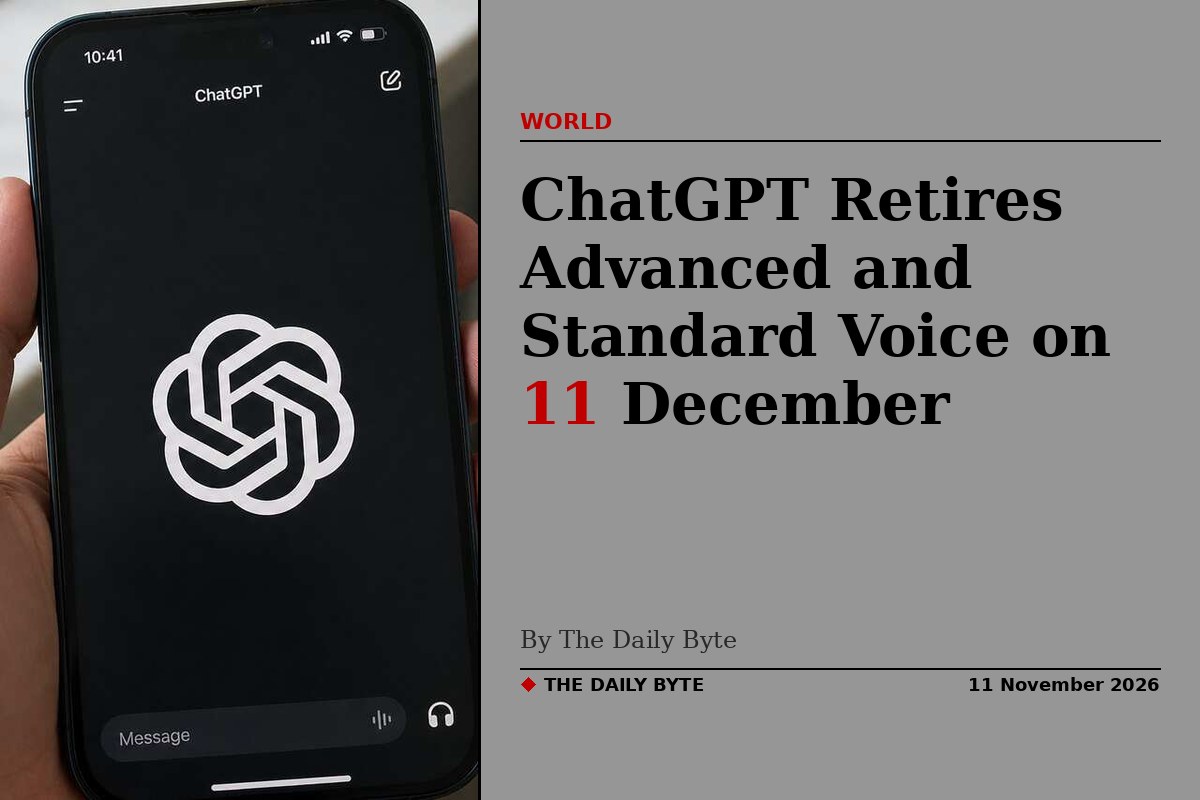
OpenAI will retire ChatGPT's Advanced Voice and Standard Voice modes on 11 December 2026, leaving its newer GPT-Live model as the only voice option in the chatbot. The company announced the change on 10 November and has begun notifying users who still rely on the older modes.
From 11 December, both options will disappear from the voice settings in ChatGPT. Anyone who has selected either mode will be switched to GPT-Live automatically, with no action needed on their part. OpenAI says the move will let it simplify the voice experience and concentrate its development work on a single model.
GPT-Live replaces two older systems
Advanced Voice arrived in 2024 and quickly became the more natural of the two older options. Unlike Standard Voice, which chained together three separate models for speech recognition, language and speech synthesis, Advanced Voice processed and generated audio directly, producing faster and more lifelike replies. Both, however, were turn-based: the model waited until the speaker had finished before it began to answer.
GPT-Live, introduced in July 2026, works differently. It uses a full-duplex design, which means it can listen and speak at the same time. Conversations can flow without the rigid pause-and-reply rhythm of the older modes, and the model can acknowledge a speaker with a brief response, stay silent while someone thinks, or hand a harder question to one of OpenAI's text models without ending the spoken exchange.
OpenAI says the shift is already well under way. Voice use in ChatGPT has nearly doubled since GPT-Live launched in July, and nearly all voice users have already moved to the new model. That, the company argues, is why the older modes can now be switched off.
What stays, and what changes on 11 December
Existing voice conversations will not be deleted. They will remain in ChatGPT history and can be continued by text or with GPT-Live. Until the deadline, users can keep using Advanced and Standard Voice exactly as before, and the company began telling affected users about the timetable on 10 November.
There is one important exception. Live video and screen-sharing in ChatGPT will keep running on Advanced Voice after 11 December, because GPT-Live does not yet support those features. OpenAI has not said when the newer model will gain them. Voice conversations with custom GPTs will also continue on Advanced Voice until the deadline, after which they too move over.
Users push back on the change
The decision has not gone down well with everyone. Some users have complained on X and Reddit that GPT-Live interrupts too often, gives shorter answers and loses track of a conversation more easily than the older modes. Others say Standard Voice gave more detailed replies and better continuity with their text chats, and some paying subscribers have threatened to cancel if the change goes ahead.
OpenAI has acknowledged that some people prefer the response style of the older modes. It says it is working to bring what it learned from them into GPT-Live, including deeper and more detailed answers, better continuity across conversations and stronger personalisation.
Whether that is enough to win over the critics remains to be seen. OpenAI has reversed course before: when it tried to retire the GPT-4o model, user backlash led it to delay the decision. For now, though, the timetable stands, and ChatGPT's two older voices have exactly one month left. Read the full reports at Neowin and Interesting Engineering.


