CVE-2026-123039: Check Point gateways hacked, ESXi wiped
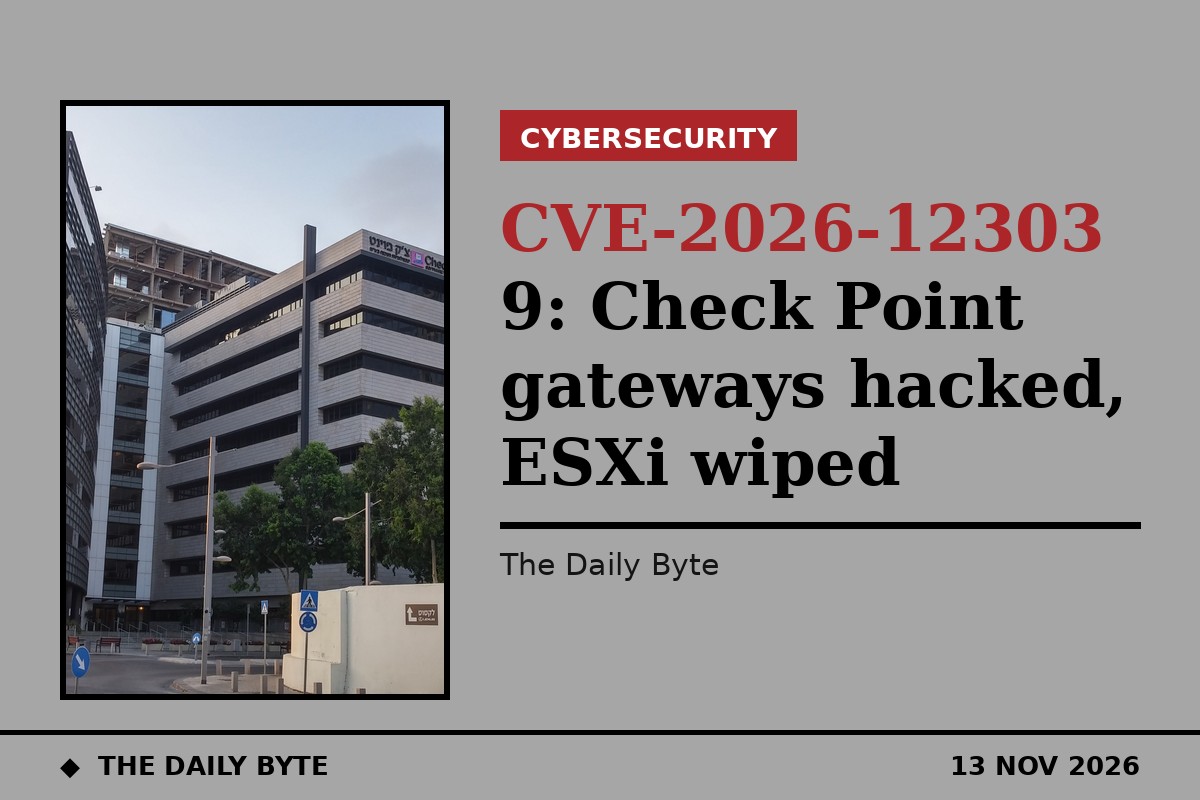
Check Point has confirmed that attackers exploited its unpatched Security Gateways through their Mobile Access portals, chained the PHP2Shell flaws with a new privilege-escalation bug tracked as CVE-2026-123039, and in some cases wiped VMware ESXi hosts. The company disclosed the campaign on 12 November 2026 after investigating intrusions that began on 30 October.
The attack started about a week after fixes were available. PHP2Shell, tracked as CVE-2026-109618 and CVE-2026-109619, gave the attackers their first foothold through the gateway's web-facing portal. They then exploited CVE-2026-123039, a missing-authorisation flaw in the DynamicCLI interface of Check Point's Gaia operating system, to move from the portal service account to full root access. Check Point scores that flaw at CVSS 7.8 and says it observed active exploitation against a couple of dozen customers.
Backdoor, lateral movement and wiper
Once they held root, the attackers planted PHP webshells in the portal's template directory and installed a persistent backdoor called TSGA, which runs disguised as slot_CPconfigdaemon and carries an embedded networking component named TSProxy. Check Point says TSGA can steal configurations, keep itself alive through backups and snapshots, inject itself into appliance processes and tamper with firewall logs.
From the gateway, the attackers scanned the internal network, moved over SSH to a VMware ESXi host using the vpxuser service account, and ran a Linux wiper called destroy_v6. The wiper deletes files regardless of extension, overwriting them with zeros first unless run in fast mode, and leaves a politically themed note named DREAM_ANNEXATION.txt in each directory it processes.
Two waves, no firm attribution
Check Point describes two waves. The first, on 30 October, targeted Israeli organisations and included destructive activity against some of them. A broader second wave on 2 November reached organisations in several countries and sectors, with no sign of destruction. Neither wave showed a preference for any particular sector, which Check Point reads as opportunistic rather than targeted.
TSGA and TSProxy are assessed to be variants of PhiliKit, a toolkit ESET previously linked to the China-nexus group UNC5221. Check Point stresses, however, that the evidence does not support a confident attribution: the wiper, the focus on Israel and the Hebrew note do not fit known patterns for that group, and the actor could have run the whole campaign, acted only as an initial-access broker, or staged a false flag. Organisations running affected gateways should apply the available fixes and check for the published indicators of compromise.
Sources: Check Point Research and The Hacker News.

