Paris Donors Pledge €278m to Repair Chernobyl Shield
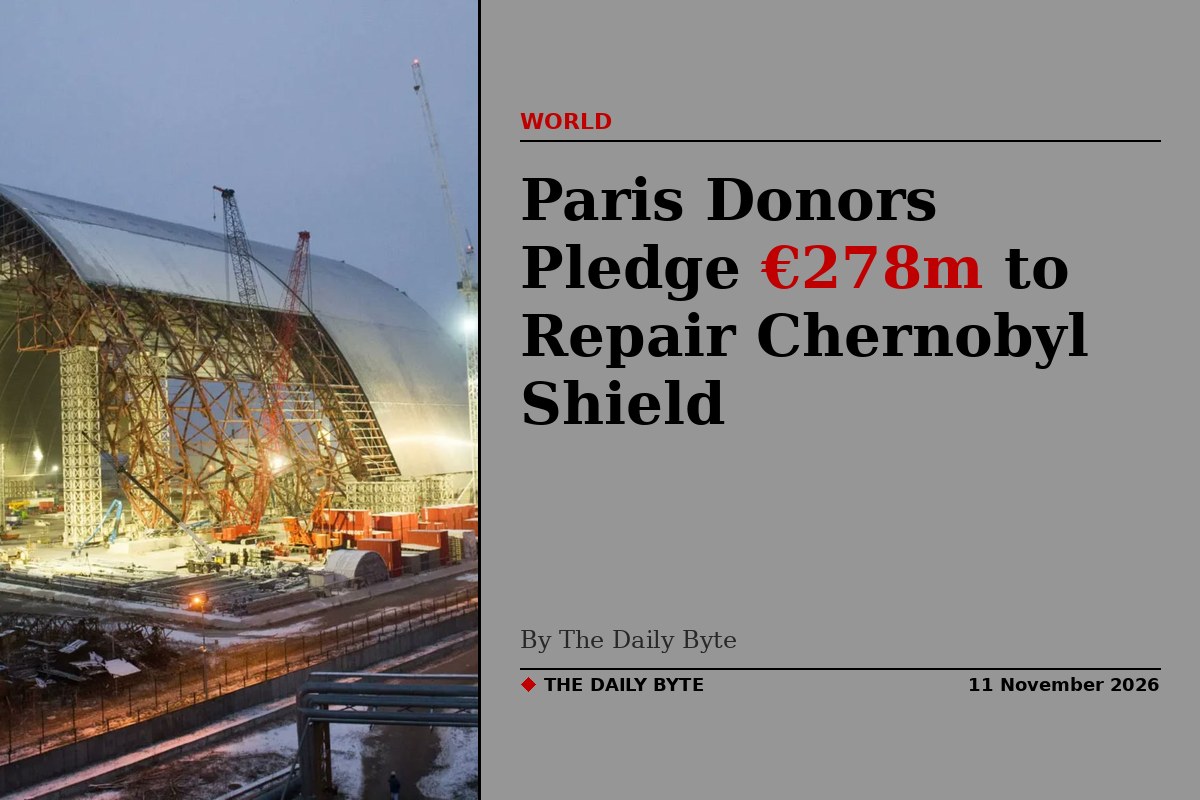
Donors in Paris have pledged €278 million towards repairing the giant steel arch shielding Chernobyl's ruined reactor, more than half of the at least €500 million the European Bank for Reconstruction and Development estimates is needed to restore the structure.
Fifteen donors confirmed commitments at the donor conference held in Paris on Monday 9 November 2026, co-chaired by France, Ukraine and the EBRD. The total was announced at the closing session by Benjamin Haddad, France's Minister Delegate for European Affairs.
What the Paris conference raised
France, which hosted the conference and holds the G7 presidency this year, pledged €40 million, including €10 million already allocated for preliminary studies and a further €30 million announced by Economy and Finance Minister Roland Lescure. Germany committed €50 million, the United States up to $100 million, and Austria €1 million.
The Paris total builds on the €260 million that the Group of Seven leading industrialised nations pledged in October at the International Monetary Fund and World Bank autumn meetings in Bangkok. The EBRD welcomed that commitment and urged the wider international community to contribute at the Paris conference to cover the remaining financing needs.
Lescure said donors have until spring 2027 to raise the full €500 million. Extensive repairs are planned to begin in 2028, and the EBRD wants the restoration completed by 2030.
Why the arch needs urgent repair
The structure at the centre of the appeal is the New Safe Confinement, a 36,000-ton steel arch standing 108 metres high over the remains of Reactor Four, which exploded in April 1986. Built between 2010 and 2019 by French companies Vinci and Bouygues with other European firms, it was designed to last 100 years and to contain radioactive material while the destroyed reactor is dismantled.
A Russian drone struck the arch on 14 February 2025, damaging both its outer and inner cladding and its safety systems. The EBRD says the arch must be fully restored by 2030 to reduce the risk of corrosion to its steel structures and safeguard the structure's 100-year design life.
EBRD President Odile Renaud-Basso has warned that without repairs, the risk of a very serious accident with very extensive consequences is quite real. The bank has led international efforts to stabilise and manage risks at Chernobyl since 1995, mobilising more than €2.5 billion in international contributions and providing over €700 million of its own resources for nuclear safety and decommissioning work at the site.
The race to raise the rest
Even after Paris, a substantial gap remains. The €278 million announced at the conference, together with the G7 commitment, still leaves the fund short of the estimated €500 million minimum, and preliminary assessments have warned the final cost could climb higher as engineers examine the full extent of the damage.
Anatolii Kutsevol, Ukraine's Deputy Energy Minister, told the conference he was confident partners would raise the entire amount required. Haddad said that by mobilising international funding, donors help ensure Ukraine does not have to bear alone the financial consequences of the Russian aggression.
Ministers and officials at the conference stressed that the work cannot wait indefinitely. The longer the damaged arch is left exposed, the greater the risk of deterioration, and the more expensive and difficult the eventual restoration becomes.
What happens next
With the Paris conference over, the focus shifts to converting pledges into signed contributions and to the detailed engineering work that must precede the main repairs. The EBRD aims to have the necessary funding in place so contracts can be awarded and the main restoration work can begin in 2028.
For Ukraine, the conference was also a test of whether international attention on Chernobyl can be sustained more than 40 years after the disaster and nearly two years after the drone strike that damaged its shield. The €278 million raised in Paris suggests the answer, for now, is yes — but the remaining gap means the fundraising effort is far from finished.
Sources: European Bank for Reconstruction and Development, October 2026; reporting from the Paris donor conference, 10 November 2026. Checked against both sources on 11 November 2026.


