Children's chief: scrap failing youth custody teaching deals
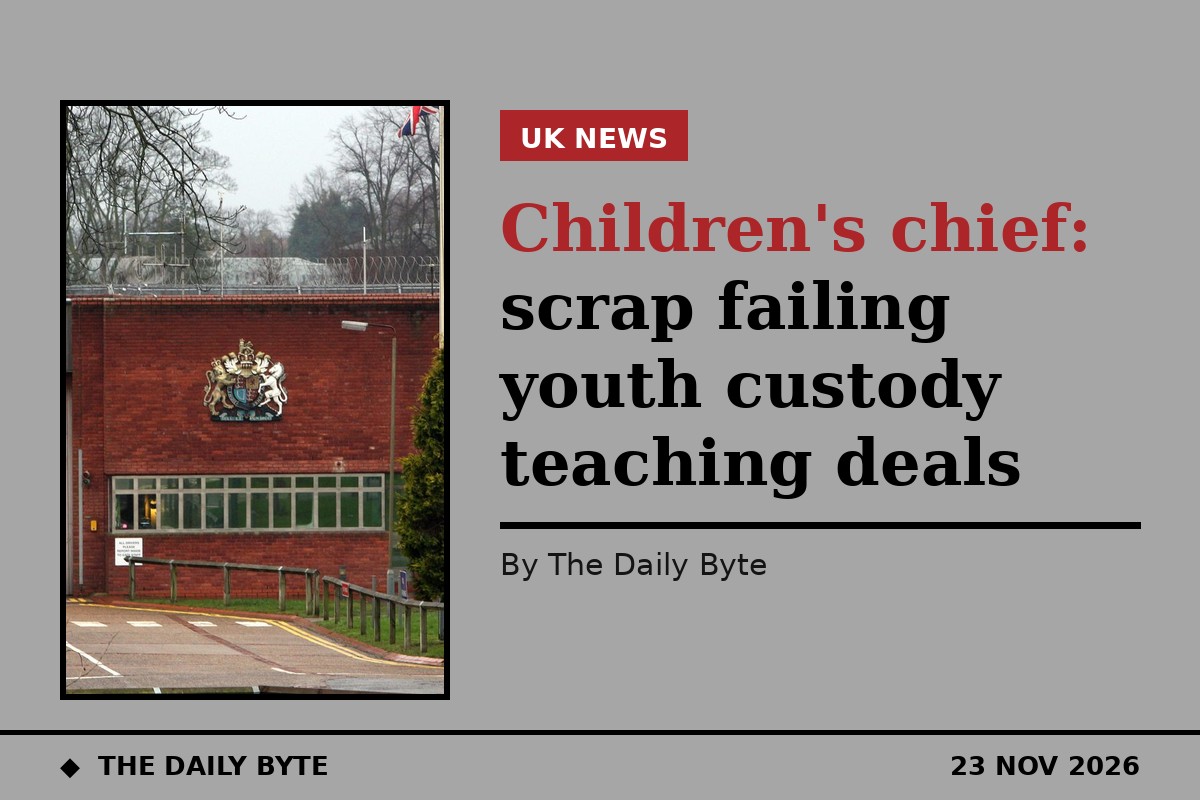
The Children's Commissioner for England has called on the government to tear up the contracts that provide education inside young offender institutions, saying the teaching on offer is failing the children held there. In a review published on Monday 23 November, Dame Rachel de Souza concludes that education in the institutions is poor, the hours are far too low, and the curriculum does not meet children's needs or support their rehabilitation.
The review was commissioned by the Ministry of Justice and carried out by the Commissioner and her team, who visited every young offender institution in England and Wales, at Feltham, Werrington and Wetherby in England and Parc in Wales. Dame Rachel, a former teacher and headteacher, says the system has suffered a decade of declining quality despite repeated attempts at reform.
Her central recommendation is that the government should terminate the three existing education contracts in English young offender institutions at the earliest opportunity, using break clauses in the agreements. The contracts, held by Shaw Trust, PeoplePlus and Novus, are worth about 78 million pounds in total. They were launched by the Youth Custody Service in 2022 and run until 2029, with break points on the fourth, fifth and sixth anniversaries. The Commissioner wants them replaced by outstanding schools and providers with a proven record of teaching children with challenging behaviour or who have been excluded from other settings.
The figures behind the call are stark. Children in young offender institutions have a legal right to at least 15 hours of education a week, but the review found that most receive far less. Between September 2025 and August 2026, the average number of education hours provided per child each week was 5.9 hours at Feltham, 9.4 hours at Wetherby and 12.8 hours at Werrington. Only Parc in Wales, inspected by the Welsh inspectorate Estyn, delivered more than the minimum, averaging over 18 hours a week. Dame Rachel recommends a minimum of 30 hours a week, comparable to mainstream schools, with high-quality vocational courses and one-to-one tutoring.
The gap in results is just as wide. Only 20 per cent of children who sat an English GCSE in custody passed, compared with 71 per cent of their peers in schools, and the same 20 per cent passed maths, against 72 per cent of their peers. The Commissioner's previous research found that more than three quarters of children in custody had been persistently or severely absent from school in the year before they entered custody, over half had been out of education for at least an academic year, and around a quarter had been permanently excluded. Children in secure settings were five times more likely to have an education, health and care plan than their peers.
The review identifies several reasons for the failure. Education providers in the institutions are not required to be registered as schools, colleges or alternative provision, and often use inappropriate or unplanned curriculums. Education staff are often offered lower salaries and benefits than their counterparts in mainstream schools, which worsens recruitment and retention. Responsibility for education is split between the Youth Custody Service, the contracted providers and institution education leaders, so accountability is fragmented, and the contract models were developed from adult prison commissioning rather than designed for children. High levels of violence, separation arrangements known as keep-aparts and limited time out of cells also mean lessons are frequently missed or disrupted.
Joint inspections by HM Inspectorate of Prisons and Ofsted rated Feltham, Werrington and Wetherby as either inadequate or requires improvement for overall effectiveness, quality of education, behaviour and attitude, personal development, and leadership and management. Only Parc received a good outcome overall. The children themselves describe the experience bluntly. One told the review team that they wake up to disappointment every day because of absent teachers and cancelled lessons. Another said they did not feel safe during lessons, reporting eight incidents the day before. Staff told the review that in some rooms it was not clear anything of educational value was happening.
Alongside the call to end the contracts, Dame Rachel makes 28 recommendations. She wants the Ministry of Justice and the Department for Education to appoint a National Advisor for Education in young offender institutions, to give teachers in the secure estate the same pay and conditions as teachers in schools, and to bring in high-performing providers at the earliest opportunity. In the longer term, she repeats her call to phase out young offender institutions and secure training centres altogether and replace them with smaller, more therapeutic settings closer to children's homes. Youth justice minister Jake Richards, who commissioned the review, said the standard of education in young offender institutions is unacceptable, and that the government will examine the recommendations closely and respond in full before Christmas.