China's $200bn Latin America bet endures, data shows
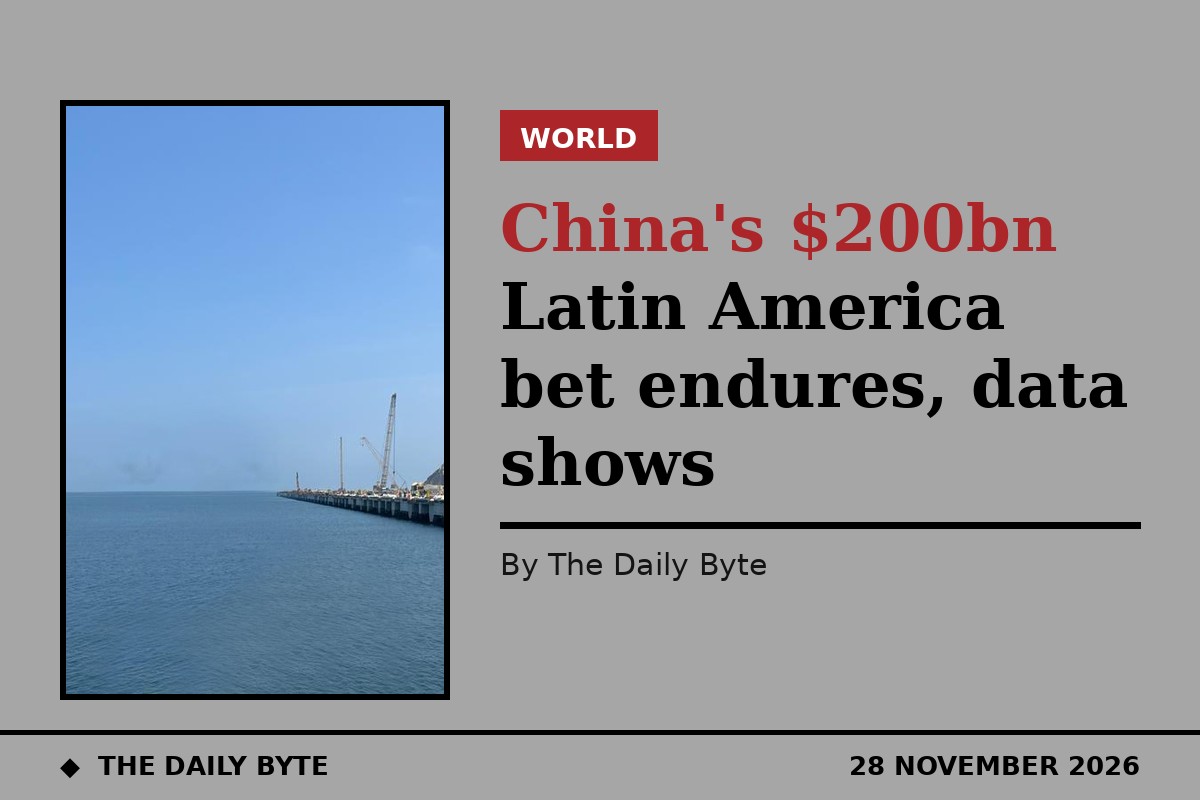
Latin America and the Caribbean have received more than $200 billion in Chinese investment since 2000, according to researchers at the National Autonomous University of Mexico, and the region's governments are still courting Beijing even as Washington steps up pressure. The figure was cited by Foreign Policy on 27 November in an assessment of the region's recent shift to the right, which found that the new governments are not turning away from China.
The total is backed by separate research from the CFA Institute, which counted 742 Chinese foreign direct investment transactions across Latin America and the Caribbean between 2000 and 2025, worth about $213 billion. The money has gone into minerals, energy, agriculture and infrastructure, with Chinese companies seeking resources, new markets and a bigger international presence.
The findings land a week after the leaders of Chile, Mexico and Peru travelled to China during the Asia-Pacific Economic Cooperation summit week in Shenzhen, which ran from 16 November. Peru's president, Keiko Fujimori, left with the most concrete result reported from the trip: a $22.5 million Chinese pledge to help Peru deal with the fallout from El Nino. The visits coincided with a meeting on the summit's sidelines between the leaders of the United States, China and Russia.
Peru shows what the relationship looks like in physical form. At Chancay, about 65 kilometres north of Lima, Chinese-made equipment is extending land into deeper water at a port whose first stage cost $1.3 billion and has four quays. The port, majority-owned by the Chinese shipping group COSCO, opened in November 2024 and gives Chinese capital a fixed position on the Pacific coast of South America, on the Pan-American highway corridor. In July 2025, China and Brazil announced they would study a railway linking Chancay to Brazil's Atlantic coast.
The figures come with a warning about how they are counted. Mexico's official register attributes each dollar to the country it came from directly, so capital routed through Hong Kong, the United States or the Netherlands does not show up as Chinese. On that measure, China sent Mexico $530 million in 2025 and $4 billion in total since 2000. The university's deal-level database, which records each deal by the Chinese company behind it, puts the figure for Mexico at $26.5 billion over the same period. Both measures fell in 2025 as projects were paused during the tariff dispute.
Washington's approach to the region has hardened in 2026. The United States has proposed a 10 per cent duty on finished Brazilian aircraft and new duties on out-of-quota sugar imports, and has kept up a military build-up in the Caribbean. Even so, analysts say the region's governments are not cutting ties with Beijing. Hussein Kalout, a former senior Brazilian foreign-policy official, told Foreign Policy that the world is splitting into spheres of influence, and that Latin American governments are keeping their options open.
Shiao Wang, an assistant professor at Fudan University who researches Latin America, urged caution about reading too much into China's responses to particular American initiatives, saying they should not be taken as evidence that any particular geopolitical arrangement has been accepted.
For the region's governments, the calculation is practical. China buys the minerals, soya and lithium the region produces, and sells the manufactured goods, telecoms equipment and electric vehicles its consumers want. Trade between China and Latin America reached $518 billion in 2024, according to figures cited by Florida International University's Security Research Hub. With the United States pressing its own claims and China offering finance and markets, the evidence of the past year is that Latin America's governments intend to keep dealing with both.


